Teaching grammar to ESL beginners is not a scaled-down version of teaching grammar to intermediate students. At A1 and A2, students are building the scaffolding for every sentence they will ever produce in English, and that scaffolding needs to be visible, predictable, and low-risk. Get the sequencing wrong and you either overwhelm students with rules they cannot yet apply, or you let them guess their way through exercises without ever noticing the pattern.
This article walks through seven activity types that work reliably at A1-A2, how to sequence them across a lesson, and when to explain a rule versus letting students find it themselves. It also covers the three grammar pain points that trip up beginners more than any others: articles, word order, and the present simple versus present continuous split.
Why beginner grammar needs a different approach
At A1-A2, the CEFR descriptors focus on "a repertoire of basic language" for "everyday situations with predictable content," not on nuance or exception-handling. That has a direct consequence for activity design: beginner exercises need a closed set of choices, not open production. A student who has never seen the third-person -s ending cannot produce it from a blank alone. Give them options to choose from first.
Three grammar areas cause the most trouble for true beginners, and they are worth naming explicitly because they shape which activities you reach for.
Articles. Many languages, including Japanese, Russian, Korean, and Polish, have no article system at all. Students from these L1 backgrounds are not being careless when they drop "a" or "the"; they are applying a grammar that genuinely does not exist in their first language. Articles need many short, controlled sentences (complete the sentence with a, an or the; find and fix the wrong article) before any free production.
Word order. English is SVO (subject-verb-object), but plenty of languages are not. Japanese and Korean are SOV, Arabic is often VSO, and several languages allow much freer word order than English does. Word-ordering exercises are not busywork here; they are the single most direct way to build physical, repeated awareness of English constituent order.
Present simple vs present continuous. Beginners often over-apply the continuous ("I am liking this") because their L1 marks ongoing action differently, or under-apply it because their L1 has no progressive aspect at all. This pair needs explicit contrast work, not just isolated drilling of each tense.
Inductive vs deductive: when to give the rule first
There are two ways into any grammar point. Deductive teaching states the rule first ("we add -s to the verb with he/she/it") and then gives examples. Inductive teaching shows examples first and lets students work out the rule themselves.
At beginner level, a hybrid usually works best. Pure induction demands too much noticing capacity from a student who has almost no metalanguage yet; pure deduction, delivered as a lecture, produces rules that sit inertly in a notebook and never transfer to speech.
A practical middle path: show three or four example sentences, ask a very short guided question ("What do you notice about the verb after he and she?"), then confirm with an explicit rule statement before moving to controlled practice. This works especially well for third-person -s, plural nouns, and comparative -er, all of which have a visible, regular pattern that beginners can spot with minimal prompting.
Save pure deductive presentation for irregular or arbitrary patterns that have no discoverable logic, such as irregular past tense forms (go/went, have/had). There is nothing to notice there; just teach it.
7 grammar activities that work at A1-A2
Each of these activities suits a specific stage of a lesson and a specific type of grammar point. None require students to produce free, unscaffolded English, which is exactly why they work at this level.
1. Gap fill with a word box
A gap-fill exercise where students choose from a provided list of words, rather than recalling forms from memory, removes the vocabulary burden and isolates the grammar point. This is the safest possible controlled-practice activity and suits any small, closed set of forms: the verb to be, subject pronouns, prepositions of place and time, question words.
Sequence it right after presentation, before students have had any chance to produce the form independently.
2. Word ordering
Giving students a jumbled sentence and asking them to physically rearrange the words builds a felt sense of English word order that a rule alone cannot. It is the best available activity for combating first-language interference in constituent order, and it works well as a warm-up or as controlled practice once the target structure has been presented, especially for questions, where English order differs most from what students expect.
3. Combining sentences
Giving students two short sentences and a joining word (and, but, because) and asking them to make one sentence shows how simple clauses link up. It suits the first conjunctions learners meet at A2, and because the joining word is given, the task stays controlled while students build longer sentences than they could write alone. Use it once students can produce simple sentences confidently.
4. Multiple choice
Multiple choice tests recognition under controlled conditions and is particularly good for verb forms and tense contrasts, where the "wrong" options represent the exact errors students are likely to make naturally. Use distractors that reflect real interference errors (do/does, is/are, present simple/continuous mix-ups) rather than random alternatives.
5. True/false
A simple true-or-false judgement on statements about a rule is a fast, low-stakes way to check whether the rule has actually landed before moving to production. It works best from A2, once students can read a short rule in English, as a quick check straight after a deductive rule explanation.
6. Error correction
Spotting and fixing an error in a sentence trains self-monitoring, a skill beginners badly need but rarely get explicit practice with. This should come later in the lesson, after students have had controlled practice, since it requires them to apply a rule critically rather than just recognise it. Third-person -s omission and article errors are ideal targets.
7. Sentence completion
A sentence with one blank, often with the base word in brackets ("She ___ (live) in Paris."), asks students to produce the form themselves rather than pick it from a list. It is the step from recognising a form to producing it, guided enough that only one answer fits. Use it after the recognition activities, once students have met the pattern several times.
Sequencing these activities with PPP
The classic Present, Practice, Produce framework gives these seven activities their order, and using it consistently removes a lot of the guesswork from lesson planning.
- Present the structure with a handful of example sentences (inductive noticing question, then explicit rule).
- Controlled practice, stage one: multiple choice, or true/false from A2, pure recognition with zero production risk.
- Controlled practice, stage two: gap fill with a word box, then sentence completion, moving from choosing a form toward producing it.
- Semi-controlled practice: word ordering or combining sentences, which force active manipulation of the structure.
- Self-monitoring check: error correction, once students have enough exposure to spot mistakes confidently.
- Produce: students write or say a few sentences of their own with the structure, the first genuinely open-ended output of the lesson.
A 45-minute A1-A2 grammar lesson rarely needs all seven activities. Three or four, sequenced in this order, is usually enough to move students from noticing a pattern to using it with some independence.
Practical tips for your next lesson
- Start every new grammar point with a maximum of three example sentences. More than that and beginners lose the pattern in the noise.
- Never introduce two contrasting structures (like present simple vs continuous) in the same activity until each has been practised separately first. Contrast comes after individual mastery, not before.
- Keep word boxes closed and short. Too many choices turns a grammar exercise into a vocabulary guessing game.
- Put error correction after, not before, controlled practice. Asking beginners to spot an error before they have internalised the correct form just teaches them to guess.
- Recycle the same grammar point across activity types within one lesson. Seeing "third-person -s" in a multiple choice task, then a sentence completion, then an error correction task builds far more retention than seeing it once in a single worksheet.
If you are building these worksheets by hand, matching each activity type to the right structure and getting the difficulty progression right takes real planning time on top of the actual teaching. That is the exact gap a properly organised grammar curriculum with built-in exercise-type filtering is designed to close.
How to create this with TeacherForge
The Grammar Composer is organised around the same CEFR structure this article has been describing, which removes a lot of the manual matching-structure-to-activity-type work.
Start by searching the curriculum of 300 grammar points and filtering to A1 or A2. This surfaces only beginner-appropriate points, present simple, articles, basic prepositions, past simple, comparatives, so there is no need to scroll past C1 conditionals or advanced passive constructions to find what you actually need. Select up to three tags per worksheet.
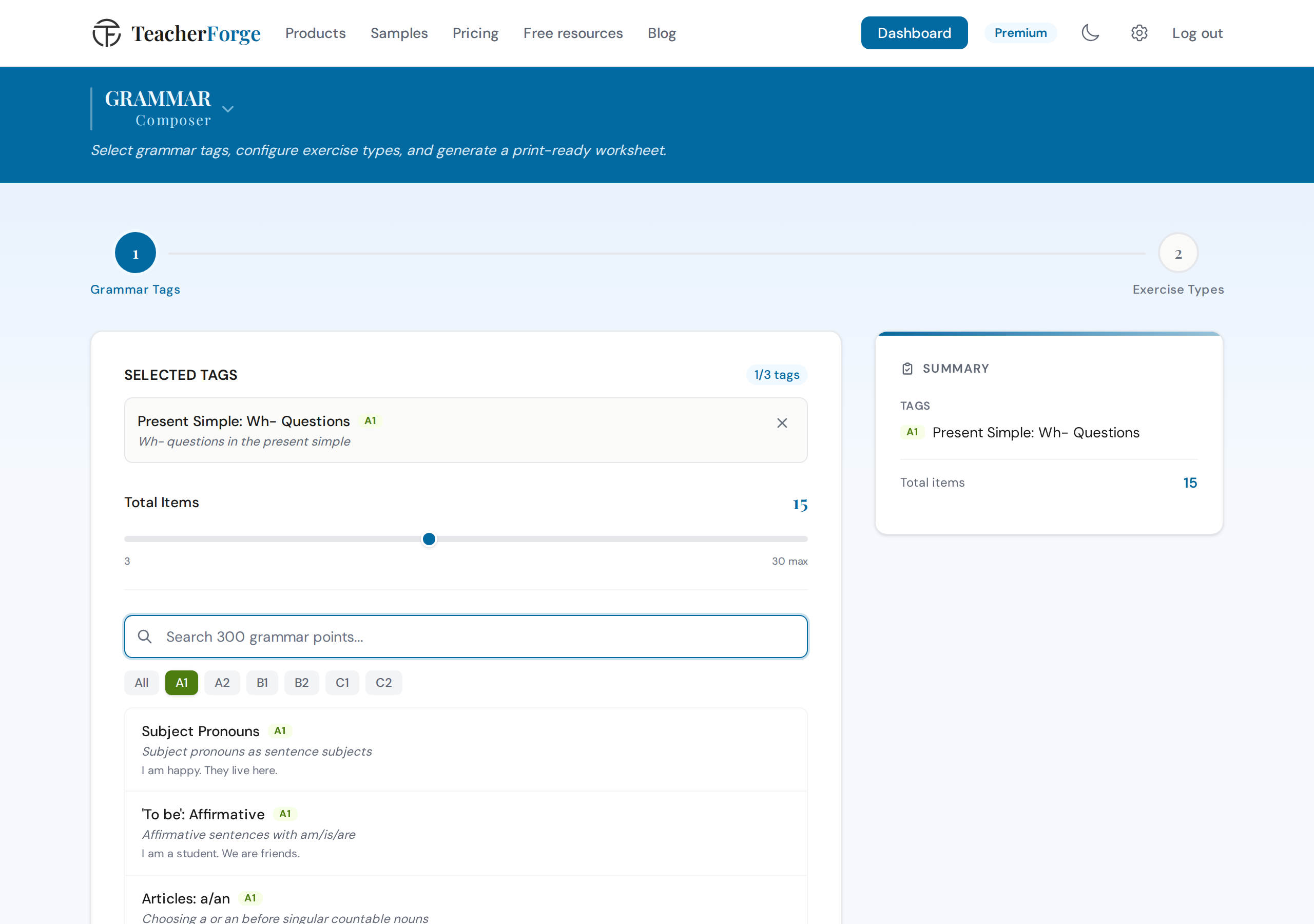
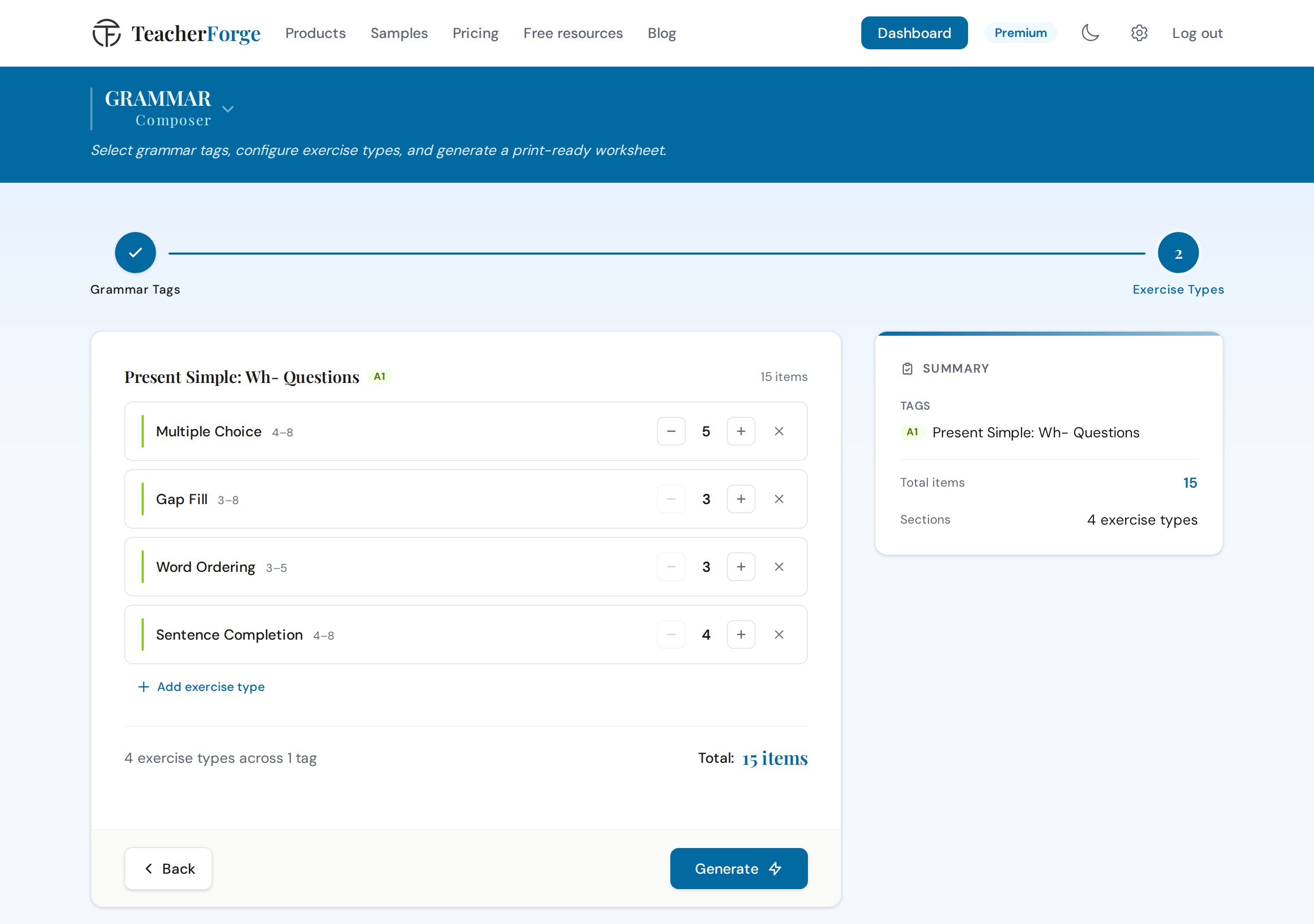
Once tags are selected, a compatibility matrix automatically shows only the exercise types that genuinely work for that grammar point at that level. Auto-distribution then spreads your chosen total items across those types automatically, so a full multi-type worksheet is ready without manually configuring each section by hand.
Every worksheet download also includes a ZIP with textbook-quality grammar reference notes covering the selected points, spanning A1 to C2, at no extra credit cost. These include formula boxes, annotated examples, and common mistake warnings, ready to print as a handout or share digitally alongside the worksheet itself.
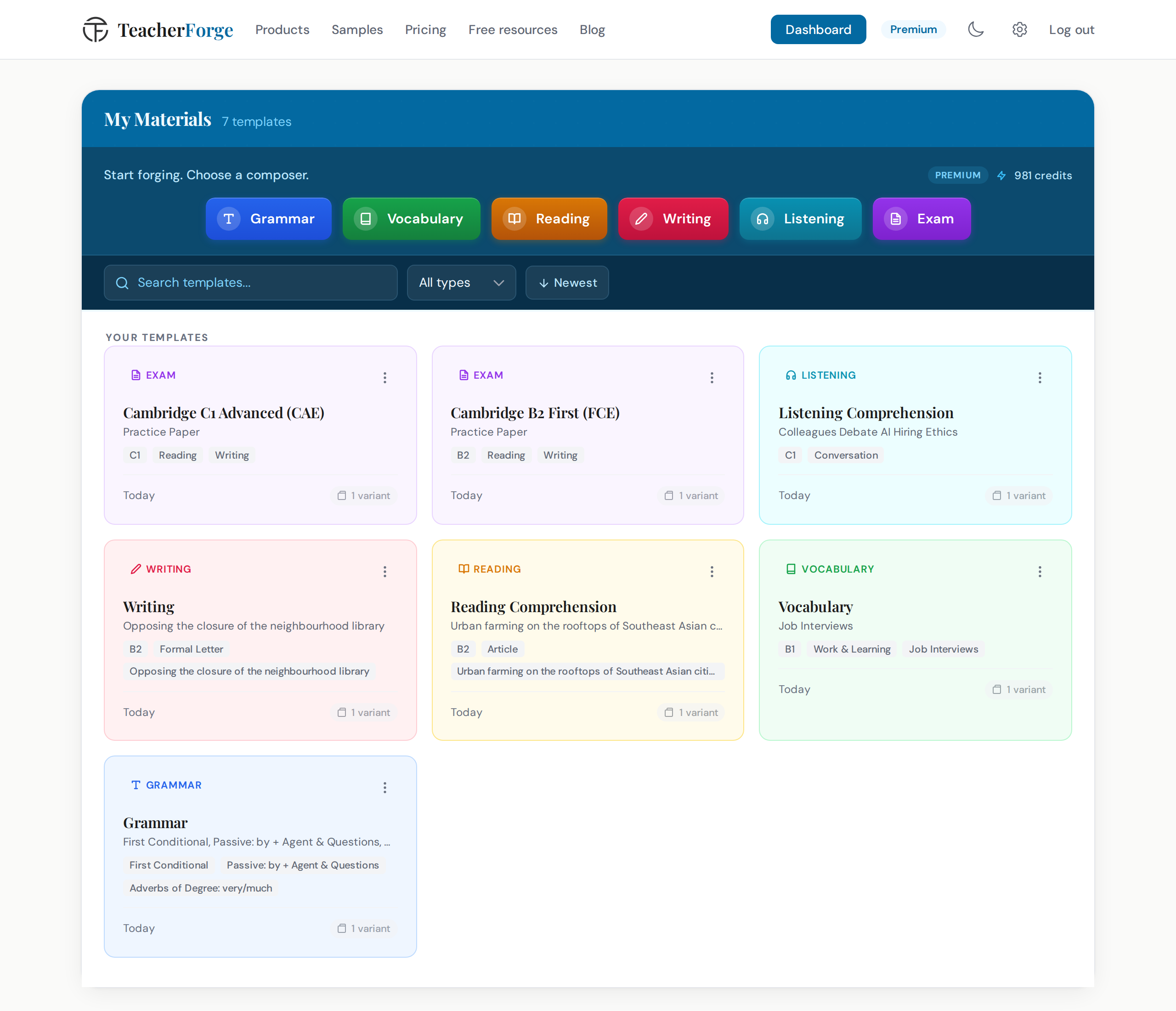
Because every generation automatically becomes a template on the dashboard, once a beginner grammar worksheet works well for one class, generating a fresh variant with the same tags and configuration for next term means choosing "Regenerate" in its card's menu, no need to rebuild the configuration from scratch.
For more on how the nine grammar exercise types compare and where each one fits, see our piece on grammar worksheets beyond gap fill.
Try it yourself
Beginner grammar teaching succeeds on sequencing and scaffolding, not on cramming in more rules. Pick two or three activity types per lesson, move from recognition to guided production, and revisit the same structure across formats before asking for free output.
Try creating your own grammar worksheet →