Grammar Worksheets Beyond Gap Fill: 9 Exercise Types That Test What Students Actually Know
Gap fill only tests recognition. Discover 9 grammar worksheet exercises for ESL that build real mastery — from error correction to sentence transformation and more.
Most grammar worksheets look the same: a list of sentences with blanks, a word box at the top, and a box for the student's name. Teachers produce them because they are quick to make and easy to mark. But if gap fill is the only exercise type our students ever see, we are testing the easiest cognitive skill available — recognition — and calling it grammar practice.
Real grammar mastery involves production, analysis, and transformation. Students need to do more than pick the right word from a list. They need to notice errors, rewrite sentences, and construct language from scratch. The good news is that a single worksheet can include several exercise types, each targeting a different skill. Here is a practical guide to all nine types used in grammar worksheets for ESL, what each one actually tests, and when to reach for it.
What Different Exercise Types Actually Test
1. Gap Fill
Gap fill is the workhorse of grammar worksheets for good reason: it is low-threat, easy to follow, and works at every level. Students see a sentence with one word missing and supply the correct form.
What it tests: form recognition and recall within a controlled context. The sentence does the heavy lifting; the student fills the gap. This is useful for initial exposure to a new structure, but it should not be the only exercise in a set.
Best for: verb tenses, auxiliary verbs, articles, prepositions, pronouns.
2. Open Cloze
Open cloze looks similar to gap fill but removes the word box. Students must supply the missing word entirely from memory, with no options to choose from.
What it tests: active recall and grammatical awareness. The student must know both the correct form and the correct word. This is a significant step up from standard gap fill and maps directly to Cambridge Use of English tasks.
Best for: prepositions, articles, auxiliary verbs, conjunctions, relative pronouns.
3. Multiple Choice
Students choose the correct option from three or four alternatives. The distractors are what make this exercise valuable: a well-designed multiple choice item forces students to discriminate between plausible but incorrect forms.
What it tests: discrimination between similar structures — particularly useful when students confuse two related forms (e.g. used to vs would, or since vs for).
Best for: any grammar point where common confusions exist. Less useful for points with only one possible error pattern.
4. Error Correction
Students read a sentence (or short text) and identify and correct a grammatical mistake. Some versions mark where the error is; others ask students to find it themselves.
What it tests: analytical thinking and metalinguistic awareness. Students must know the rule well enough to spot when it has been broken. This is a higher-order skill than production — you cannot correct what you cannot explain.
Best for: any grammar point students have already been introduced to. Particularly effective for common fossilised errors (third person -s omission, irregular past tenses, subject-verb agreement).
5. Word Ordering
Students are given a set of jumbled words and must arrange them into a grammatically correct sentence.
What it tests: syntactic knowledge — where elements sit in a sentence relative to each other. This is especially revealing for structures with fixed word order: adverb placement, question formation, reported speech.
Best for: question formation, reported speech, comparative structures, adverb placement, negative constructions.
6. Sentence Transformation
Students rewrite a sentence so that it has the same meaning, using a given word or structure. The classic example: She started learning French ten years ago. → She ____ French for ten years.
What it tests: productive flexibility and deep structural understanding. Students must understand both the source and target structure well enough to convert between them without changing the meaning. This is one of the most demanding exercise types on a grammar worksheet.
Best for: passive voice, reported speech, conditionals, modal verbs, comparative structures, perfect tenses. Critically, this type does not work for every grammar point — articles, for instance, cannot be meaningfully transformed in this way.
7. Select & Combine
Students are given two sentences and a connector, and join them into one sentence using it.
What it tests: control of how clauses fit together. The student has to restructure two simple sentences around the connector the grammar point teaches, which shows whether they can use it, not just recognise it.
Best for: conjunctions of reason, contrast and purpose (because, although, so that), relative clauses (who, which), time clauses.
8. True/False
Students read a short explanation of a grammar rule, then decide whether each statement about it is true or false: for example, whether a given form is the right one for a particular word.
What it tests: rule knowledge and the ability to evaluate a sentence against a grammatical standard. True/false items are quick to complete and work well as a warm-up or review activity.
Best for: reviewing rules students have studied, checking understanding of a grammar explanation, or identifying common misconceptions.
9. Sentence Completion
Students complete a sentence using the target structure. Unlike gap fill, there is no word box: the student produces the form, and the sentence (or a base word in brackets) steers them to the one that fits.
What it tests: productive control. Students must generate language, not just recognise it. This bridges the gap between controlled practice and free writing.
Best for: conditionals (If I had more time, I ____ (travel) more.), reported speech, modal verbs, relative clauses. Works particularly well as the final exercise in a sequence, after students have practised with more controlled types.
If you would rather see these types than read about them, the ESL grammar worksheets page shows worked examples of four (gap fill, multiple choice, error correction and sentence transformation), each with the answer revealed.
The Compatibility Problem Nobody Talks About
Knowing these nine types is one thing. Knowing which type works with which grammar point is another matter entirely.
Sentence transformation is powerful for conditionals but meaningless for articles. Word ordering works beautifully for question formation but becomes trivial for prepositions of place. Open cloze suits auxiliary verbs but is poorly suited to comparative adjectives where the context needs more scaffolding.
This is why designing a grammar worksheet from scratch takes time. You are not just choosing exercises — you are checking whether each exercise type is actually compatible with the grammar point you are teaching. Get this wrong and you end up with an exercise that either cannot be answered (because the transformation does not apply) or is so easy it tells you nothing.
A well-sequenced worksheet typically moves from recognition to production: start with multiple choice or true/false, move through gap fill and open cloze, and finish with sentence transformation or sentence completion. This mirrors the natural progression from noticing a form to controlling it.
Practical Tips for Building Better Grammar Worksheets
-
Match the exercise to the learning stage. Use gap fill and multiple choice for initial exposure. Use error correction and sentence transformation after students have had practice. Use sentence completion as a bridge to free production.
-
Include at least three exercise types per worksheet. A single type gives students one angle on the grammar. Three types — one recognition, one controlled production, one analytical — give a fuller picture of what they actually know.
-
Write your distractors carefully. In multiple choice, the wrong options should reflect real errors your students make, not random alternatives. Pull from your error correction notes if you keep them.
-
Use error correction strategically. Do not use it on a grammar point students have seen only once. It works best as a review activity, two or three lessons after initial teaching.
-
Do not force sentence transformation where it does not fit. If you cannot write a clean, unambiguous transformation for a grammar point, use a different type. Forced transformations produce marking headaches and student confusion.
-
Pair exercises with reference notes. Students who can see the rule while practising build the connection between explicit knowledge and use. A grammar reference on the same handout (or a companion sheet) reduces anxiety and supports independent study.
How to Create This with TeacherForge
Building a worksheet that uses all nine exercise types — and makes sure each type is compatible with your grammar point — is exactly the kind of task that eats an afternoon if you do it manually.
The Grammar Composer approaches this differently. Instead of a free-text prompt box, you search a structured curriculum of 300 grammar tags spanning A1 to C2. Each tag is a specific grammar structure at a specific level (e.g. "third conditional at B2" or "present perfect continuous at B1"), complete with a human-readable label, the grammar rule, and an example sentence. You select 1 to 3 tags per worksheet.
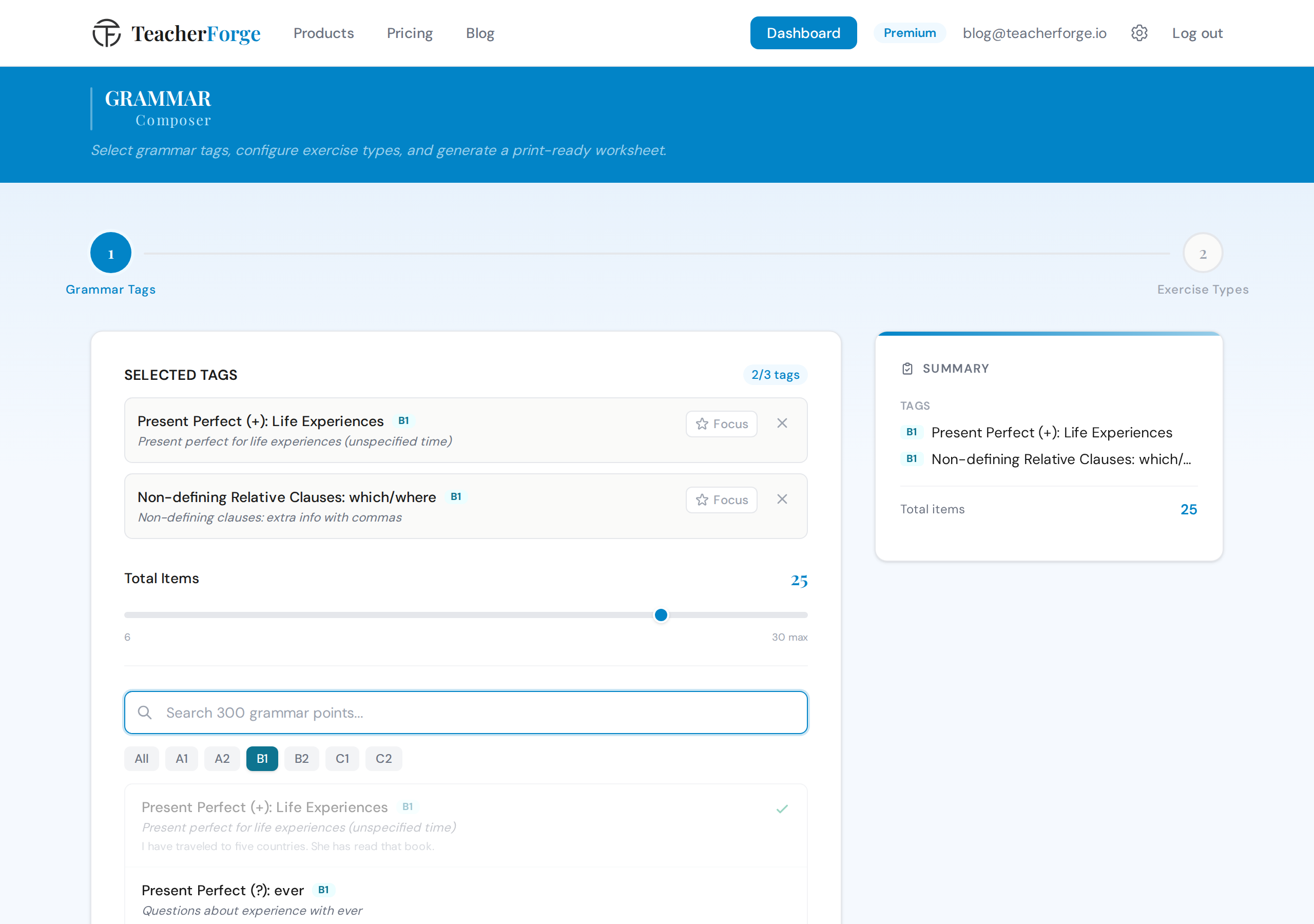
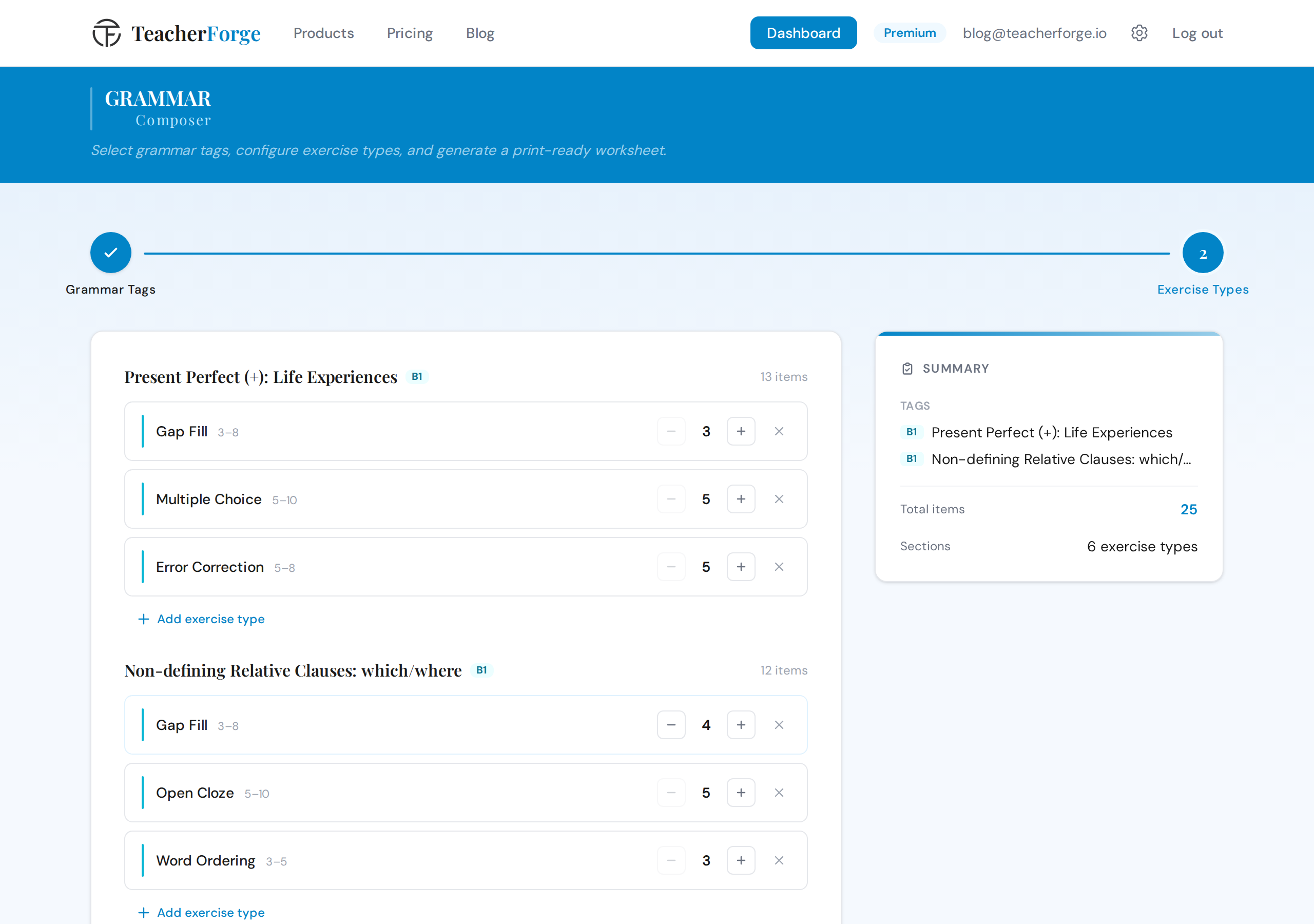
Once you have selected your tags, a compatibility matrix does the work of checking which exercise types are valid for each tag. You cannot accidentally add sentence transformation to a tag that does not support it — the system simply will not offer it. The auto-distribution then spreads your items across the compatible types, and you can adjust counts per type using simple +/- steppers if you want more error correction items and fewer true/false, for instance.
If you select two or three tags, a Focus toggle lets you weight one tag as the main focus, giving it a larger share of the total items. This is useful when you are reviewing a previous point alongside a new one and want the new structure to dominate the worksheet.
The ZIP download includes the student worksheet (PDF and editable DOCX), the complete answer key, and a folder of textbook-quality grammar reference notes covering the selected grammar points. The notes span A1 to C2, include formula boxes, annotated examples, conjugation tables, and common mistake warnings. They are ready to print as classroom handouts or share digitally. There is no extra cost and no extra step — they are bundled automatically.
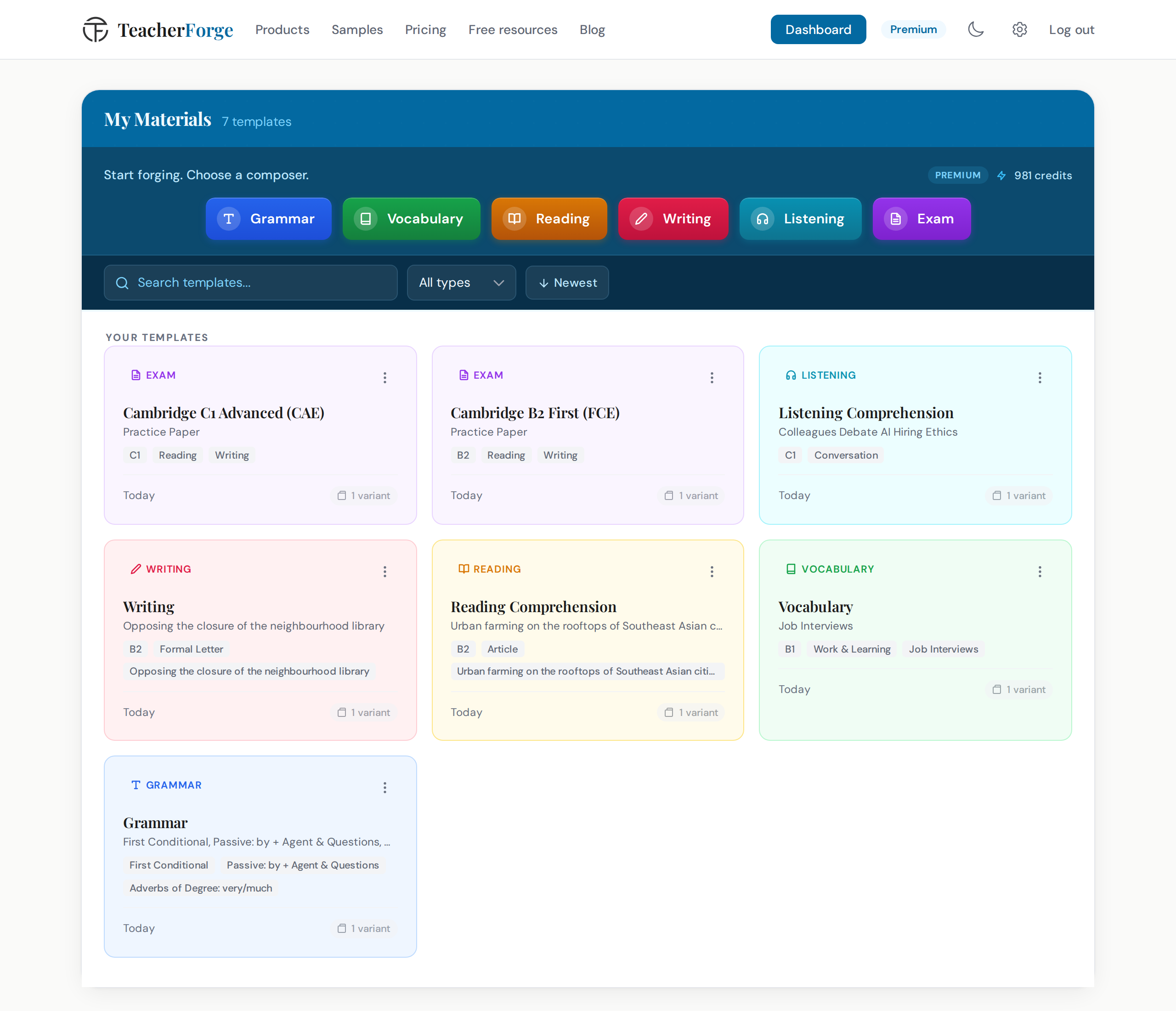
Because every generation automatically becomes a template on your dashboard, you can return later and choose "Regenerate" from its card's menu to get a fresh set of exercises with the same configuration — same tags, same exercise types, same weighting — without rebuilding anything. Useful when you teach the same level across multiple classes or want to give a make-up worksheet that covers the same ground without identical questions.
Further Reading
- How Much Time Do ESL Teachers Spend Creating Materials (and How to Cut It in Half)
- How to Create an ESL Worksheet in 5 Minutes: A Step-by-Step Guide
Start Building
If your grammar worksheets have been gap fill by default, it is worth spending one lesson planning session mapping out which exercise types actually suit the structures you are teaching. The nine types above cover the full range from recognition to production — and used in combination, they give a much clearer picture of what students genuinely know.
Try building your own grammar worksheet with the Grammar Composer →