At B2 and above, most students can pass a matching quiz. They can look at a word and select the right definition from four options. What they struggle with is everything that comes after recognition: choosing the right word in a writing task, using it with the correct collocation, knowing when it sounds too formal or too casual for the context.
This is the vocabulary plateau. Students know thousands of words but lack the depth to use them accurately and flexibly. Teaching vocabulary at B2 and C1 means addressing that gap directly.
Why Rote Learning Stops Working at B2
Flashcard-style memorisation serves learners well at A1 and A2. The vocabulary is concrete, the meanings are relatively stable, and frequency of exposure does most of the work. By B2, the picture is more complicated.
Consider a student who has learned the word decision. They know what it means. But do they know you make a decision, not do one? Do they know that resolve and determination carry different connotations even when they share a rough meaning? Can they distinguish slim, skinny, and thin in terms of the social weight each word carries?
These are not vocabulary gaps in the traditional sense. The student has the word. What they lack is depth of knowledge: collocational range, register awareness, connotation, and productive control.
Rote learning does not build any of these. A student who has reviewed a flashcard fifty times will still freeze when writing a formal report and reach for buy instead of purchase, or produce do a mistake instead of make a mistake.
What Depth of Vocabulary Knowledge Actually Means
Nation (2001) and subsequent vocabulary researchers describe word knowledge as multi-dimensional. For upper-intermediate and advanced learners, the dimensions that matter most are:
Collocational knowledge. Which words travel together? Make a decision, reach a conclusion, draw a distinction. Students who lack this produce grammatically correct but unnatural English.
Connotation and register. Slim is often flattering; skinny can be neutral or pejorative depending on context; thin is the most neutral of the three. Purchase belongs to formal and commercial contexts; buy is the unmarked everyday choice. Advanced learners need to feel these differences, not just know they exist.
Productive control. Can the student actually use the word in a sentence they construct themselves, not just recognise it in a sentence someone else wrote? This is the difference between receptive and productive vocabulary, and it is the dimension most neglected by traditional exercises.
Sense discrimination. Many high-frequency words have multiple senses or near-synonyms that overlap in some contexts but not others. Economic and economical are a classic example. So are affect and effect, or raise and rise.
Vocabulary Selection at B2 and Above
Before thinking about exercises, it is worth being deliberate about which words to teach. At B2 and C1, three categories deserve priority.
Academic vocabulary. The Academic Word List (Coxhead, 2000) covers roughly 570 word families that appear frequently across academic disciplines. Words like analyse, consequence, significant, and establish are underrepresented in general English coursebooks but essential for students preparing for IELTS, Cambridge exams, or university study.
Abstract concepts. B2 and above requires students to discuss ideas, not just objects and actions. Words like ambiguity, integrity, inequality, and perspective are difficult to teach through pictures or simple definitions. They require contextualised examples and carefully constructed exercises.
Topic-specific terminology. A C1 student preparing for a business English exam needs a different vocabulary set than one preparing for a medical admissions interview. Selecting words from the actual domain the student will operate in makes learning immediately transferable.
All three routes are supported directly: the ESL vocabulary worksheets page takes your own list, extracts vocabulary from a text you paste, or draws from 528 curated subtopics, and every word carries its part of speech, definition and CEFR level for you to review before exercises are built.
Exercise Types That Build Deeper Knowledge
Once you have selected a word set, the exercise type determines what kind of knowledge students actually practise. Here is how to match exercise type to learning goal.
Matching: test collocation, not just definition
At lower levels, matching exercises typically pair a word with its definition. At B2 and above, you can raise the cognitive demand by matching words to their collocates, or matching sentence halves that test whether students understand how a word behaves in context. A student who matches reach to conclusion is demonstrating more than recognition; they are showing collocational knowledge.
Multiple choice: make every option plausible
The weakness of many MCQ vocabulary exercises is that the distractors are obviously wrong. At B2 and above, all four options should be real words the student knows, and the correct answer should depend on close reading of the context. The question is not "what does this word mean?" but "which word fits here?" That shift forces students to consider register, collocation, and nuance rather than simple recall.
Gap fill with near-synonyms
A word box that contains near-synonyms is one of the most effective exercises for advanced learners. Rather than filling a blank with the only possible word, students must choose between slim, slender, and lean, or between suggest, propose, and recommend. The act of choosing forces students to articulate (at least implicitly) why one word fits and the others do not.
The word box should include a small number of distractors drawn from the same word set, not random vocabulary. This keeps the focus on discrimination within a coherent lexical field.
True/false: test nuanced understanding
True/false statements can test much more than basic comprehension if they are written carefully. A statement like "Economical and economic are interchangeable in formal writing" requires a student to have internalised the distinction between the two, not just to have seen both words before. Statements that target connotation, register, or common learner errors are particularly effective at B2 and above.
Word ordering: demand productive construction
Asking students to rearrange a jumbled sentence forces them to produce, not just recognise. At B2 and above, the sentences can include idiomatic collocations, complex clause structures, or formal register markers. A student who successfully orders a sentence containing notwithstanding or in light of has demonstrated genuine productive control.
Practical Tips for Vocabulary Lessons at B2+
These principles translate into concrete classroom decisions.
-
Build your word set around a theme, not a page. A coherent set of 12 to 15 words from the same domain (e.g. environmental policy, workplace communication) gives students a lexical field to navigate rather than isolated items to memorise.
-
Sequence exercises from receptive to productive. Start with matching or true/false (recognition), move to multiple choice (discrimination), then gap fill (constrained production), then word ordering (free construction). This scaffolding mirrors how vocabulary knowledge develops.
-
Make distractors do pedagogical work. Every wrong option in an MCQ or every near-synonym in a gap fill should be a word the student is also studying. If a student chooses the wrong answer, the error is informative: it reveals a confusion between two words in the target set, which you can address directly.
-
Include a reflection step. After completing exercises, ask students to write two or three original sentences using words they found difficult. This bridges the gap between controlled practice and free production.
-
Return to words across lessons. Vocabulary depth builds through repeated, varied encounters. Plan to revisit the same word set in a different exercise type the following week. A word seen in a gap fill today should appear in a word ordering task next lesson.
-
Discuss connotation explicitly. Do not assume students will absorb register and connotation from context alone. Spend five minutes comparing slim, skinny, and thin as a class. Ask students which they would use to describe a fashion model, a sick patient, a new phone. The discussion itself is the learning.
How to Create This With TeacherForge
Building a vocabulary worksheet at this level of specificity from scratch takes time: selecting the right words, writing contextualised sentences, constructing plausible distractors, and checking that the exercise set tests a range of cognitive skills. The Vocabulary Composer handles the structural work so you can focus on the pedagogical decisions.
There are three ways to bring your word set into the composer. If you already know which words you want to teach, the "My Words" path lets you paste up to 30 words directly. The system enriches every word automatically, assigning a part of speech, CEFR level, and level-adapted definition to each one. You review and confirm the set before any exercises are built.
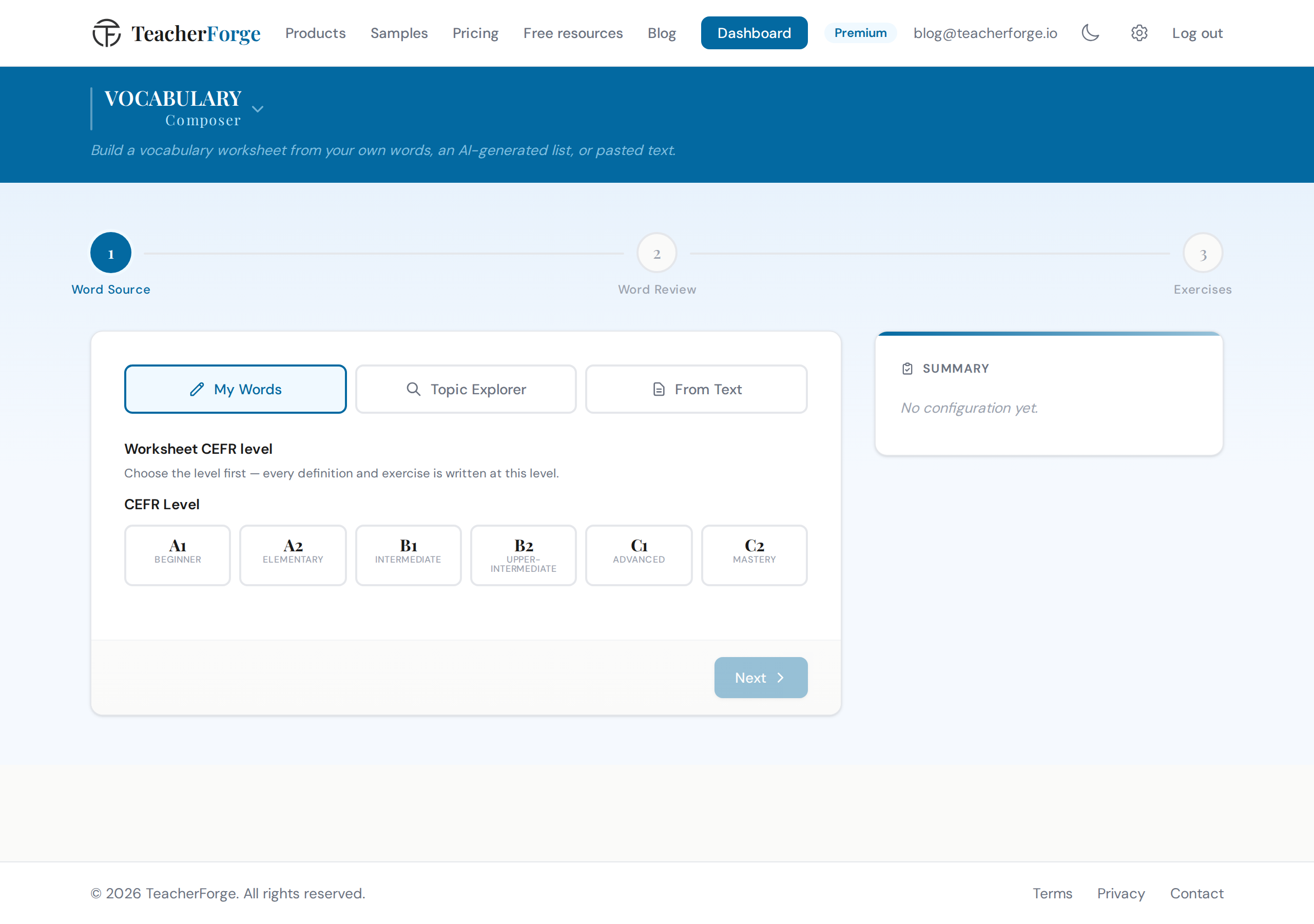
If you are building a lesson around a specific topic, the Topic Explorer offers 528 curated subtopics across 11 domains, filtered by CEFR level. At B2 or C1, you might select "Work & Learning" and browse to a subtopic like Salary Negotiations or Academic Research. Each subtopic shows 5 example words before you commit, and you set a word count between 8 and 30.
If you are working from a text (a newspaper article, a Cambridge reading passage, a textbook excerpt), the "From Text" path lets you paste up to 8,000 characters. The AI detects the CEFR level automatically, extracts key vocabulary, and enriches each word with the same POS, level, and definition data. You set a word count target and review the extracted list before proceeding.
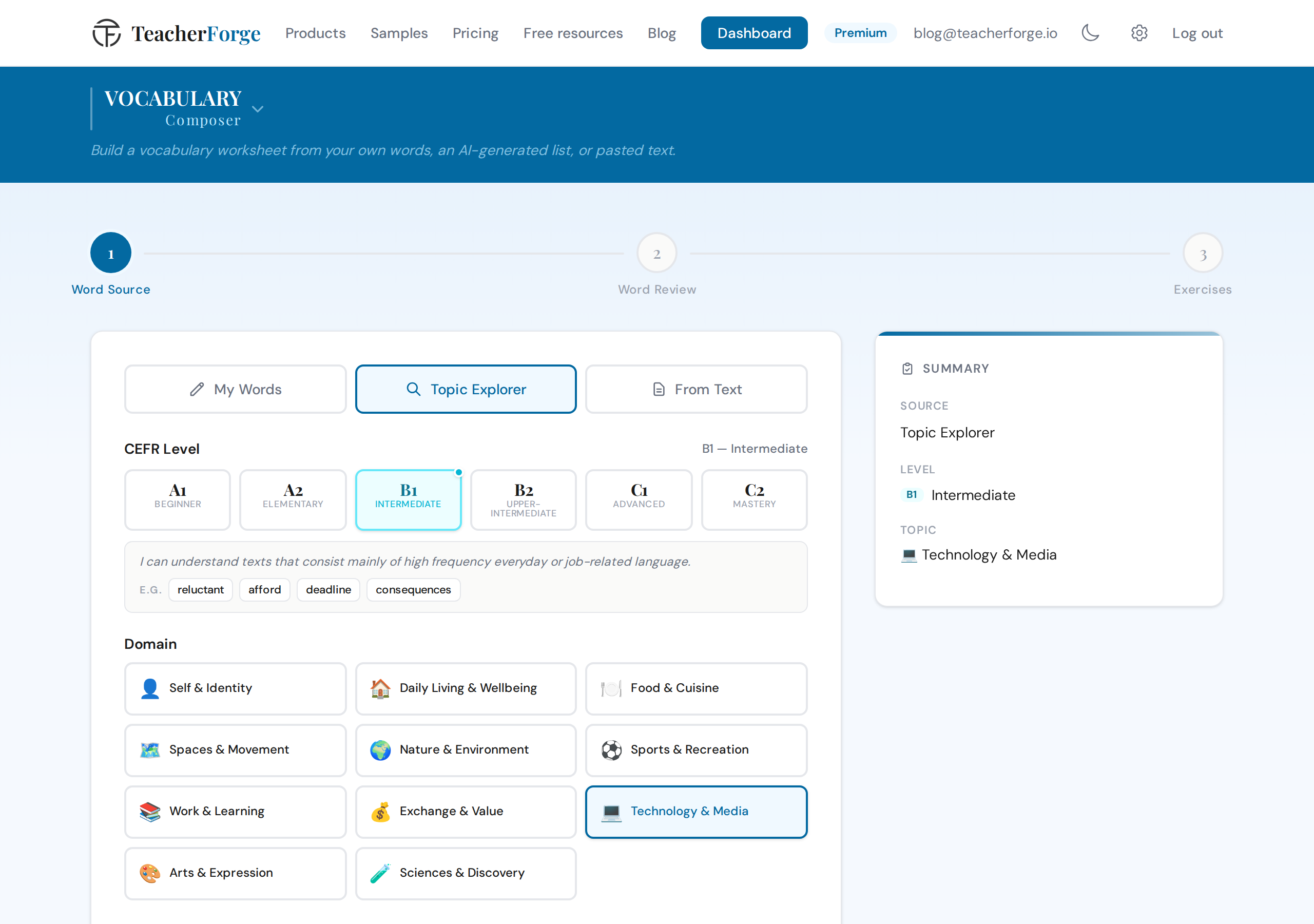
Once your word set is confirmed, you build the exercise sections from 5 types: matching, gap fill, multiple choice, true/false, and word ordering. In the composer, matching pairs each word with its definition, multiple choice asks which of four definitions gives a word's meaning in a sentence, true/false asks whether a definition is correct, gap fill uses a word box, and word ordering asks the student to build a sentence around the word. Crucially, the distractors in every exercise are drawn from your own confirmed word list, not invented vocabulary. A student who selects the wrong answer in an MCQ is confusing two words they are actively studying, which is exactly the kind of productive error you want to surface.
The composer uses a two-pass distribution algorithm to ensure every word appears at least once across the exercise set before any word is repeated. No word appears twice in the same section. The result is a worksheet where every target word gets genuine practice, not just the most common or most obvious ones.
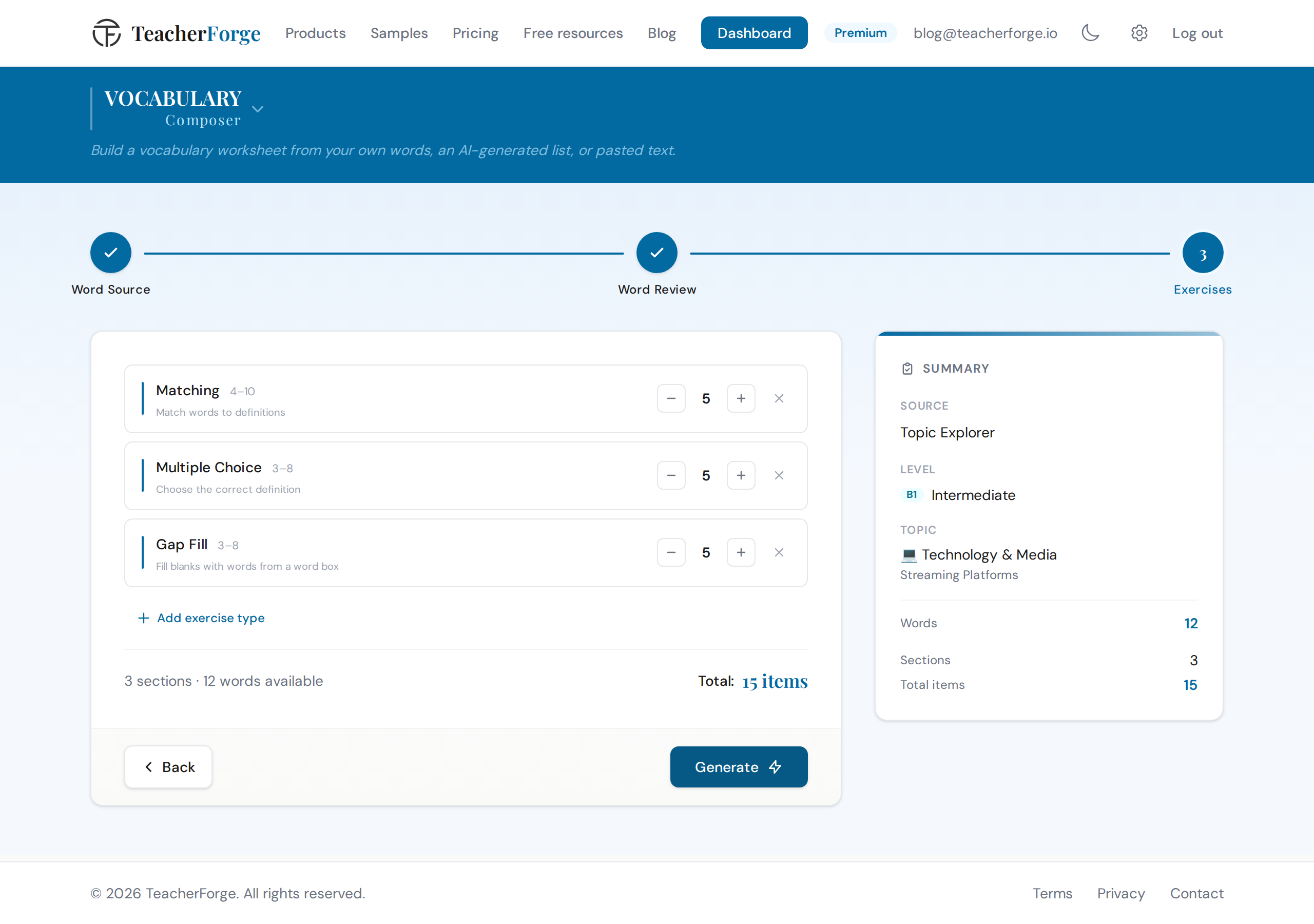
The output is a print-ready PDF and an editable DOCX, with a complete answer key. Every generation automatically becomes a template on your dashboard. If you teach the same topic to a different class, or want a fresh variant with new sentences and distractors, you choose "Regenerate" from the template card's menu and get a new worksheet with the same configuration and zero re-setup.
Going Further
Vocabulary at B2 and above is inseparable from the other skills. The words students practise in a vocabulary worksheet need to reappear in reading passages, writing tasks, and listening exercises if they are going to move from controlled practice into genuine fluency. If you are building integrated lessons around a lexical theme, the Reading Comprehension Composer and Writing Task Composer can generate materials around the same topic, giving students multiple encounters with the target vocabulary in different skill contexts.
For more on vocabulary exercise design, see Vocabulary Worksheets That Test More Than Definitions: 5 Exercise Types Every Teacher Should Use, which covers the mechanics of each exercise type in detail.
Ready to build your next B2 or C1 vocabulary worksheet? Try the Vocabulary Composer →