Most vocabulary worksheets ask students to match a word to its definition and call it done. It is a reasonable starting point, but recognition is only one part of knowing a word. A student who can match meticulous to "very careful and precise" may still struggle to use it in a sentence, identify it in context, or distinguish it from thorough or precise.
Vocabulary exercises ESL teachers rely on should test the full range of word knowledge: recognition, contextual understanding, discrimination between similar meanings, and ultimately production. This article walks through five exercise types that do exactly that — and explains what each one is actually testing.
What Does It Mean to "Know" a Word?
Paul Nation's research on vocabulary acquisition identifies several dimensions of word knowledge: form, meaning, and use. Knowing a word's definition is the entry point. Using it accurately in context is the goal. Between those two points, students need repeated exposure in varied conditions.
This is why a single exercise type is never enough. If every vocabulary activity on your worksheet is a matching task, you are repeatedly testing the same dimension of knowledge. Students who score well may still be unable to produce the word correctly or recognise it in an unfamiliar sentence.
The five exercise types below map onto different stages of word learning. Together, they give a much fuller picture of what students actually know.
5 Exercise Types and What They Test
1. Matching: Recognition
Matching tasks (word to definition, or word to synonym) test whether students can recognise a word's meaning when both the word and the definition are visible. This is the lowest-stakes form of vocabulary knowledge and a natural starting point for new vocabulary.
Matching works well as the first exercise in a worksheet sequence. It activates prior knowledge, gives students confidence, and provides a reference point for the exercises that follow. For lower levels (A1–A2), it is often the most appropriate format. For higher levels, it should be one component among several, not the whole worksheet.
One practical tip: use definitions that reflect how the word behaves in context, not dictionary-style abstractions. "A person who studies the stars and planets" is clearer than "one who practises the science of celestial bodies" for most B1 students.
2. Gap Fill: Contextual Recall
Gap fill tasks require students to retrieve a word from memory (or a word box) and place it correctly in a sentence. This tests contextual recall: not just knowing the definition, but recognising which word fits a particular grammatical and semantic slot.
A well-designed gap fill sentence provides enough context to make the correct answer clear, without being so obvious that the student never engages with the meaning. Compare these two sentences for the word negotiate:
- "She had to __ with her boss about her salary." (clear context, tests real usage)
- "She __ something." (no useful context, just tests spelling)
When a word box is included, it reduces the retrieval demand and makes the task more accessible. Without a word box, the task becomes closer to free recall, which is appropriate for review lessons or higher-level students.
3. Multiple Choice: Discrimination
Multiple choice vocabulary tasks test something different from both matching and gap fill: the ability to discriminate between words with related meanings. The distractors are the key. If the options are semantically unrelated, the task collapses back into simple recognition. The real challenge comes when options are near-synonyms or words from the same topic area.
For example, if your list holds reluctant, hesitant, nervous and stubborn, a question shows reluctant in a sentence and offers the definitions of all four. All four words describe a kind of resistance or unwillingness, but they are not interchangeable. Students who have only memorised a definition may struggle here. Students who have encountered the words in context will fare better.
This makes multiple choice particularly useful for revision lessons, when students have already been introduced to a set of words and you want to check for deeper understanding.
4. True/False: Conceptual Understanding
In a vocabulary true/false task, students see a word with a definition and judge whether the definition is correct. This tests conceptual understanding: does the student grasp what the word actually means well enough to evaluate a claim about it?
Example: frugal: "spending money freely on luxury items." (False)
This format is particularly effective for abstract nouns, adjectives describing character, and words that are frequently confused. It also works well for lower-level students because it asks for a judgement, not production, which reduces the cognitive load.
Mix true and false items, so students cannot simply assume every unusual-sounding definition is false.
5. Word Ordering: Production
Word ordering tasks ask students to rearrange jumbled words into a grammatically correct sentence. This is the most demanding of the five types because it requires students to produce accurate language, not just recognise or recall it.
For vocabulary purposes, the target word should appear in its correct form in the jumbled set (students are not expected to inflect it), but the surrounding words require students to think about sentence structure and word order. This reveals whether students understand how a word functions grammatically, not just what it means.
Word ordering is best placed at the end of a worksheet, after students have encountered the vocabulary in lower-stakes tasks. It serves as a productive consolidation activity and gives you a clear signal about who is ready to use the words actively.
The Word List Problem
Exercise types are only half the challenge. Before you can build any vocabulary worksheet, you need the right word list for your class. This is where many teachers lose significant preparation time.
Building a word list from scratch means deciding which words are appropriate for the CEFR level, checking that definitions are pitched at the right complexity, and ensuring there is enough semantic overlap for meaningful distractors in MCQ and gap fill tasks. For a 15-word worksheet, that process can take 30–45 minutes before you have written a single exercise.
That is the problem the three entry paths on the ESL vocabulary worksheets page are built around: bring your own list, paste any text, or pick from 528 curated subtopics, with part of speech, definition and CEFR level attached to every word before you generate anything.
There are three practical approaches to word list construction:
Start with your own words. If you are teaching a specific text or following a coursebook unit, you already know which words your students need. Write them down and build from there.
Browse by topic and level. If you are planning a standalone vocabulary lesson, working from a topic area (food, technology, the environment) gives you a coherent set of words that will feel connected to students.
Extract from a text. If you have a reading passage or article you plan to use in class, pulling the key vocabulary from that text creates a natural bridge between the reading and the vocabulary work.
Whichever approach you use, the next step is the same: check that every word is appropriate for the level, has a clear and usable definition, and is the right part of speech for the exercises you are planning.
Practical Tips for Building Better Vocabulary Worksheets
-
Sequence your exercise types by demand. Start with matching or true/false (recognition), move through gap fill and multiple choice (recall and discrimination), and finish with word ordering (production). This scaffolds the cognitive load across the worksheet.
-
Keep your word list focused. Eight to fifteen words is enough for a single lesson. A worksheet with 30 words and only matching tasks teaches less than one with 10 words tested across four exercise types.
-
Make distractors do work. In multiple choice tasks, use words from the same semantic field. Distractors that come from the same word list the students are learning are far more pedagogically useful than random vocabulary.
-
Calibrate definitions to the level. A B1 student does not need a C1 definition. If your definitions are harder than the words themselves, the worksheet is testing reading comprehension, not vocabulary.
-
Review words before you build exercises. Check part of speech, confirm the definition is accurate for the intended meaning (many words have multiple uses), and remove any words that are too similar to cause confusion unless discrimination is your goal.
-
Include a word box in gap fill for A1–B1. Remove it for B2+ to increase the retrieval demand. The same exercise type can be adjusted for different levels with this one change.
How to Create This with TeacherForge
TeacherForge's Vocabulary Composer handles both the word list and the exercises in a single workflow, with the teacher in control at every step.
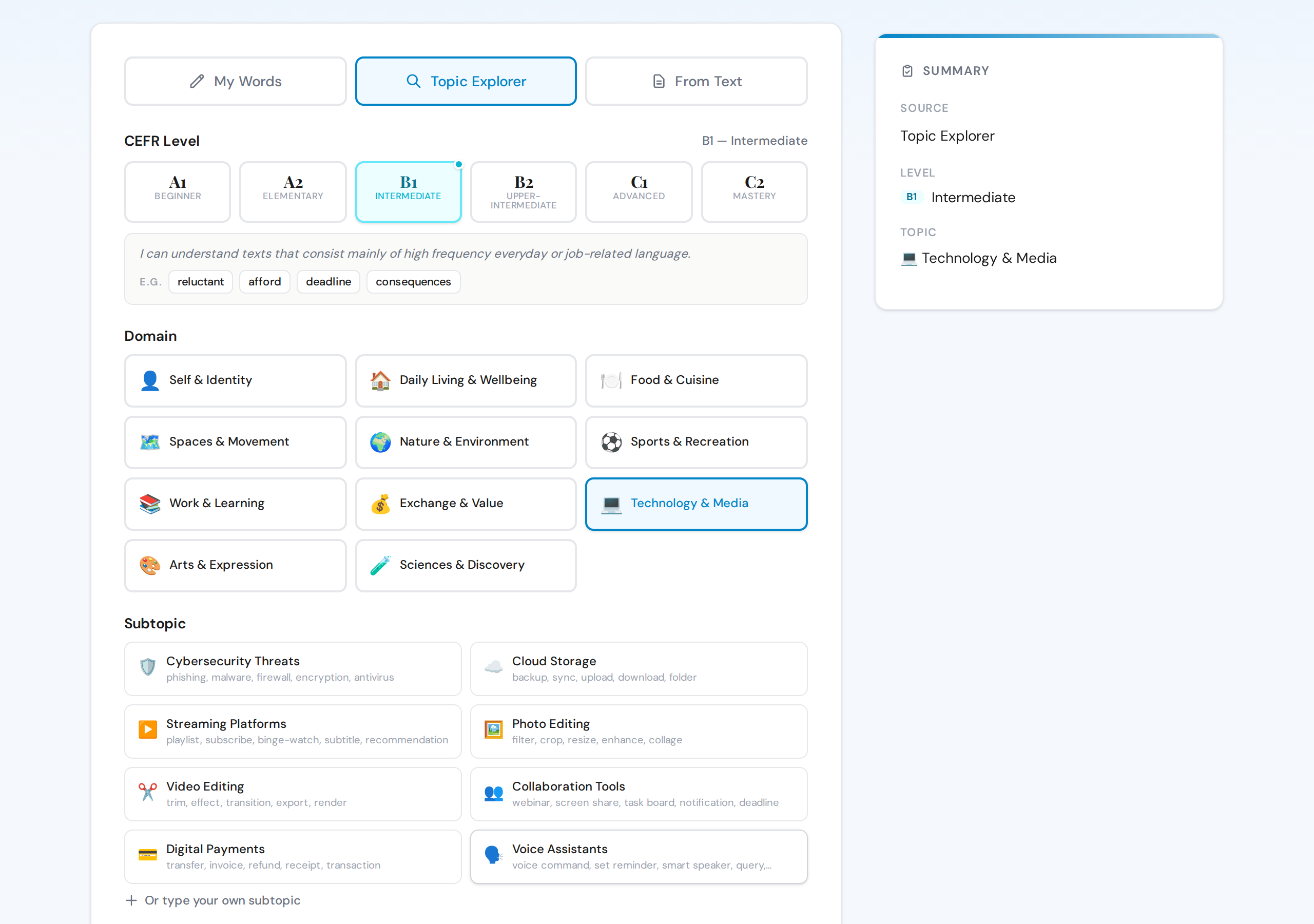
You start by choosing how to build your word list. If you have specific words in mind, paste them directly and proceed to enrichment. If you are planning a standalone vocabulary lesson, browse 528 curated subtopics across 11 domains (Self & Identity, Technology & Media, Nature & Environment, and more), filtered by CEFR level from A1 to C2. Each subtopic shows 5 example words so you can preview the vocabulary before committing.
A third option bridges your vocabulary work directly to reading materials. Paste any text — a coursebook passage, a news article, an extract you plan to use in class — up to 8,000 characters. The system detects the CEFR level, identifies the most teachable vocabulary in context, and builds your word list automatically. This is particularly useful when you want the vocabulary exercises to reinforce a reading lesson students have already completed or are about to start.
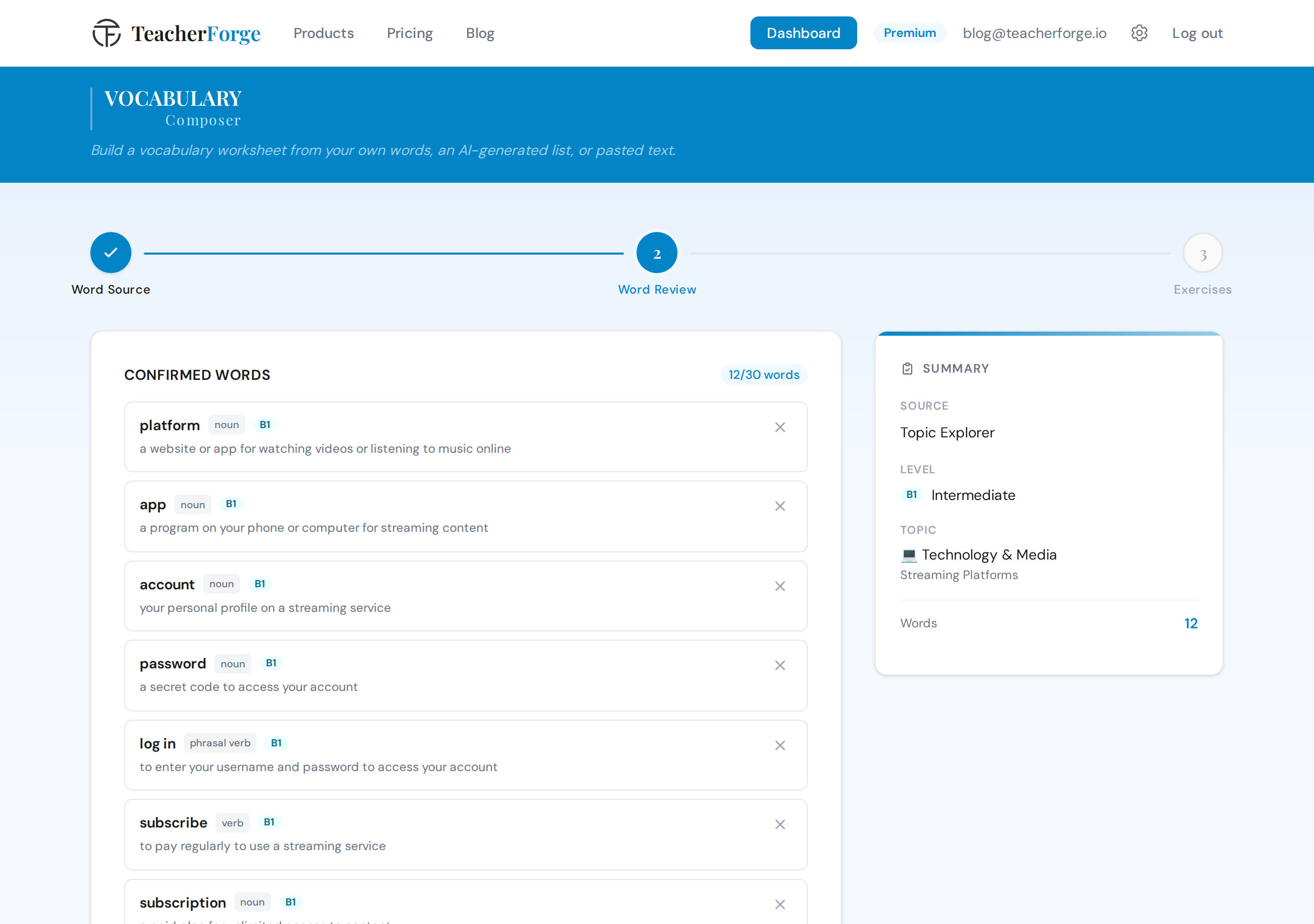
Once your words are in, every word is enriched with its part of speech, CEFR level, and a level-adapted definition. If a word has multiple meanings (for example, run as a noun versus a verb), you choose which meaning you want before proceeding. You can remove words that do not fit, add others, and adjust anything that looks wrong. Nothing moves forward until you have confirmed your word list.
Then you build exercises. The five types available are matching, gap fill, multiple choice, true/false, and word ordering — exactly the five discussed above. You choose which types to include and how many items each section should contain. The composer distributes your confirmed words across sections automatically, so every word appears at least once and no section is overloaded. Critically, all distractors in multiple choice and all word box entries in gap fill are drawn from your confirmed word list, not generated from elsewhere. Every wrong answer is a real word your students are learning, which means the exercises are testing discrimination, not guessing.
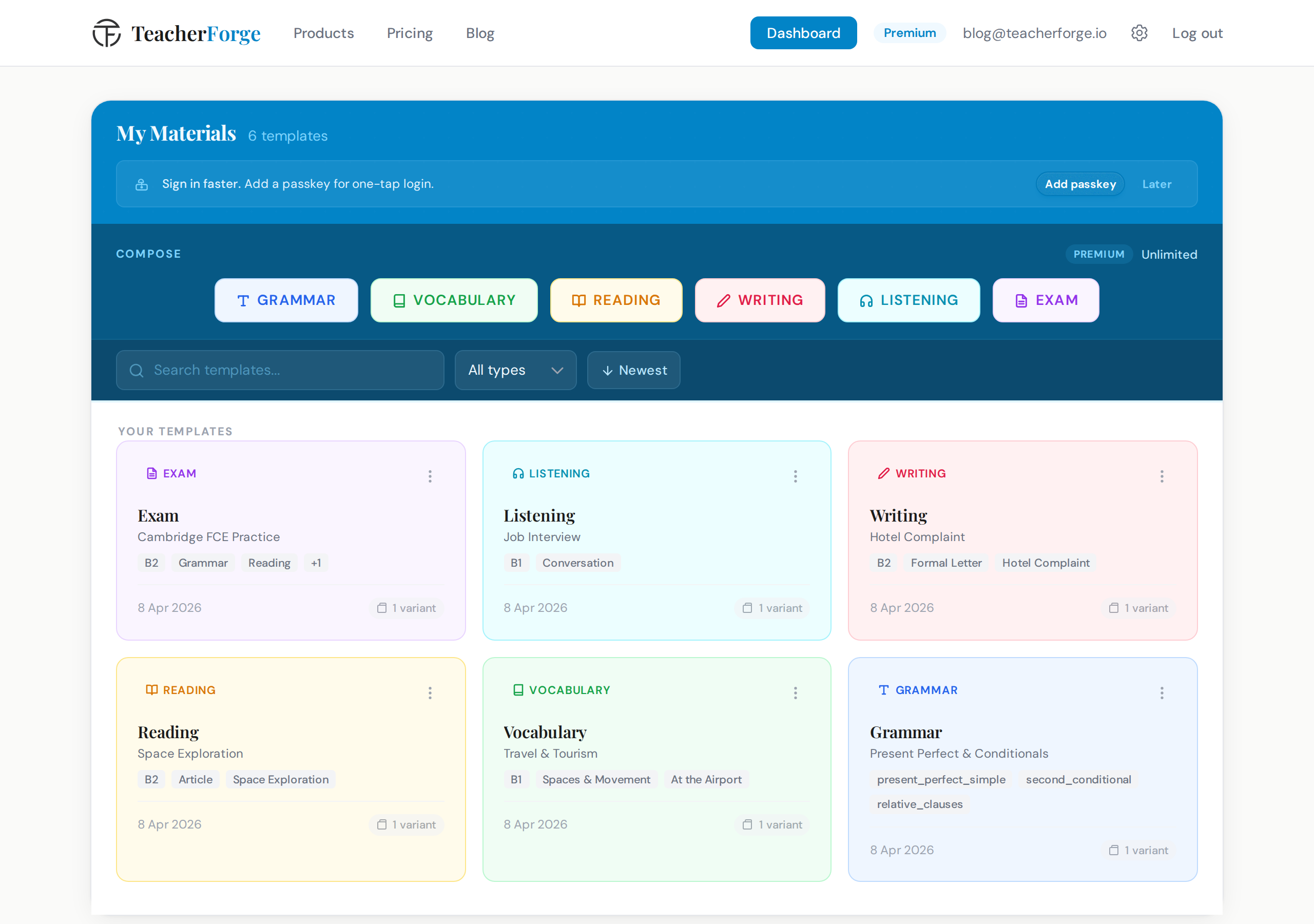
When you generate, you get a print-ready PDF and an editable DOCX, both with a complete answer key. The generation automatically becomes a template on your dashboard. Next week, if you want a fresh set of exercises using the same word list and exercise configuration, you choose "Regenerate" from the template card's menu and the composer reopens with everything already set.
Further Reading
- How Much Time Do ESL Teachers Spend Creating Materials (and How to Cut It in Half)
- How to Create an ESL Worksheet in 5 Minutes: A Step-by-Step Guide
- Grammar Worksheets Beyond Gap Fill: 9 Exercise Types That Test What Students Actually Know
Ready to build a vocabulary worksheet that tests more than definitions? Try the Vocabulary Composer →