Hand a student a writing prompt and you have given them a destination with no map. Most ESL writing tasks stop at the prompt: "Write an essay about social media." The student stares at a blank page, writes whatever comes to mind, and you mark it against criteria they have never seen. Nobody wins.
A genuinely useful ESL writing task worksheet has five components. Each one serves a specific purpose, and removing any of them creates a gap that shows up directly in student output. This article walks through all five, explains why they matter, and looks at how to build them without spending an hour on each task.
Why a Writing Prompt Alone Is Not Enough
The prompt is where most teachers start and stop. That is understandable. Writing a good prompt takes effort, and adding anything beyond it feels like extra work. But the prompt is only the beginning of what students need.
Research into writing instruction consistently shows that students produce better work when they have explicit support at the planning stage, not just at the correction stage. Feedback after submission is useful, but it comes too late to change what the student has already written. The support needs to be there before the pen hits the paper.
This is not about making writing easier in the sense of reducing challenge. It is about removing the wrong kind of difficulty: the kind that comes from not knowing what to do, rather than from genuinely grappling with language.
The 5 Components of a Complete Writing Task
1. The Writing Prompt (with Full Context)
A good prompt is not a topic. It is a scenario: who the student is, who they are writing to, why they are writing, and what they need to include. Compare these two:
Weak: "Write a review of a restaurant."
Strong: "You recently visited a new restaurant in your city with a group of friends. Write a review for a local food website. Include information about the food, the service, and the atmosphere, and say whether you would recommend it."
The second version gives the student a situation, an audience, a purpose, and a content framework. It does not make the task easier. It makes it possible to complete it well. At lower CEFR levels (A1–A2), this scaffolding is essential. At higher levels (C1–C2), it keeps the task focused and assessable.
Task type matters too. The standard ESL writing task types (essay, informal letter, formal letter, report, review, article, story and, at C1, proposal) each have different conventions, registers, and structural expectations. A prompt for a formal letter looks nothing like a prompt for a story, and students need to see those differences modelled in the task itself.
2. The Planning Checklist
Planning is the step most students skip, usually because nobody has shown them what planning looks like for this specific task type. A planning checklist makes the process concrete.
For an essay at B2, the checklist might read: identify your position, note two or three supporting arguments, consider a counterargument, plan your conclusion. For an informal letter at A2, it might be: decide who you are writing to, list three things you want to say, choose how to open and close.
The checklist is task-type specific, not generic. "Brainstorm ideas" is not a useful instruction. "Write down one argument for each paragraph" is. The difference between these is the difference between a checklist that students actually use and one they ignore.
3. The Useful Language Box
This is the component that makes the biggest difference to writing quality, and it is the one most often missing.
A useful language box is a curated set of phrases and structures organised by function, calibrated to the student's CEFR level, and matched to the task type and topic. For a B1 essay on environmental issues, it might include phrases grouped under: Giving your opinion ("In my view...", "It seems to me that..."), Adding information ("Furthermore...", "In addition to this..."), and Contrasting ideas ("However...", "On the other hand...").
This is standard practice in published ESL textbooks. Open any major Cambridge or Pearson writing course and you will find a language box on every task page. Teachers know this works. The problem is that creating one from scratch for every task, calibrated correctly to the level and topic, takes significant time.
The useful language box transforms writing from a retrieval task ("what words do I know?") into a production task ("how do I use these tools?"). Students who have a language box write more fluently, use more varied structures, and make fewer compensatory errors. Students without one default to the vocabulary they are most comfortable with, which is rarely the vocabulary you want to see at their level.
4. Assessment Criteria
Students write better when they know what they are being assessed on before they write, not after. This is not a controversial claim. It is the basis of every published exam marking scheme, from Cambridge to IELTS to Trinity.
A useful criteria sheet for a writing task covers four dimensions: Content (did the student address all parts of the task?), Communicative Achievement (is the register and format appropriate?), Organisation (is the writing logically structured?), and Language (is the vocabulary and grammar accurate and varied?). Each dimension should have level-appropriate descriptors so students understand what "good" looks like at their stage.
Sharing criteria before the task also changes how students read their own work. A student who knows they are being assessed on organisation will re-read their draft with that lens. That is a metacognitive skill worth developing, and the criteria sheet is what triggers it.
5. The Model Answer
A model answer is not a cheat sheet. It is a reference point that shows students what a successful response at their level looks like. Used correctly (shown after students have submitted their own work, or used as an analysis task before writing), it is one of the most effective writing development tools available.
The key word is "at their level." A C1 model answer shown to B1 students is demoralising and misleading. A B1 model answer shown to B1 students is instructive. The model should sit within the target word limit for that level and task type, demonstrating the kind of language, structure, and register you actually expect to see.
Assembling all five by hand for every task is the reason most teachers stop at the prompt. The ESL writing task worksheets page produces the whole package in one step, across eight task types from A1 to C2, with the word limit set by the level and task type rather than chosen by you.
Practical Tips for Building Writing Tasks
Here is how to approach writing task design in a way that is sustainable across a full teaching week.
-
Start with the task type, not the topic. Decide whether you need an essay, a letter, a report, or another format based on what your students need to practise. The topic is secondary.
-
Match the word limit to the level. Cambridge guidelines give clear word count targets for each level and task type. Deviating significantly from these creates assessment problems and gives students unrealistic expectations before exams.
-
Build the language box from the task, not the other way around. Write the prompt first, then ask: what phrases would a competent writer at this level use to complete this task? Group them by function (giving opinions, sequencing, contrasting, summarising) rather than by grammar category.
-
Write the model answer before you finalise the criteria. This sounds counterintuitive, but writing the model first reveals what you actually value in the response. Then formalise that into criteria descriptors.
-
Separate the student sheet from the teacher sheet. Students need the prompt, the planning checklist, the language box, and a writing space. The criteria and model answer go on the teacher sheet (or are distributed after submission). Mixing everything together undermines the task.
-
Reuse the language box structure across tasks. The functional categories (giving opinions, adding information, contrasting) stay consistent across many task types. Once you have a well-designed structure, adapting it for a new topic takes far less time than building from scratch.
-
Pilot the checklist yourself. If you cannot complete the planning checklist in under three minutes, it is too complex for students. Simplify until the steps are genuinely actionable.
How to Create This with TeacherForge
Building all five components manually for every writing task is the reason many teachers default to giving just a prompt. The time cost is real: a well-designed task with a language box, criteria, and model answer can take 45 minutes to an hour to produce from scratch.
The TeacherForge Writing Task Composer generates all five components in a single step. You select the CEFR level (A1 through C2), choose the task type from the eight available options, and enter a topic or pick from suggested topic chips. The word limit is automatically set to the recommended range for that level and task type, with no guesswork needed.
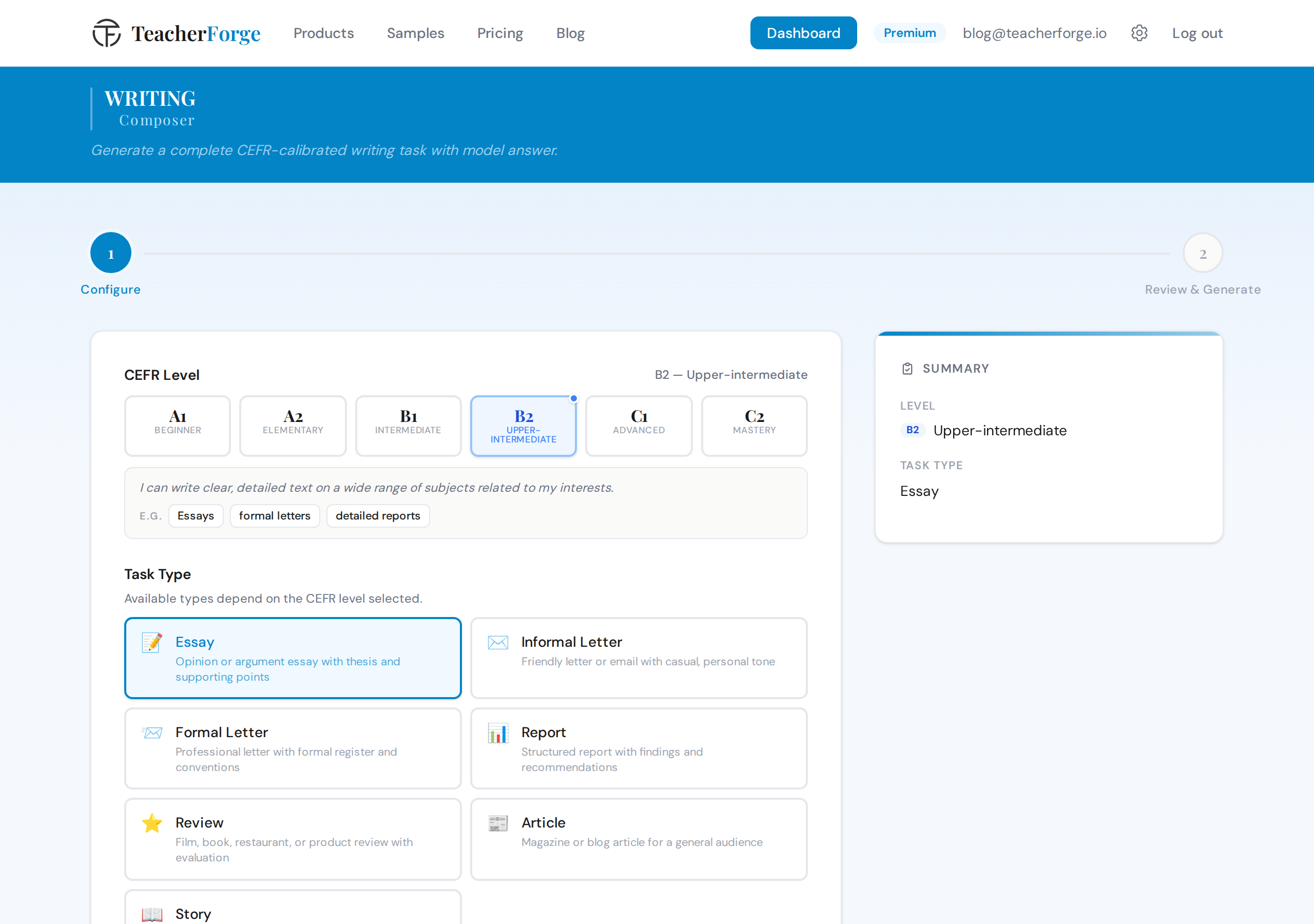
The output comes as two separate files. The student worksheet contains the writing prompt and a writing space, with the planning checklist and the useful language box when they are on. The teacher answer key contains everything on the student sheet plus the assessment criteria with level-appropriate band descriptors and a complete model answer within the target word limit. Both files download as PDF and editable DOCX.
For teachers preparing Cambridge exam classes, Cambridge Standard mode sets the task as the exam does for the task types the FCE and CAE papers set (essay, formal letter, report, review and article from B1, the proposal at C1): a model answer and Cambridge's four criteria, with no planning checklist or useful language box. For other contexts, Custom mode lets you choose which components to include and switch between task-specific and generic criteria. The word limit is set by the level and task type in both modes.
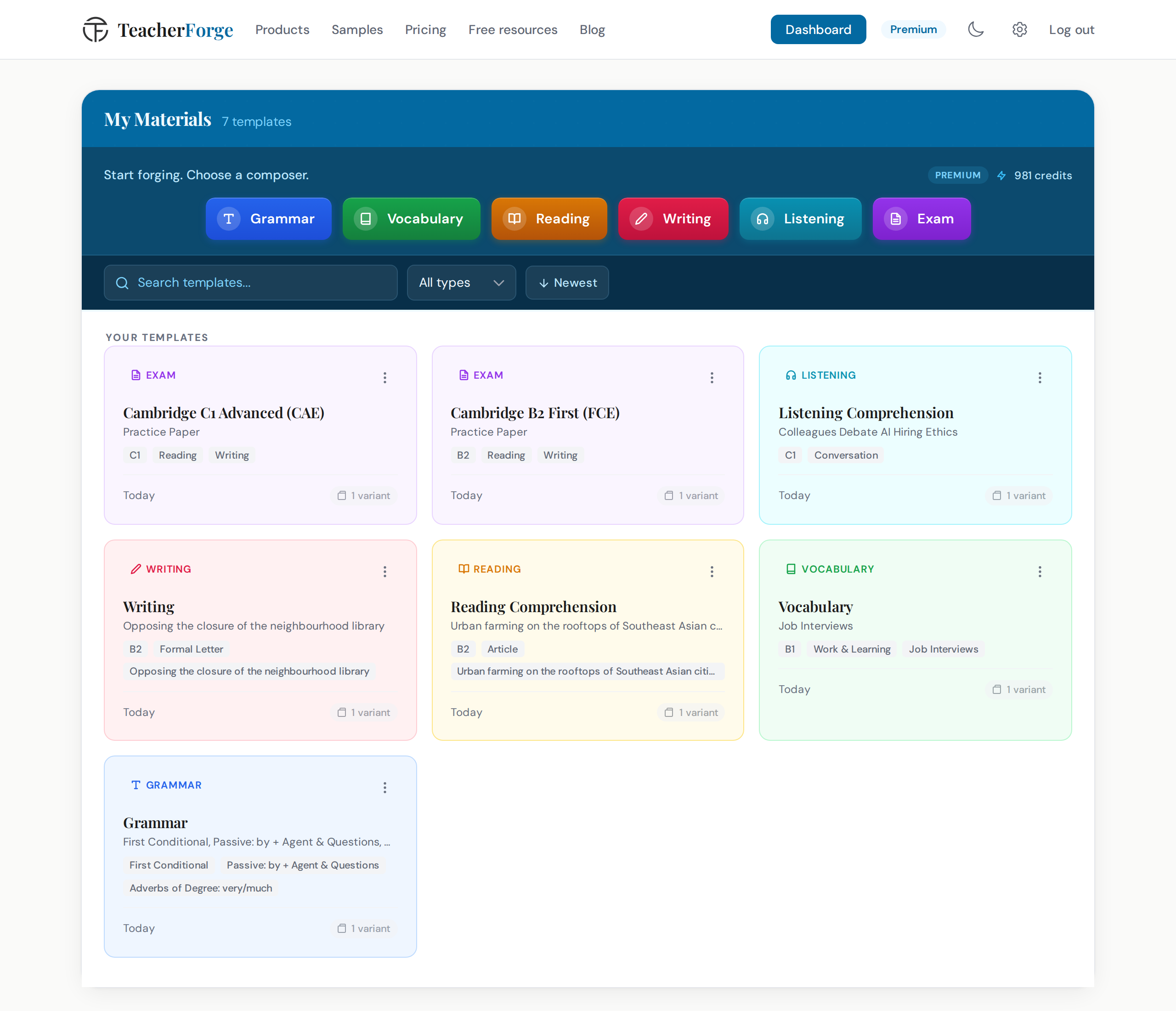
Every task you generate automatically becomes a reusable template on your dashboard. From there, you can choose "Regenerate" from its card's menu to get a fresh task with the same configuration (same level, same task type, same structure) without going through the setup again. Useful for classes that need multiple practice tasks on the same format before an exam.
What This Looks Like in the Classroom
A complete writing task changes the classroom dynamic in a specific way. Instead of students spending the first ten minutes staring at a blank page, they spend those ten minutes working through the planning checklist and annotating the language box. The writing itself starts from a more informed position.
After submission, the criteria sheet gives you a shared vocabulary for feedback. Instead of writing "needs more varied language" on a script, you can point to the Language dimension of the criteria and discuss what range looks like at that level. Students understand the feedback because they have seen the framework.
The model answer, used as a post-task analysis activity, turns the marking process into a teaching moment. Students compare their own writing to the model, identify differences, and articulate what they would change. That reflection is where a lot of the learning happens.
None of this requires a fundamentally different approach to teaching writing. It requires a more complete task to start with.
If you want to see how the five components fit together in practice, the Writing Task Composer is free to try with the credits included at signup.
Try creating your own writing task worksheet →
Related reading: