Listening is the hardest skill to create materials for. Grammar worksheets take 20 minutes. A reading text can be pulled from a textbook or adapted from an article. But a listening lesson needs audio at the right level, a script the teacher can work with, and exercises that actually test what students heard. That combination is genuinely difficult to put together, and most of the workarounds teachers use have real problems.
Why the Usual Options Fall Short
YouTube clips
YouTube is the first place most of us look. There is no shortage of content, but level control is almost impossible. A news clip aimed at native speakers will overwhelm a B1 class. Authentic interviews are full of crosstalk, mumbling, and cultural references that derail the lesson before it starts. The bigger problem is reliability: videos get taken down, region-locked, or updated without warning. Building a lesson around a clip that disappears the night before class is a familiar frustration.
Recording yourself
Some teachers record their own audio. It works, but the time cost is significant. You write a script, record it, edit out the false starts, convert the file, and then build exercises from scratch on top of that. You also end up with a single accent on every recording, which is a real pedagogical gap. Students preparing for IELTS or Cambridge exams need exposure to multiple speakers and registers, not just their teacher's voice.
Free listening libraries
There are free sites with pre-made listening exercises, and they are useful up to a point. The limitation is that each recording comes with one fixed set of questions. If the gap fill is too easy for your class, or you want short answer questions instead of multiple choice, there is nothing you can do. The audio and the exercises are locked together. You take it as it is or you leave it.
What a Complete Listening Lesson Actually Requires
Before looking at solutions, it helps to be clear about what we actually need when we create ESL listening exercises.
Level-appropriate audio. A2 students need slower speech, shorter turns, and familiar vocabulary. C1 students need natural pace, overlapping speakers, and complex syntax. A single audio library that does not distinguish between these levels is only useful for part of your timetable.
Diverse audio formats. Real-world listening is not one thing. Students need practice with conversations between friends, formal interviews, public announcements, academic lectures, personal monologues, news reports, and phone calls. Each format has its own conventions, and students who only practise with conversations will struggle when they encounter a recorded announcement in an exam.
Flexible exercises. The same audio can serve very different purposes depending on the exercise type. A news report could support a note completion task for a detail-focused lesson, or a true/false task for a gist-level warm-up. If the exercises are fixed, the teacher loses that flexibility.
A complete bundle. A listening lesson is not just a worksheet. It is the audio file, the student handout, and the answer key, all formatted and ready to use. Assembling these separately adds time that most of us do not have.
The 7 Listening Formats and Why They Matter
When we talk about listening formats, we mean the communicative context of the audio, not just the topic. Each format makes different demands on students.
- Conversation: Two or more speakers in an informal exchange. Tests turn-taking, inference, and colloquial language.
- Interview: A structured question-and-answer format, often with a clear information hierarchy. Common in Cambridge and IELTS contexts.
- Announcement: One speaker delivering information to an audience. Students must identify key facts quickly.
- Lecture: Extended monologue with academic vocabulary and logical structure. Essential preparation for EAP and C1/C2 learners.
- Monologue: Personal narrative or opinion piece. Tests sustained listening and attitude recognition.
- News report: Formal register, dense information, often with numbers and proper nouns. Useful for B2+ classes.
- Phone call: One-sided or two-sided, with the challenges of informal register and incomplete information.
A well-balanced listening programme should cycle through these formats over the course of a term. If your students have only ever practised with conversations, a phone call or announcement in an exam will feel unfamiliar even if the language is within their range.
Cycling through all seven does not mean hunting down seven different recordings. The ESL listening exercises page browses a library of scripts that already have the audio attached, so picking a phone call or an announcement is a choice from a list rather than a search for usable material.
7 Exercise Types for Listening Comprehension
The exercise type determines what cognitive skill the student is using. Using only one type, typically multiple choice, means students practise recognition but not recall, note-taking, or tracking who said what.
Here are the exercise types worth building into your listening lessons:
- Multiple choice (suitable for all levels): Tests recognition and inference. Works well for gist and detail questions.
- True/false (all levels): Fast to complete, good for checking basic comprehension before moving to more demanding tasks.
- Gap fill (A1–A2): Students complete sentences with words from a box. Each blank has its own decoy in the box, a word that sounds close to the answer but is never said (fifteen / fifty), so only listening decides. From B1, students write what they hear instead.
- Short answer (all levels): Open-ended responses. Tests recall without the support of options.
- Sentence completion (A2+): Students complete sentences using words or phrases from the audio. Bridges gap fill and short answer.
- Note completion (B1+): Students fill a structured set of notes. Mirrors real-world note-taking and is a core IELTS task type.
- Matching (B1+): IELTS-style speaker matching. Students write which speaker says each thing, or Both when two people talk. It is offered only on conversations whose speakers students can tell apart, never on interviews or phone calls, where each speaker's role gives the answer away. Requires holding information across multiple turns.
A practical tip: pair a gist task (true/false or multiple choice) with a detail task (note completion or gap fill) in the same lesson. Students listen twice with different purposes, which is more realistic and more pedagogically sound than a single listening with a single task.
Practical Tips for Building Listening Lessons
Match format to exam target
If your students are preparing for IELTS, prioritise note completion, sentence completion, and matching. If they are working towards Cambridge B2 First, focus on multiple choice and sentence completion. For general English classes, rotate formats so students build broad listening stamina.
Use the exercise type to control difficulty
The audio does not need to change for the lesson to get harder. A B1 recording with a multiple choice task is manageable. The same recording with a note completion task is significantly more demanding. Varying the exercise type is one of the most underused tools for differentiation.
Preview before you commit
Always listen to the full audio before the lesson, not just the first 30 seconds. Check for any content that might need contextualising, any speakers whose accent might be unfamiliar to your class, and whether the pace is appropriate for the level you intend.
Build in a pre-listening stage
Activate schema before students hear the audio. A short discussion question, a prediction task, or simply displaying the topic and format primes students for what they are about to hear. This is especially important for announcement and lecture formats, where the register shift can be jarring without preparation.
Recycle audio across lessons
The same recording can anchor two or three different lessons if you change the exercise type. Use sentence completion for a detail lesson, short answer for a follow-up discussion, and matching if the audio is a conversation between speakers students can tell apart. This is efficient and also helps students develop deeper familiarity with extended spoken texts.
How to Create This with TeacherForge
TeacherForge's Listening Exercise Composer takes a different approach to the problem. Instead of generating audio on demand (which produces unpredictable quality), it maintains a curated library of recordings in seven formats across all six CEFR levels. Every script in the library has been quality-checked before teachers see it, so you are not gambling on whether the audio will be usable.
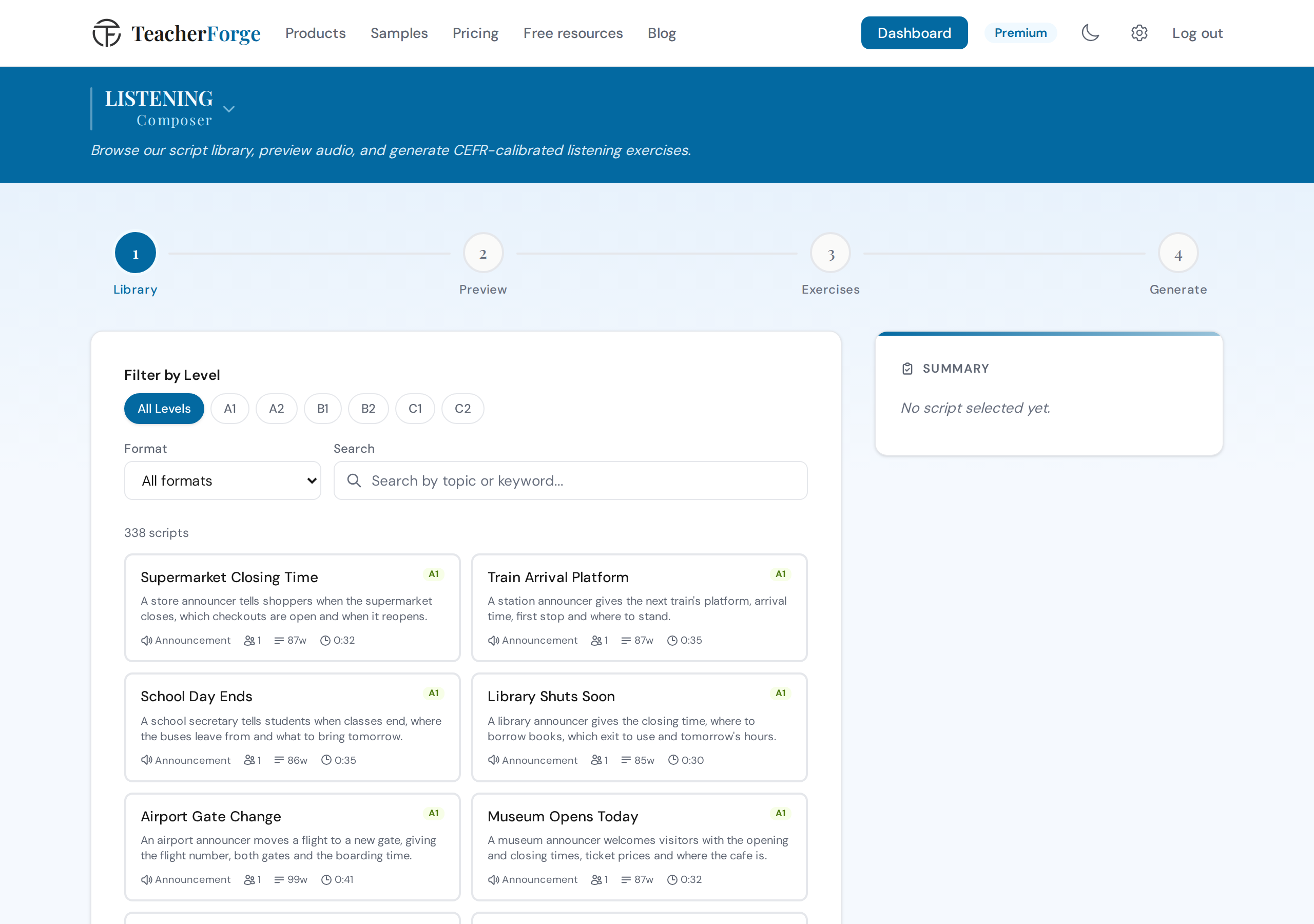
You browse the library by filtering on CEFR level, format (all 7 types are filterable), or by keyword search. Results show as cards with the format, speaker count, word count, and audio duration visible before you open anything.
When you find a script that looks right, you open a full preview: the complete transcript, speaker names, word count, and an audio player with speed controls (0.5x through 1.25x). You can listen at full speed or slow it down to check whether the pace suits your class. Only after you have confirmed the script do you move to the exercise composer.
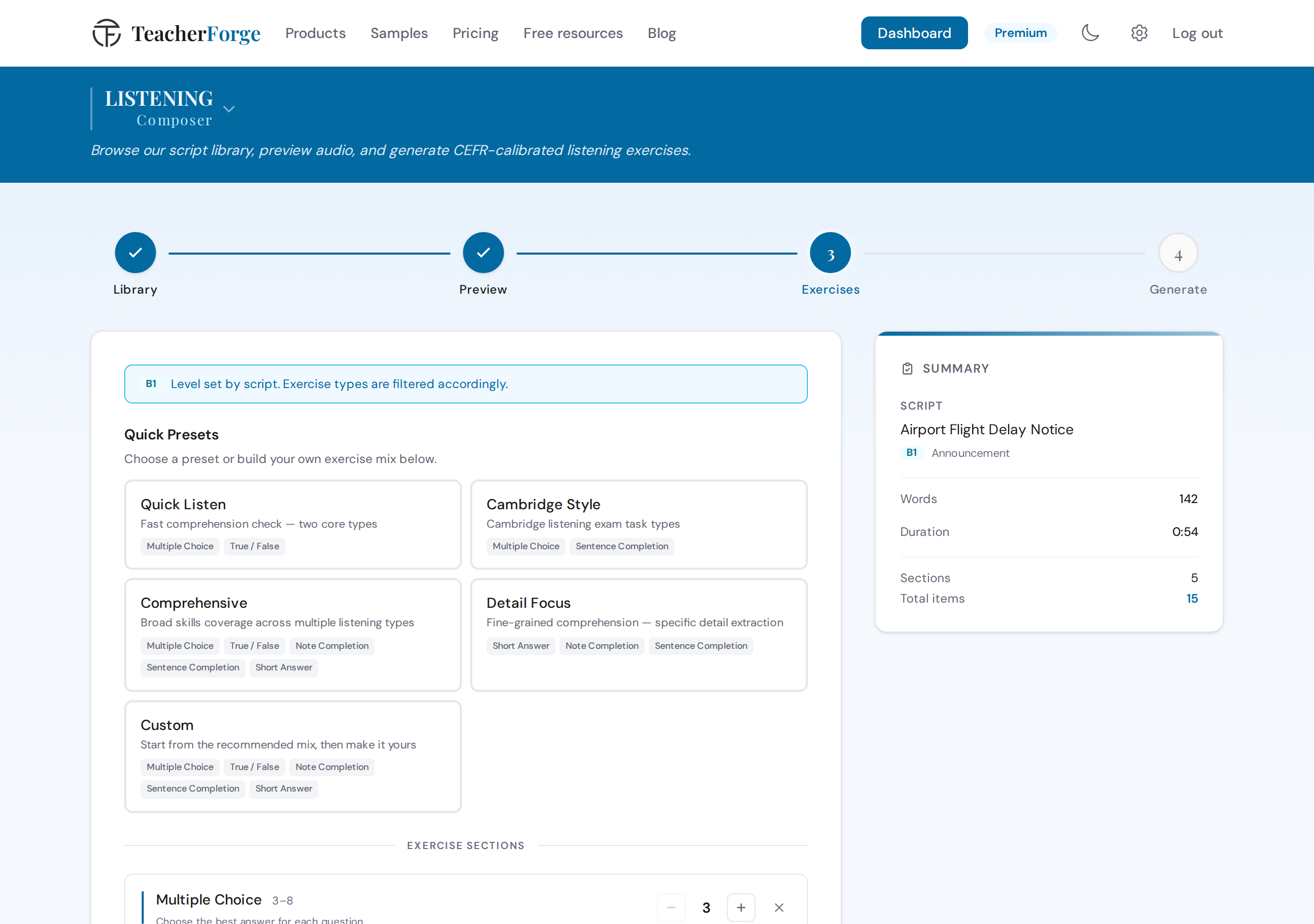
This separation between audio selection and exercise creation is the key difference from traditional listening libraries. The same recording can produce dozens of different worksheets. You choose your exercise types from the 7 available (gated by the script's level and, for matching, by its format and speakers, so only appropriate types appear for your chosen script), set item counts, or apply one of 6 presets.
The presets are:
- Quick Listen (all levels, 10 items): Multiple choice and true/false. Good for a focused 20-minute lesson.
- Beginner Listening (A1–A2, 10 items): Gap fill with a word box, then multiple choice.
- IELTS Style (B1+, 20 items): Note completion, matching, sentence completion, and multiple choice, on conversations whose speakers students can tell apart, where matching is offered.
- Cambridge Style (B1+, 10 items): Multiple choice and sentence completion, the two tasks every Cambridge listening paper sets from B1.
- Comprehensive (B1+, 20 items): Multiple choice, true/false, note completion, sentence completion, and short answer, on every script.
- Detail Focus (B1+, 15 items): Short answer, note completion, and sentence completion for intensive detail work.
Once you generate, the download ZIP contains everything for the lesson: the student worksheet as PDF and DOCX, the answer key as PDF and DOCX, the transcript as a PDF, and the MP3 audio file. There is nothing else to find or format.
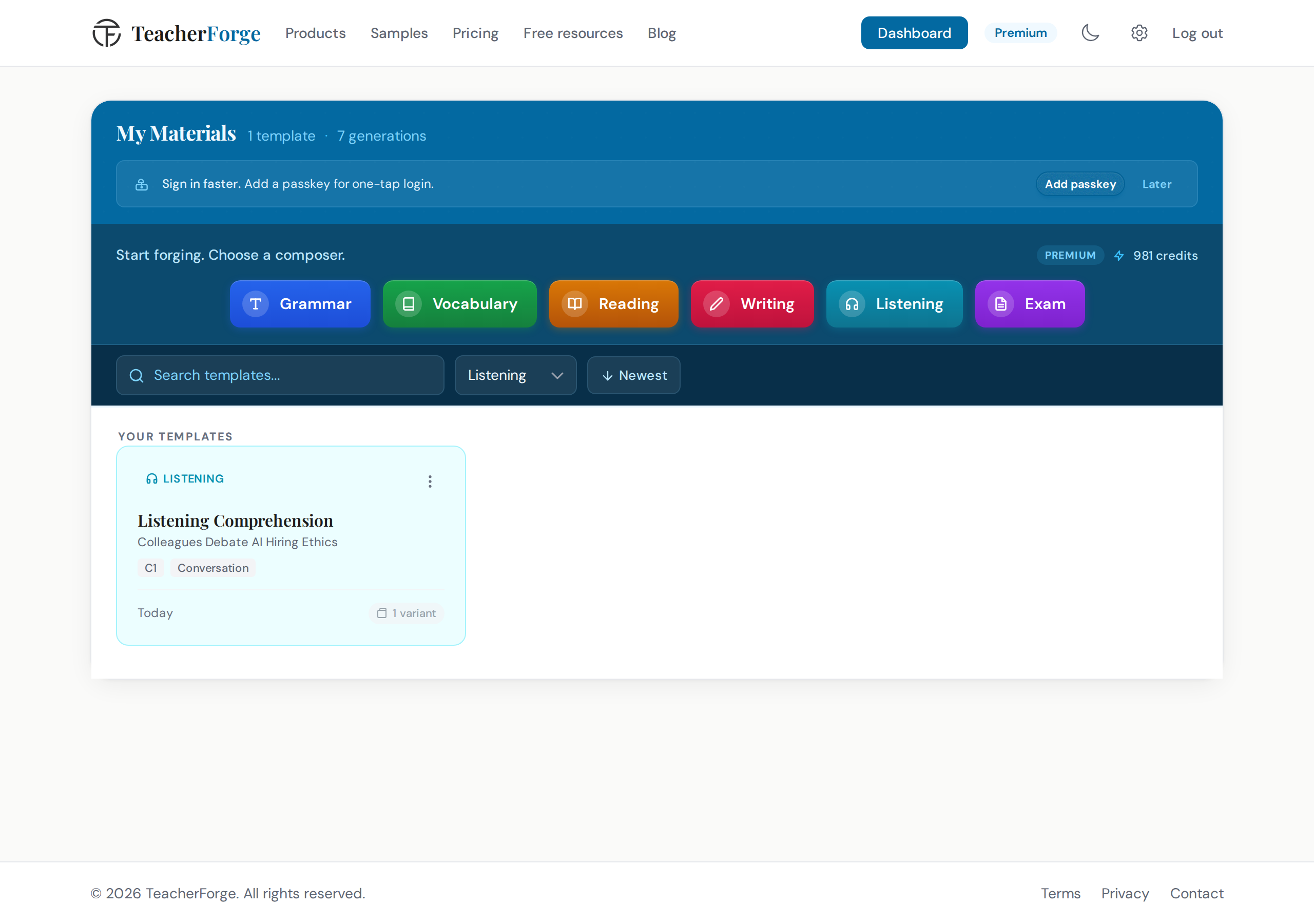
Every generation automatically becomes a template on your dashboard. If you want to use the same recording with a different exercise configuration for another class, you choose "Regenerate" from the template card's menu and adjust the exercise types before generating. No re-setup needed.
If you cannot find a script that fits what you need, you can submit a topic request directly from the library browser. You specify the topic, CEFR level, and optionally the format, and that request feeds into what gets added to the library next.
Putting It Together
Creating listening materials has always been the hardest part of lesson planning because it requires three things at once: appropriate audio, a usable script, and well-designed exercises. Most tools give you one of these, or give you all three locked together with no flexibility.
The approach that works is to separate audio selection from exercise design, use diverse formats across your teaching, and match exercise types to the specific skill you want students to practise. Whether you are building materials manually or using a tool to speed up the process, those principles hold.
For more on how to cut down overall material prep time, see How Much Time Do ESL Teachers Spend Creating Materials (and How to Cut It in Half). If you also want to build reading comprehension materials that match your students' level, How to Create Reading Comprehension Worksheets That Match Your Students' Level covers the same structured approach for written texts.
Explore the full Listening Exercise Composer on the Listening product page, or go straight to building your first worksheet.