Finding a good reading passage is the hardest part of building a reading comprehension worksheet for ESL students. Most teachers spend far more time hunting for a suitable text than they ever spend writing questions. The passage has to be the right length, the right vocabulary density, the right topic, and it has to be level-appropriate in a way that US grade-level labels simply do not capture for an international EFL classroom.
This article walks through what makes a reading passage work at each CEFR level, how to choose text styles that give students realistic reading practice, and which exercise types belong at which stages of the curriculum.
What Makes a Good Reading Passage at Each CEFR Level
Level-appropriateness is not just about vocabulary. It involves sentence complexity, topic familiarity, text length, and the cognitive load of the ideas being expressed. Here is a practical breakdown.
A1–A2: Short, Concrete, Familiar
At A1 and A2, students need texts built around familiar, everyday topics: introductions, daily routines, simple descriptions of places or people. Sentence structure should be predominantly subject-verb-object, with minimal subordinate clauses. Vocabulary should sit within the most frequent 1,000–2,000 words of English.
Length matters too. A1 texts work best at around 80–120 words. A2 can stretch to 150–180 words. Beyond that, the cognitive load of holding meaning across a longer text becomes a barrier that has nothing to do with language ability.
Text styles that work well at this level include emails, dialogues, and short stories. These formats use natural, high-frequency language and give students clear contextual scaffolding.
B1–B2: Longer, More Abstract, Varied Topics
At B1, students can handle texts of 200–350 words covering a broader range of topics, including some abstract ideas and unfamiliar situations. Sentences become more complex, with relative clauses, passive constructions, and discourse markers that signal argument structure.
B2 is where academic and journalistic language starts appearing. Articles, reports, and formal letters become appropriate. Vocabulary density increases, and students are expected to infer meaning from context rather than recognise every word. Texts at this level often have a clear argument or point of view, which opens up exercise types like cause-and-effect analysis and matching headings.
C1–C2: Dense, Nuanced, Discipline-Specific
At C1 and C2, the challenge is no longer decoding words; it is tracking argument, tone, and implicit meaning across a longer text. C1 texts typically run 400–600 words; C2 can go further. Topics may be drawn from academic disciplines, policy debates, or literary sources. Lexical range is wide, and idiomatic or formal register features prominently.
Exercise types at this level should push students beyond surface comprehension: multiple matching, gapped text reconstruction, and nuanced short-answer questions that require synthesis rather than retrieval.
Text Style Is Part of the Level
Text style is not a cosmetic choice. A dialogue and a formal report make completely different demands on a reader, even at the same CEFR level.
A dialogue between two speakers gives students turn-taking cues, contracted language, and natural discourse markers. It is ideal for lower levels because the register is familiar and the chunks of text are short. A report, by contrast, uses titled sections, impersonal passive constructions, and formal vocabulary, appropriate for B2 and above, and excellent preparation for academic or professional English.
An email has a from/to/subject header and an opening greeting, which gives lower-level students immediate contextual information before they read a single sentence of the body. A blog post uses an informal, first-person voice with short paragraphs and opinionated language. It is great for B1 students practising reading for attitude and opinion.
Matching the text style to the level (and to what you want students to practise) is a decision worth making deliberately, not defaulting to "article" every time.
Those four are not the full set: the reading comprehension worksheets generator offers seven (article, story, email, blog post, letter, dialogue and report), or builds the exercises from a text you paste in yourself.
Exercise Types: Which Ones Work at Which Levels
Not every exercise type is appropriate at every CEFR level. This is a point that gets lost when teachers pull exercises from generic worksheet generators that ignore level entirely.
Multiple choice, true/false/not given, and short answer questions work across all levels, though the cognitive demand of the questions themselves should scale with the level. A true/false question at A2 might test whether a specific fact appears in the text. At C1, the same format might require students to distinguish between what is stated, what is implied, and what is not mentioned at all. This is why reading comprehension uses a three-way true/false/not given format rather than a simple two-option version.
Sequencing is particularly effective on stories at A1–B1, where students practise reconstructing narrative or procedural order. It is less useful at higher levels, where texts are argumentative rather than sequential.
Matching headings, multiple matching, note completion, and cause-and-effect questions are appropriate from B1 upwards. Matching headings requires a text with distinct paragraph structure; it does not work with dialogues, emails, or letters, which lack that architecture. Multiple matching asks students to identify which section of a text contains specific information, a skill that maps directly to Cambridge and IELTS exam tasks.
Building worksheets with the wrong exercise types for the level is one of the most common sources of student frustration. A matching headings task given to an A2 class is not "challenging"; it is simply inappropriate.
Practical Tips for Building Level-Appropriate Reading Worksheets
-
Start with the passage, not the questions. Read the text as if you were a student at that level. If you find yourself rewriting sentences in your head, the text is probably too difficult.
-
Count your exercise types before you count your questions. A worksheet with 20 multiple choice questions is not more rigorous than one with 12 questions across four different types. Variety tests different comprehension skills.
-
Use authentic text styles for exam preparation. If your students are working towards Cambridge B2 First or IELTS Academic, they need regular exposure to articles and reports, not just stories and emails.
-
Match the topic to the level, not just the language. A C1-level text about quantum physics may be linguistically appropriate but cognitively overwhelming if students have no background knowledge. Familiarity with the topic domain reduces extraneous cognitive load.
-
Build in a "not given" option for true/false tasks at B1 and above. This prevents students from guessing by elimination and trains the careful reading skill that exam tasks require.
-
Vary passage length across a unit. One longer text per week and several shorter ones gives students both stamina practice and the confidence that comes from completing a manageable reading task.
-
If you are pasting a text from a textbook or article, check the CEFR level before you build questions. A text that feels like B1 to you may sit at B2 once you analyse vocabulary density and sentence complexity systematically.
How to Create This with TeacherForge
The Reading Comprehension Composer is built around the insight that the passage and the exercises are two separate decisions. Most tools collapse them into one step, which means you are committing to questions before you have properly read what your students will see. TeacherForge separates them.
You start by choosing your passage source. If you want a generated passage, you select a CEFR level (A1 through C2), type a topic (the more specific the better: "a day at a Japanese fish market" produces a more interesting text than "Japan"), choose from 7 text styles (article, story, email, blog post, letter, dialogue, or report), and set the length. The system uses level-aware word-count targets: a B1 medium-length passage, for example, aims for 220–320 words.
Once the passage is generated, you see the full text before a single question is created. You read it, decide whether it works for your class, and either proceed or go back and regenerate. Only after you confirm the passage do you move to exercise configuration.
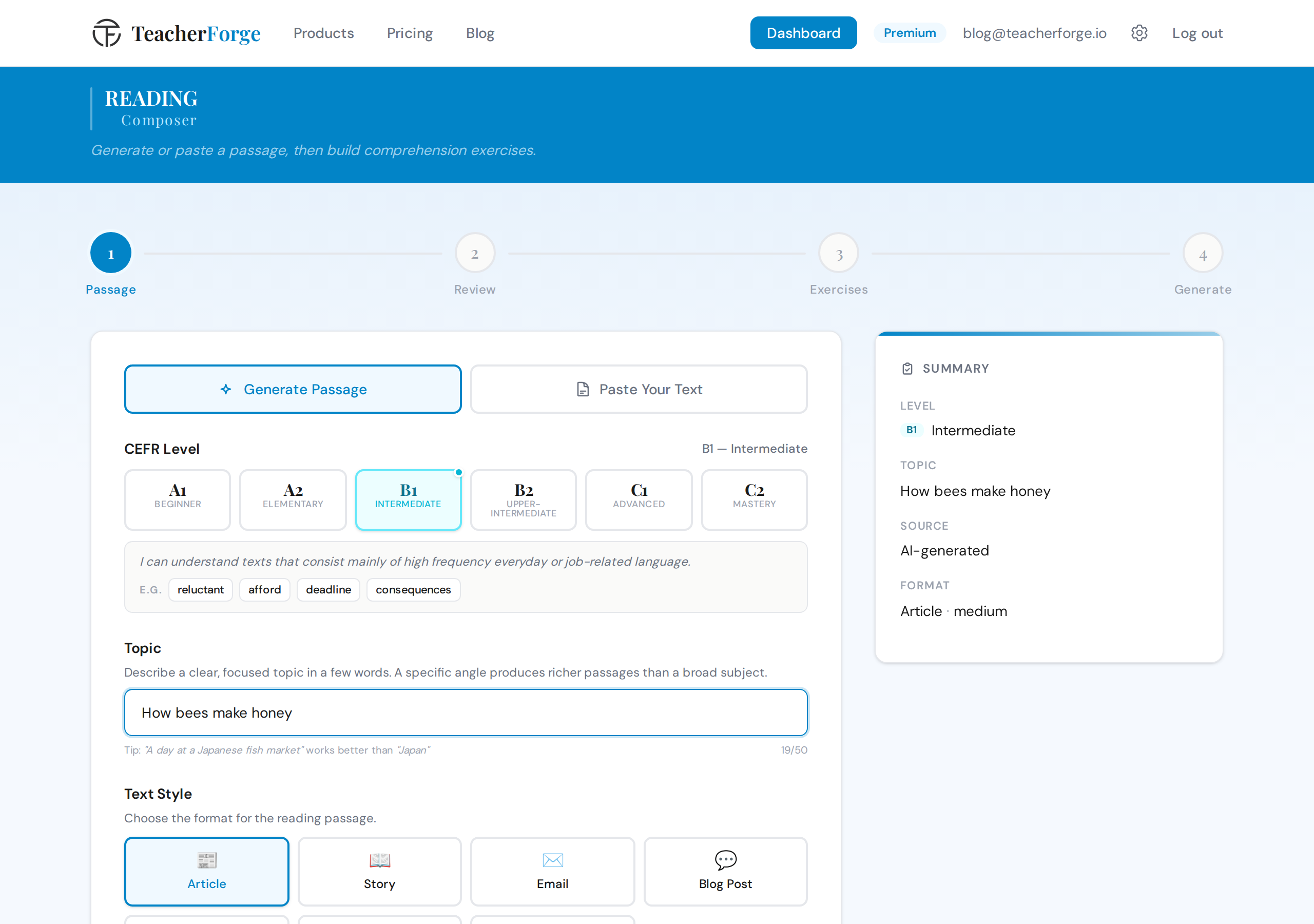
If you already have a text you want to use (from a textbook, a newspaper, a student's email), you paste it instead. The system automatically detects the CEFR level and extracts a topic. You can override both if needed. The exercise pipeline is identical regardless of whether the passage was generated or pasted.
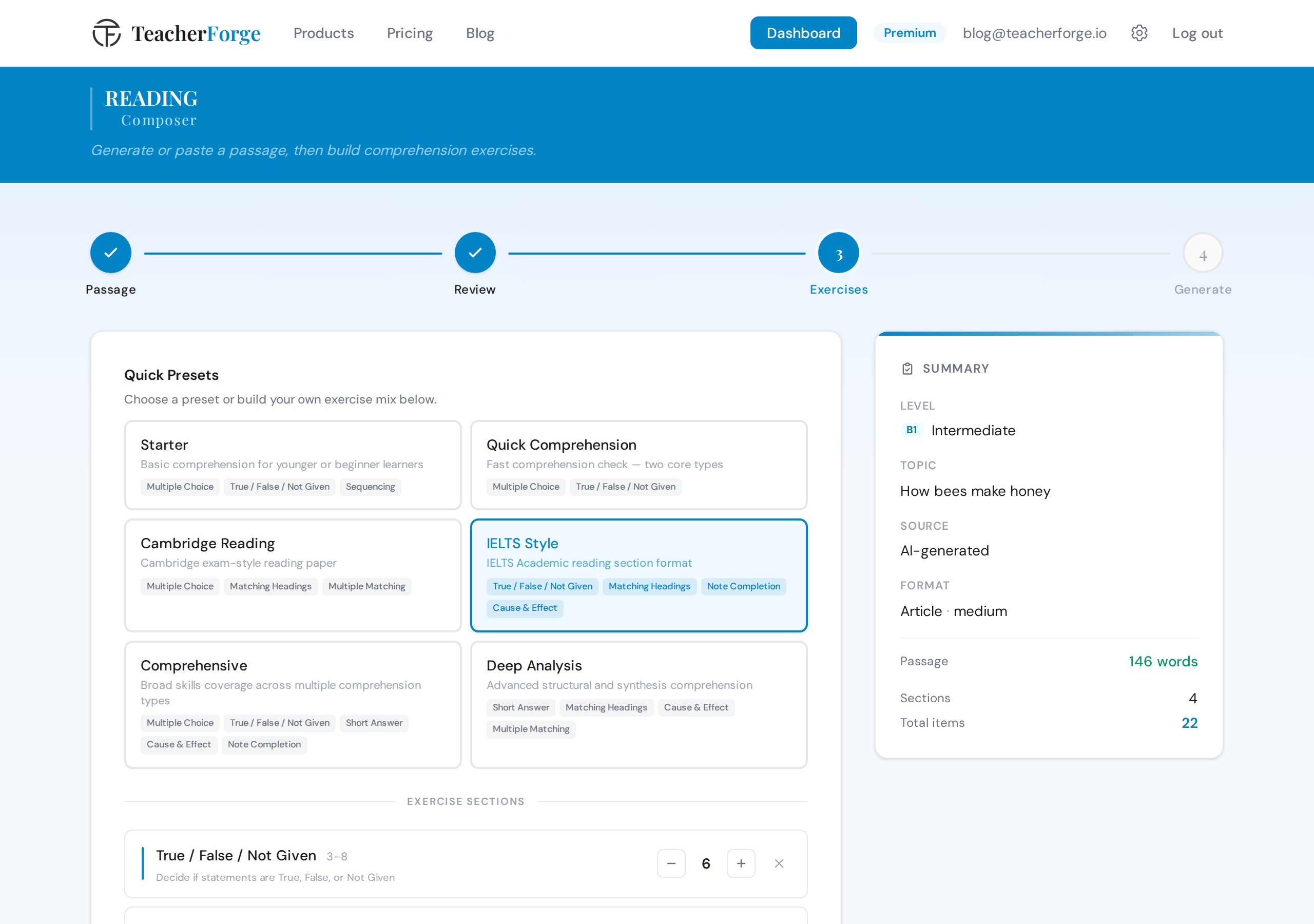
For exercise configuration, the composer first proposes a default worksheet for your level and text style, and you can choose from 5 ready-made presets or build manually. Quick Comprehension (all levels) combines multiple choice and true/false/not given in 10 items. Cambridge Style (B1+) assembles multiple choice and multiple matching across 16 items, at B2 First's own counts. IELTS Style (B1+) uses true/false/not given, matching headings, note completion, and short answer for a 22-item exam-format sheet. If you prefer to build from scratch, you pick from the 8 exercise types and set item counts per section. The system gates advanced types (matching headings, multiple matching, note completion, cause-and-effect) to B1 and above automatically.
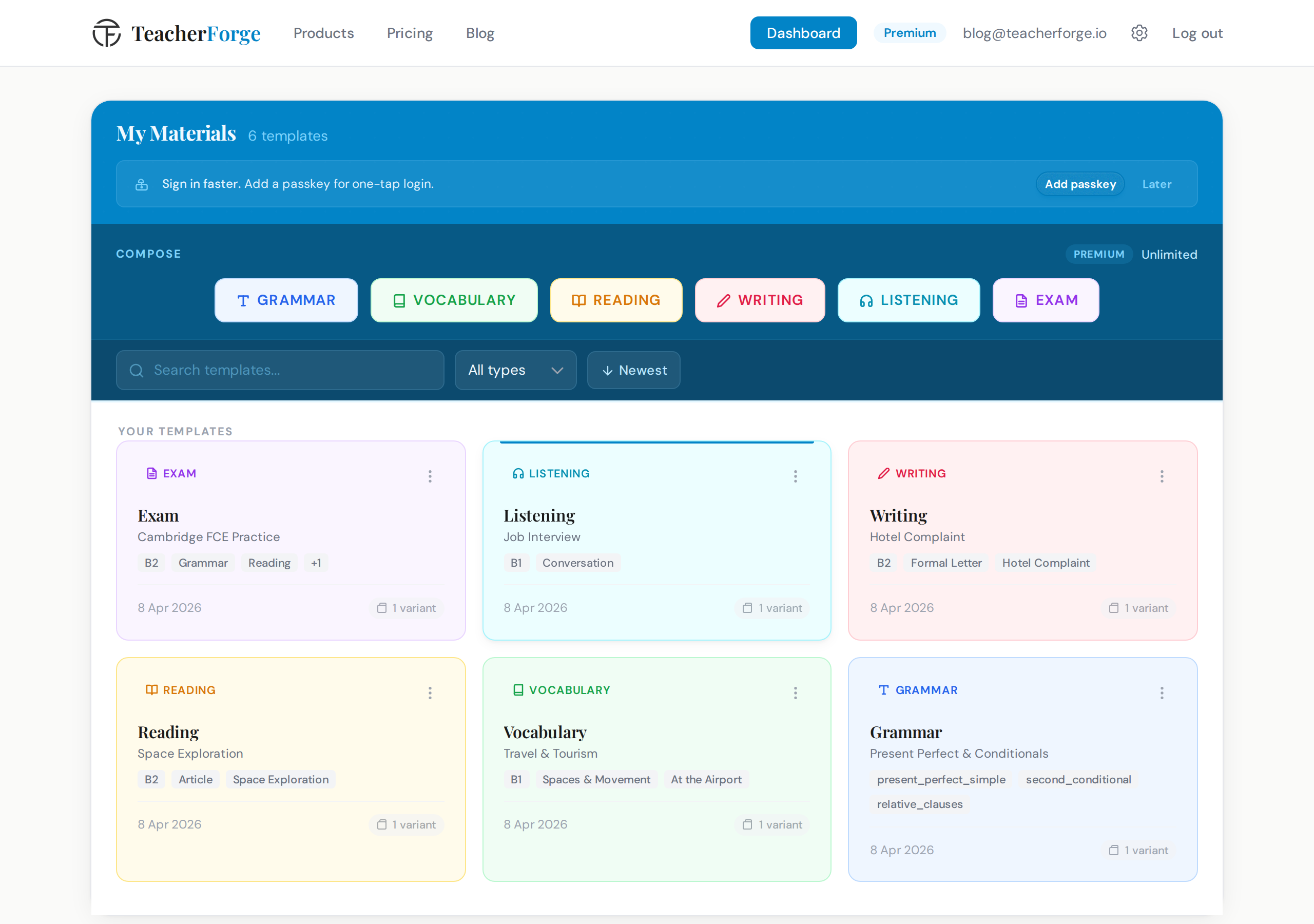
Every generation automatically becomes a template on your dashboard. When you need a fresh worksheet on the same topic and level (for a different class, a resit group, or next term), you choose "Regenerate" from the template card's menu. The configuration is kept; you get a new passage and new questions without starting from scratch.
Output is a print-ready PDF and an editable DOCX, both paired with a complete answer key. After generation, you can adjust the theme, font and page density in the preview, at no extra cost, no regeneration needed.
Further Reading
- How Much Time Do ESL Teachers Spend Creating Materials (and How to Cut It in Half)
- How to Create an ESL Worksheet in 5 Minutes: A Step-by-Step Guide
- Vocabulary Worksheets That Test More Than Definitions: 5 Exercise Types Every Teacher Should Use
Ready to build your next reading comprehension worksheet? Explore the Reading Comprehension Composer or go straight to building: Create a reading worksheet →