Not all reading comprehension worksheets are created equal. A text that challenges a B2 student will overwhelm an A1 learner, but the problem goes deeper than difficulty. The wrong question types at the wrong level are not just hard; they are pedagogically inappropriate. Understanding what changes across CEFR levels helps us design materials that actually develop reading skill rather than just test it.
What the CEFR Reading Descriptors Tell Us
The Common European Framework of Reference describes reading ability in terms of what learners can do, not what they cannot. At A1, a reader "can understand very short, simple texts, reading them one short sentence at a time." By B2, that same reader "can read with a large degree of independence, adapting style and speed of reading to different texts and purposes." At C1, they "can understand in detail lengthy, complex texts, whether or not these relate to their own area of speciality."
These descriptors carry practical implications for every variable in a reading worksheet: text length, vocabulary, sentence structure, topic familiarity, and question type. Change one of these without adjusting the others and the material stops working.
Text Length and Complexity Across Levels
The most visible difference between a well-designed A1 text and a B2 text is word count. A1 and A2 passages should be short and dense with high-frequency vocabulary. Sentences are simple or minimally compound. Topics are concrete and personally familiar: family, food, daily routines, school.
At B1, texts grow longer and begin to include some low-frequency vocabulary. Sentences include subordinate clauses. Topics can extend to familiar social issues, travel, and work. The reader is expected to follow a logical sequence across several paragraphs.
At B2, texts become genuinely argumentative or analytical. Writers express opinions, qualify claims, and use cohesive devices like "however", "consequently", and "in contrast" to signal relationships between ideas. Topic familiarity matters less; B2 readers can engage with unfamiliar subjects provided the language is within range.
At C1 and C2, texts are dense and often domain-specific. Implicit meaning, irony, and nuanced hedging all appear. A C1 reader is expected to infer the author's stance from tone and word choice, not just from explicit statements.
Word Count Ranges as a Practical Guide
As a rough guide, a typical passage length by level looks something like this:
- A1: 120–180 words
- A2: 150–220 words
- B1: 220–320 words
- B2: 300–450 words
- C1: 350–500 words
- C2: 400–550 words
These are typical lengths for a standard worksheet. Drop shorter for absolute beginners, and push longer (up to around 800 words) for exam-prep reading at C1 and C2. They are not rigid rules, but if your B1 passage runs well past 400 words, the cognitive load of sustained reading will interfere with comprehension before the questions even begin.
Vocabulary Density and Abstraction
Vocabulary density refers to the proportion of content words (nouns, verbs, adjectives, adverbs) relative to function words. Academic and technical texts have high lexical density; conversational texts have low density. A1 and A2 texts should sit at the low end: short sentences, common words, minimal nominalisation.
Abstraction is a separate dimension. Concrete nouns ("dog", "table", "rain") are easier to process than abstract ones ("justice", "perception", "momentum"). At A1–A2, nearly all nouns should be concrete. At B1–B2, abstract nouns begin to appear but should be supported by context. At C1–C2, abstract vocabulary is expected and is not scaffolded.
A common mistake in lower-level materials is using simple grammar but slipping in abstract vocabulary. "The government decided to change the policy" is grammatically A2 but lexically B1+. Both dimensions need to match the target level.
Sentence Complexity and Discourse Structure
At A1, sentences are short and paratactic: "She went to the shop. She bought milk. She came home." At A2, basic connectors appear: "She went to the shop and bought milk." At B1, subordination becomes normal: "Although she was tired, she went to the shop because they had run out of milk."
At B2 and above, discourse structure matters as much as sentence structure. Paragraphs develop arguments, concede counterpoints, and use topic sentences. A B2 reader is expected to track the logical structure of a text across paragraphs, not just decode individual sentences.
This is why question types that require paragraph-level understanding are inappropriate below B1. A student who is still processing sentences one at a time cannot be expected to identify the main idea of a paragraph, let alone match it to a heading.
Why Level-Gating Question Types Matters
This is the part that is most often overlooked in worksheet design. Teachers sometimes select question types based on what they like or what they have seen in published materials, without asking whether the cognitive demand of the question type matches the learner's current ability.
Consider matching headings. To complete a matching headings task, a student must: read a paragraph, identify its main idea, hold that idea in working memory, scan a list of headings, evaluate each heading for fit, and select the best match. This requires paragraph-level comprehension, the ability to distinguish main ideas from supporting details, and tolerance for ambiguity when two headings seem plausible.
An A1 student cannot do this. Not because they are unintelligent, but because they are still building the sentence-level decoding fluency that paragraph-level tasks presuppose. Giving them a matching headings task does not stretch them productively; it produces confusion and discourages engagement.
At A1 and A2, the appropriate question types are factual and sequential:
- Multiple choice with clearly stated answers in the text (not requiring inference)
- True/False based on explicitly stated facts
- Sequencing, ordering the events of a story
- Short answer with the answer stated in the text
At B1, inferential question types become appropriate:
- Short answer questions requiring the student to paraphrase or synthesise, a step up from locating the answer
- Note completion, filling a structured summary of key information
- Cause and effect, identifying relationships stated or implied in the text
At B1+, paragraph-level tasks unlock:
- Matching headings, requires paragraph structure (not suitable for dialogues, emails, or letters)
- Multiple matching, matching statements to sections of a longer text
At all levels, True/False/Not Given (three-way, not two-way) is appropriate, but the sophistication of the statements should scale with level. At A1, a "Not Given" item should be clearly absent from the text. At C1, the distinction between "False" and "Not Given" may hinge on a single hedging adverb.
The Sequencing Exception
Sequencing deserves a note. It is excellent for A1–B1 learners because it asks students to demonstrate comprehension through ordering rather than language production. But it stops being useful at B2, where texts are argumentative rather than narrative. You cannot sequence the paragraphs of an opinion essay in the same way you can sequence the events of a story. This is why sequencing is an A1–B1 exercise type, not a universal one.
Text Style and Level Appropriateness
Text style interacts with level in ways that are easy to miss. An email is a natural choice for A2: it is short, personal, and has a clear communicative purpose. A report is a natural choice for B2: it is structured, formal, and analytical. A news report or lecture transcript suits C1 learners who need practice with dense, impersonal prose.
Style also affects which question types are valid. A dialogue has no paragraphs, so matching headings cannot apply. Cause-and-effect questions need a text that explains what causes what, which is why they suit stories and articles rather than letters or emails. Matching the text style to the level and the question types to the text style is the full design challenge.
That constraint is enforced rather than left to memory on the reading comprehension worksheets page: the eight question types are gated by level and by text style, so sequencing stops being offered above B1 and matching headings never appears on a dialogue.
Practical Tips for Designing Level-Appropriate Reading Worksheets
-
Start with the CEFR descriptor, not the text. Before selecting or writing a passage, write down what your students can do according to the CEFR. Then find or write a text that sits just above that baseline.
-
Count words before you choose question types. If your passage is 120 words, you cannot write 8 short-answer questions without most of them overlapping or being trivial.
-
Check vocabulary with a word frequency tool. Paste your text into a frequency analyser and flag any words outside the top 2,000 for A1–A2, or top 5,000 for B1–B2. Decide whether each one is worth teaching or worth replacing.
-
Limit inferential questions at A1–A2. Every question should have a clear, locatable answer in the text. If you find yourself writing answer key notes like "implied by paragraph 3", the question is too advanced for A2.
-
Use True/False/Not Given at all levels, but calibrate the statements. At lower levels, make the "Not Given" items obviously absent. At higher levels, use statements that paraphrase the text closely enough that students must read carefully to distinguish "False" from "Not Given".
-
Match text style to purpose. If you are teaching B1 students to write emails, give them an email to read first. If you are preparing C1 students for academic writing, expose them to reports and articles, not dialogues.
-
Pilot one question type at a time. When introducing a new question type (e.g. note completion for the first time with a B1 class), scaffold it explicitly. Show students what a completed example looks like before asking them to attempt it independently.
How to Create Level-Appropriate Reading Worksheets with TeacherForge
Building a reading worksheet that respects all of these variables by hand takes time. Choosing a passage, checking its level, writing questions, verifying that question types match the CEFR level, formatting the answer key: it is a 45-minute task at minimum, and longer if you are writing from scratch.
The Reading Comprehension Composer handles the level-gating automatically. When you select a CEFR level, the exercise type menu only shows the types appropriate for that level. Sequencing appears for stories at A1–B1 and disappears at B2. Matching headings, multiple matching, note completion, and cause and effect unlock at B1+, and cause and effect is offered on stories and articles only. You cannot accidentally assign a C1-level task to an A2 class because the interface does not offer it.
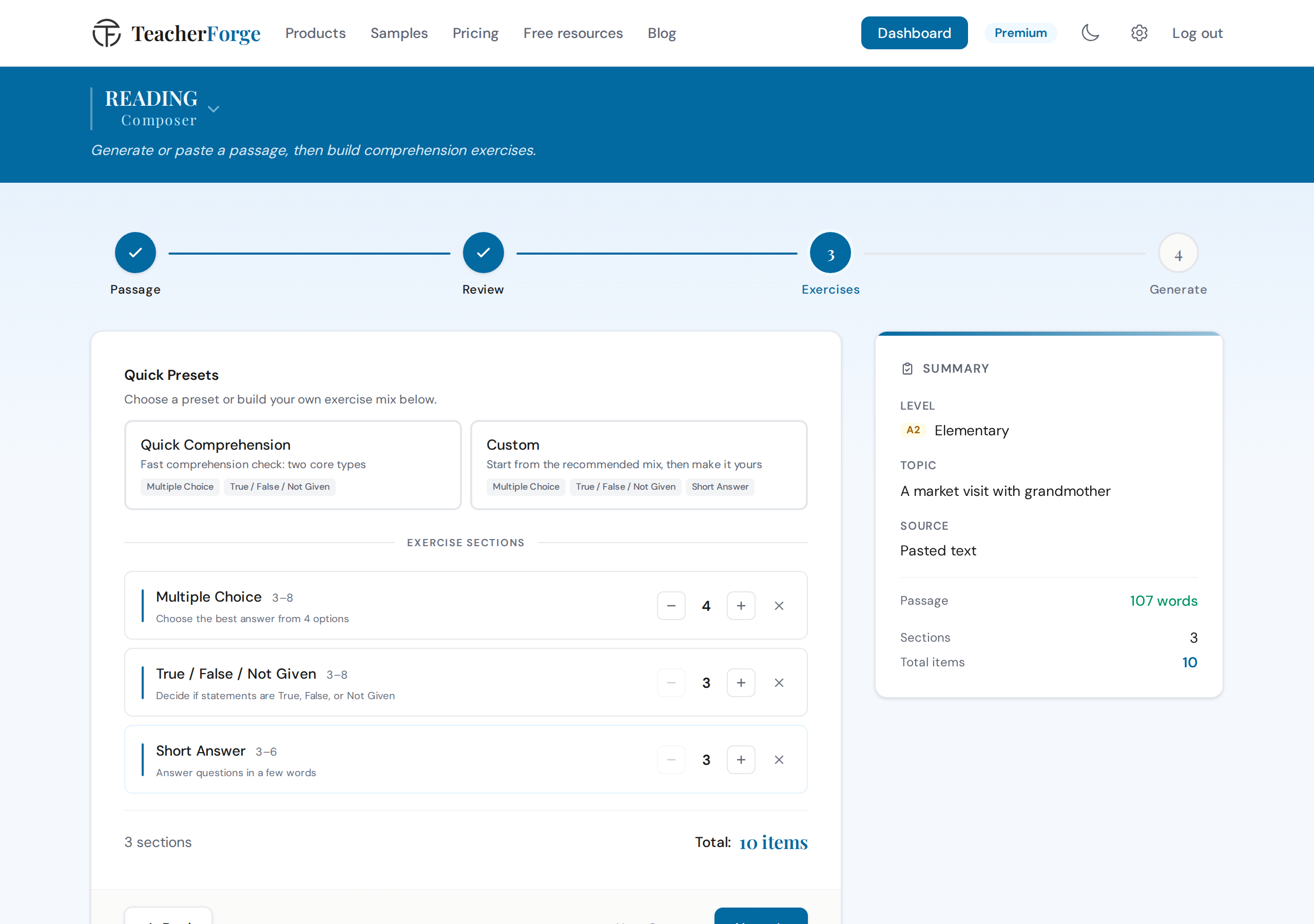
The composer also offers 7 text styles: article, story, email, blog post, letter, dialogue, and report. Each is rendered with authentic formatting. An email includes from, to, and subject fields. A dialogue uses named speakers with turn-by-turn formatting. This matters because students need to practise reading in the formats they will encounter in real life and in exams.
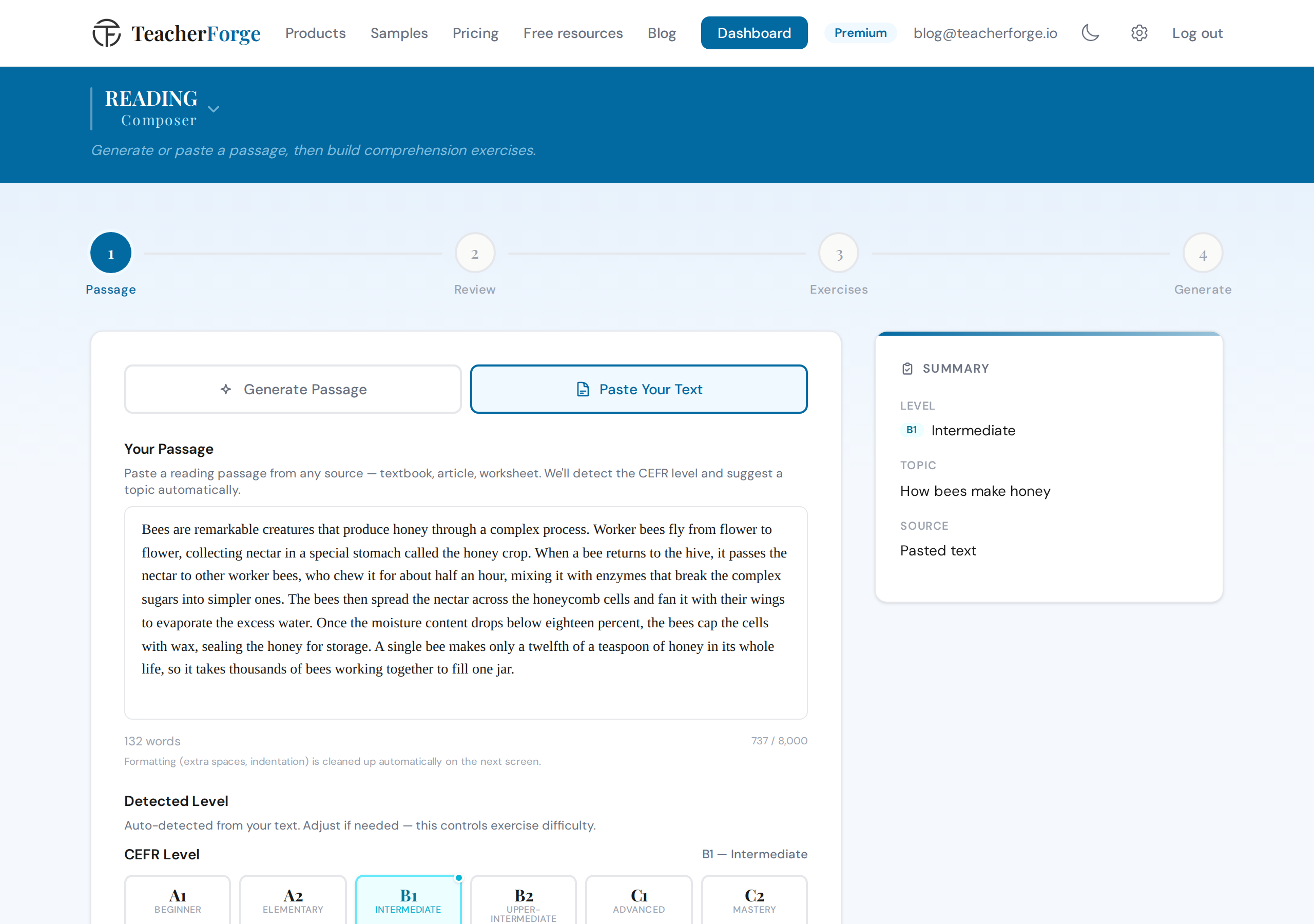
If you already have a text you want to use, such as an excerpt from a coursebook, a news article, or a student's own writing, you can paste it directly into the composer. The system automatically detects the CEFR level and extracts a topic. You can override the detected level if needed, and then the same level-gated exercise pipeline applies. This means your own materials get the same structural rigour as AI-generated ones.
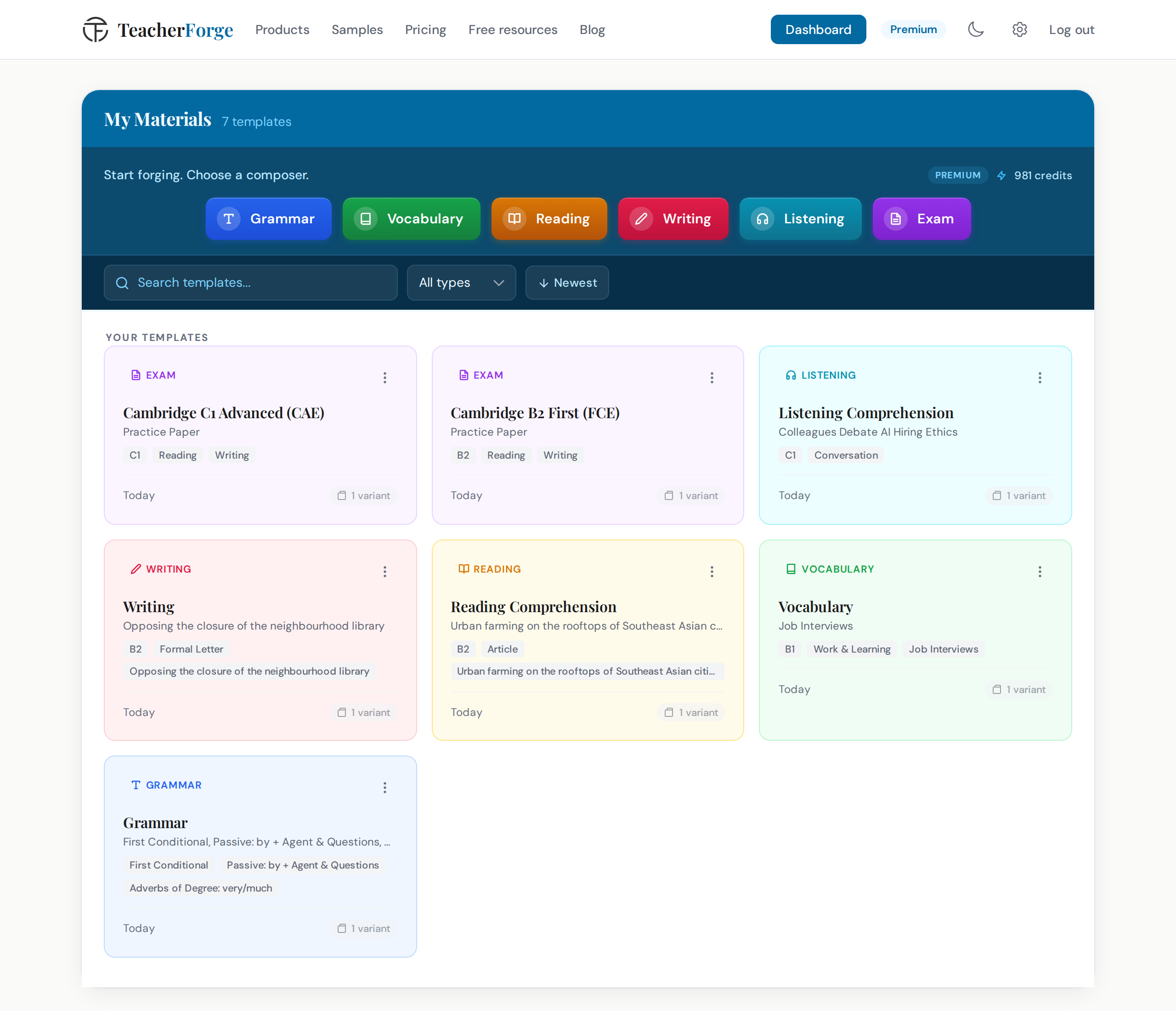
Every worksheet you generate automatically becomes a reusable template on your dashboard. When you need a fresh version of the same configuration, perhaps a new passage on the same topic at the same level with the same question types, you choose "Regenerate" from the template card's menu. No re-setup needed.
Connecting the Variables
Level-appropriate reading comprehension is not one decision; it is five decisions made in concert: text length, vocabulary density, sentence complexity, topic familiarity, and question type. Get one wrong and the material stops working, even if the others are right.
The CEFR gives us a principled framework for making all five decisions consistently. The key is treating it as a design constraint rather than a label you attach after the fact.
For a broader look at how to match reading materials to your students' level in practice, see How to Create Reading Comprehension Worksheets That Match Your Students' Level. If you are thinking about how reading fits into a full multi-skill assessment, How to Build a Multi-Skill English Exam From Scratch walks through the design process from start to finish.
Ready to build a reading worksheet that is right for your class's level? Try the Reading Comprehension Composer →