One of the most common questions new ESL teachers ask is: "What grammar should I actually be teaching at this level?" It sounds simple, but the answer requires understanding not just what structures exist, but why they appear when they do. The Cambridge English Profile and the Council of Europe's Common European Framework of Reference (CEFR) provide the authoritative answer, and this article turns that research into a practical, scannable reference you can return to every time you plan a new term.
Bookmark this page. It is designed to be used repeatedly, not read once.
Why Grammar Sequencing Matters
Grammar scope and sequence is not arbitrary. Structures are introduced at specific CEFR levels because of two converging factors: functional need and cognitive readiness.
Functional need means the learner genuinely requires that structure to accomplish communicative goals at their stage. A1 learners need to say who they are and what they do; present simple serves that purpose directly. C1 learners need to argue, persuade, and express nuanced stance; inversion and advanced modality serve those goals.
Cognitive readiness means the learner has enough prior grammar knowledge to process the new structure without overload. You cannot teach the third conditional meaningfully to someone who has not yet internalised the past simple. Sequence matters because grammar builds on itself.
The descriptions below draw on the Cambridge English Profile corpus research and the Council of Europe's CEFR illustrative descriptors. They are not exhaustive, but they cover the core structures that define each level.
A1: Foundations for Communication
At A1, learners are building the absolute minimum grammar needed to introduce themselves, describe immediate surroundings, and handle very basic transactions.
Core structures:
- Present simple (I live, she works, they have)
- Subject pronouns and basic possessives (my, your, his)
- Indefinite and definite articles (a/an, the)
- Basic prepositions of place and time (in, on, at)
- Singular and plural nouns (regular forms)
- Yes/no questions and short answers
- "There is / there are"
Why here? These structures are the grammar of identity and immediate reality. A1 learners need to name things, locate them, and make simple true/false claims about the world around them. Articles, though notoriously difficult for speakers of article-free languages, must be introduced early because they appear in almost every English sentence.
Common teaching mistake: Rushing to verb tenses before articles and prepositions are stable. Shaky foundational grammar creates fossilised errors that persist through B2 and beyond.
A2: Expanding Into the Past and Comparison
A2 marks the point where learners begin to talk about events outside the present moment and start comparing things. This is a significant cognitive step.
Core structures:
- Past simple (regular and high-frequency irregular verbs)
- Comparative and superlative adjectives (bigger, the biggest)
- Modal verbs of ability and permission (can, could, may)
- Future with "going to" and present continuous for future arrangements
- Adverbs of frequency (always, usually, sometimes, never)
- Countable and uncountable nouns with quantifiers (some, any, much, many)
- Basic conjunctions (and, but, because, so)
Why here? The ability to narrate past events is the single biggest communicative leap between A1 and A2. Once learners can say what happened, they can participate in social interaction at a meaningful level. Comparatives appear because A2 learners need to make choices and express preferences, which requires comparison. Modals of ability allow learners to describe their own skills and ask for permission, both high-frequency real-world functions.
Sequencing note: The Cambridge English Profile corpus shows that "going to" future appears significantly more frequently than "will" in A2 learner output, reflecting the emphasis on planned, concrete future events at this stage.
B1: The Independent User Threshold
B1 is the Council of Europe's "independent user" threshold. Learners at this level can handle most everyday situations and express opinions, but they need the grammar to do it with accuracy and nuance.
Core structures:
- Present perfect (experience, recent past, unfinished time)
- First conditional (real, possible situations)
- Second conditional (hypothetical, unlikely situations)
- Passive voice (present and past simple passives)
- Reported speech (basic backshift with say and tell)
- Modal verbs of deduction and obligation (must, should, might, have to)
- Relative clauses (defining, with who/which/that)
- Time clauses (when, while, after, before, until)
Why here? The present perfect is perhaps the most pedagogically significant arrival at B1. It requires learners to hold two time frames simultaneously (past action, present relevance) and to distinguish it from the past simple, a distinction that does not exist in many languages. This is a cognitive readiness issue as much as a linguistic one.
Conditionals follow naturally: first conditional requires present simple and "will", both already known; second conditional requires past simple and "would", extending existing knowledge. The passive voice becomes necessary because B1 learners encounter more formal and academic texts where it is common.
Common teaching mistake: Treating the present perfect as "just another tense" without spending sufficient time on the contrast with past simple. This contrast is the single most tested B1 grammar point in Cambridge examinations.
B2: Upper Intermediate Complexity
B2 learners can interact with native speakers with a degree of fluency and spontaneity. The grammar at this level reflects that: structures become more complex, and learners begin working with discourse-level cohesion.
Core structures:
- Third conditional (past hypothetical)
- Mixed conditionals (past condition, present result and vice versa)
- Reported speech (full range: questions, commands, suggestions)
- Advanced passive constructions (continuous, perfect, modal passives)
- Wish and if only (present and past regrets)
- Gerunds and infinitives (full range, including complex cases: remember doing vs. remember to do)
- Quantifiers and determiners (advanced: few/a few, little/a little, both/either/neither)
- Discourse markers and cohesion devices (however, nevertheless, in contrast, as a result)
Why here? The third conditional requires learners to manipulate three verb forms simultaneously (past perfect + would have + past participle) and to reason about counterfactual past events. This is a significant cognitive load and requires stable past perfect knowledge, which is why it sits at B2 rather than B1.
Mixed conditionals are the natural extension: once learners understand both second and third conditionals as separate systems, they can combine them to express more nuanced relationships between past and present. Discourse markers arrive at B2 because learners are now producing extended text (essays, reports, arguments) and need tools to organise it.
C1: Advanced Control and Pragmatic Precision
C1 learners can express themselves fluently and spontaneously without much obvious searching for expressions. The grammar at this level is less about new structures and more about expanding the range of existing ones and developing stylistic control.
Core structures:
- Inversion for emphasis (Not only did she..., Rarely have we seen...)
- Cleft sentences (It was the teacher who..., What I need is...)
- Advanced modality (would for past habits, should have done, needn't have done)
- Subjunctive in formal/fixed expressions (I suggest that he be informed, It is essential that she attend)
- Ellipsis and substitution (I think so, I hope not, so do I)
- Participle clauses (Having finished the report, she..., Seen from a distance,...)
- Nominalization (the development of, a reduction in)
Why here? Inversion and cleft sentences are not new information structures; they are emphasis and focus devices. Learners at C1 have the communicative competence to choose between "She never spoke to him again" and "Never again did she speak to him" based on stylistic effect. That choice requires both structural knowledge and pragmatic awareness.
Nominalisation is particularly important for academic and professional English. The ability to convert verb phrases into noun phrases ("the government decided" becomes "the government's decision") is a defining feature of formal written English and a key target for C1 learners in academic contexts.
C2: Mastery and Discourse-Level Grammar
C2 represents mastery: the ability to understand virtually everything heard or read and to express oneself spontaneously, very fluently, and precisely. Grammar at this level is not about learning new rules but about complete control of the full system, including rare forms, register variation, and discourse organisation.
Core structures:
- Full subjunctive range (were to, as if/as though + past, formal mandative subjunctive)
- Advanced discourse connectors and hedging language (to the extent that, insofar as, it could be argued that)
- Stylistic inversion beyond fixed phrases (flexible, creative use)
- Register-appropriate grammar choices (knowing when to use passive, nominalisation, or formal subjunctive)
- Pragmatic grammar: implicature, understatement, irony through grammatical choice
- Complex noun phrases and pre-modification (e.g. a recently published, peer-reviewed study)
Why here? The distinction between C1 and C2 is largely one of automaticity and range rather than new structural knowledge. A C2 learner does not just know the subjunctive; they deploy it naturally in the appropriate register without conscious effort. They can shift between formal and informal grammar registers within a single conversation or text, and they understand the pragmatic implications of those choices.
For teaching purposes, C2 work is often less about drilling structures and more about exposure to authentic text, stylistic analysis, and developing meta-linguistic awareness.
A Quick Reference Summary
| Level | Defining Structures |
|---|---|
| A1 | Present simple, articles, basic prepositions, there is/are |
| A2 | Past simple, comparatives, modals of ability, going to future |
| B1 | Present perfect, conditionals 1 & 2, passive voice, relative clauses |
| B2 | Third conditional, mixed conditionals, reported speech, wish/if only |
| C1 | Inversion, cleft sentences, advanced modality, participle clauses |
| C2 | Full subjunctive, discourse grammar, register control, pragmatic precision |
Search any structure in this table in the 300-tag curriculum behind the ESL grammar worksheets generator, and the ones it covers become a printable worksheet without you rebuilding the sequence by hand.
Practical Tips for Using This Scope and Sequence
Knowing the framework is one thing. Applying it to a real class is another. Here are five ways to use this reference in your planning.
-
Audit your current syllabus. Map your existing materials against this framework. If you are teaching B1 students but have not yet covered the present perfect vs. past simple contrast, that is a gap worth addressing before moving to B2 content.
-
Use it for diagnostic placement. When a new student joins mid-term, a quick grammar diagnostic built around the structures at their claimed level will tell you whether they belong there. Gaps in B1 structures in a student claiming B2 are a reliable signal.
-
Plan backwards from an exam target. If your students are sitting Cambridge B2 First in six months, work backwards from the B2 column to identify which structures need consolidation versus which need introduction.
-
Sequence mixed-level classes. In a mixed A2/B1 class, teach past simple and present perfect in the same unit. A2 students consolidate past simple; B1 students extend to the contrast. The same content serves both groups at different depths.
-
Use it to justify your choices to students. Learners often ask "why are we doing this?" Being able to explain that reported speech is a B2 structure they will need for Cambridge exams or professional communication gives grammar practice a purpose beyond the exercise on the page.
How TeacherForge's Grammar Composer Uses This Framework
Building a grammar worksheet that accurately reflects CEFR scope and sequence is harder than it looks. You need to know which structures belong at which level, which exercise types suit each structure, and how to combine multiple grammar points without the worksheet becoming incoherent.
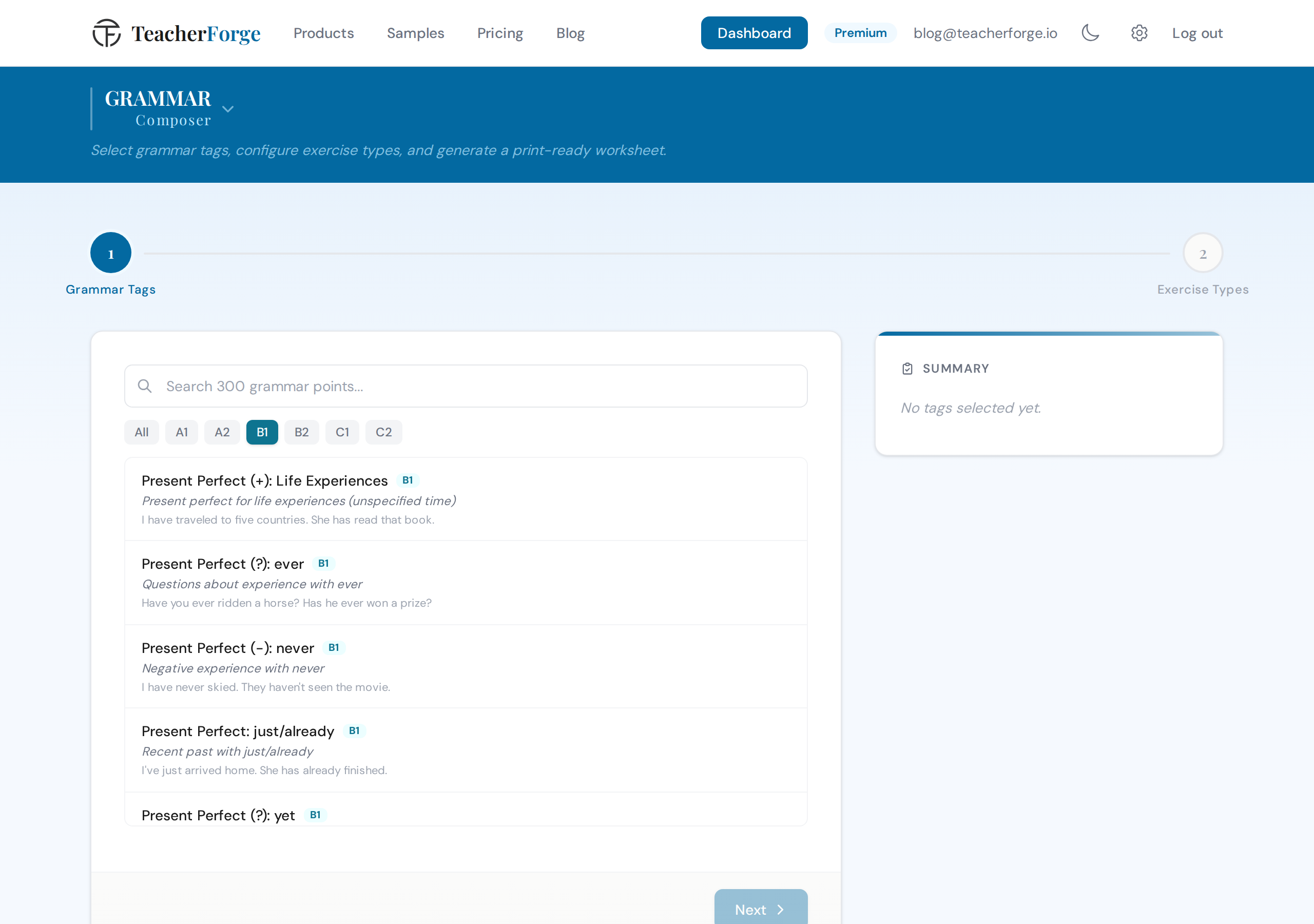
TeacherForge's Grammar Composer is built on a 300-point CEFR grammar curriculum. Each tag in that curriculum is tied to a specific CEFR level and displays a human-readable label, the grammar rule, and an example sentence. You search the curriculum directly, not a chatbox. If you want to build a B1 worksheet on present perfect and first conditional, you search for those tags, select them, and the system builds from there.
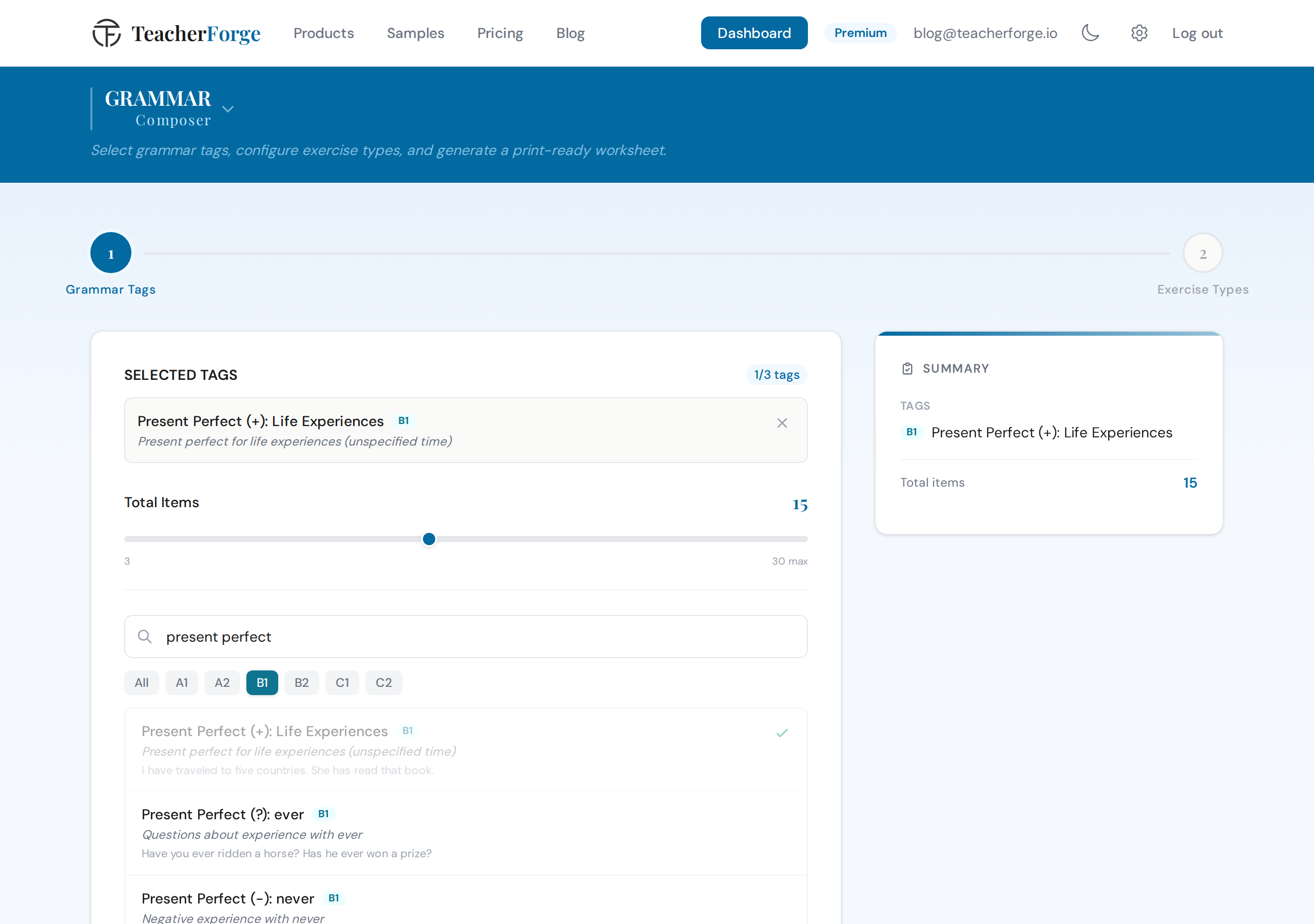
One of the most common frustrations with generic AI tools is receiving exercises that do not fit the structure. You ask for a sentence transformation exercise on articles and get something that would work better as a gap fill. TeacherForge avoids this through a compatibility matrix: a static mapping of which exercise types work with which grammar tags. If sentence transformation does not suit the structure you have selected, it simply does not appear as an option. You can choose from 9 exercise types across the Grammar Composer (gap fill, open cloze, multiple choice, error correction, word ordering, sentence transformation, true/false, sentence completion, and select and combine), but only the ones that genuinely suit your chosen tags.
The ZIP download of every grammar worksheet also includes textbook-quality grammar reference notes covering the selected grammar points. These are professionally designed PDFs spanning A1 to C2, with explanations, formula boxes, annotated examples, conjugation tables, and common mistake warnings. They are bundled automatically inside the ZIP download at no extra cost. Print them as classroom handouts or share them digitally before the lesson.
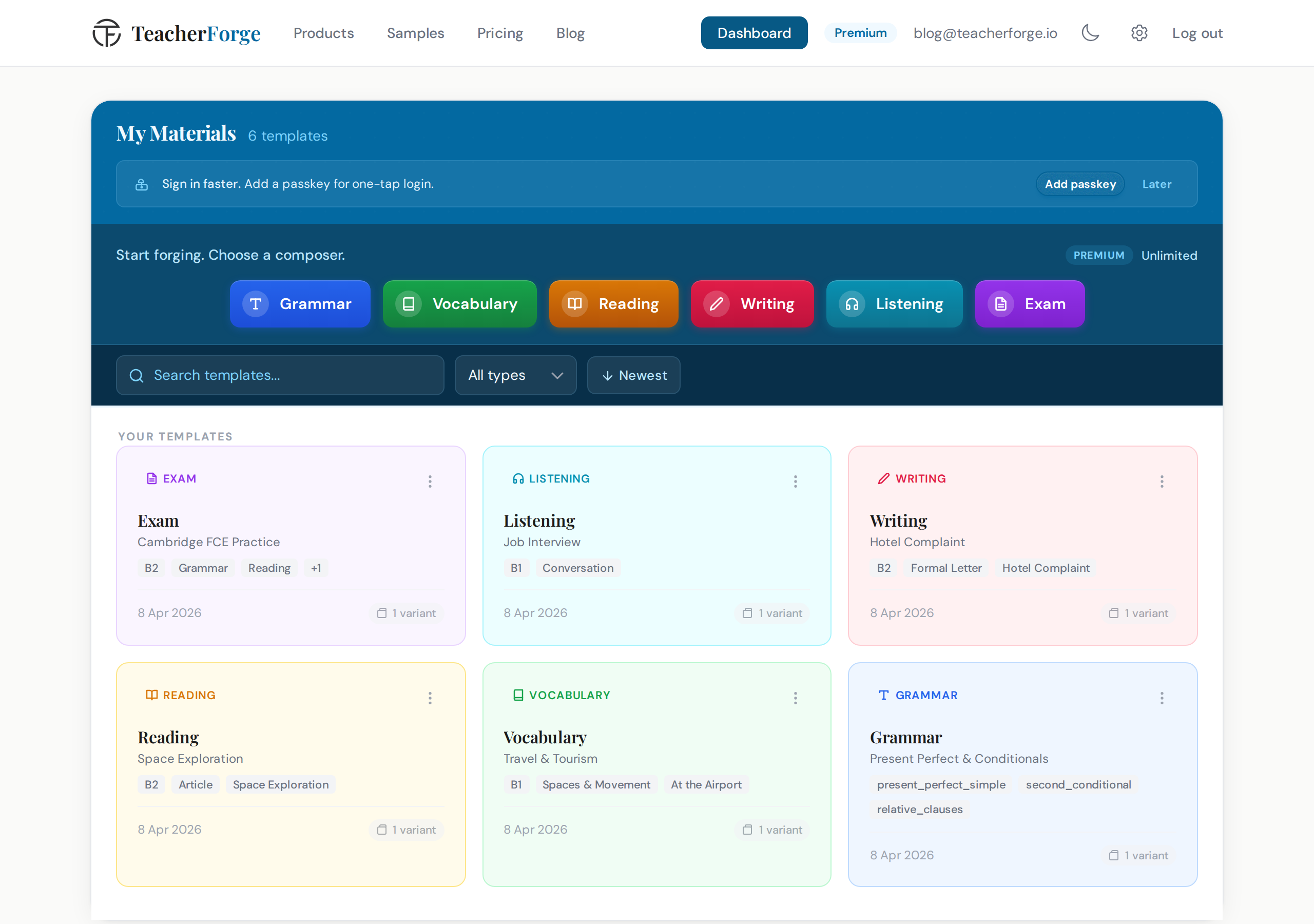
From your dashboard, every worksheet you generate automatically becomes a reusable template. When you need a fresh set of exercises on the same grammar points for a different class or a retake group, choose "Regenerate" from the template card's menu and the system produces new items with the same configuration. No re-setup needed.
Learn more about the Grammar Composer and the exercise types it supports at TeacherForge Grammar.
Further Reading
If you found this scope and sequence useful, these articles go deeper on related topics:
- Grammar Worksheets Beyond Gap Fill: 9 Exercise Types That Test What Students Actually Know
- How Config-First Generation Gets ESL Worksheets Right the First Time
- How to Build a Multi-Skill English Exam From Scratch (Without Losing Your Weekend)
Ready to build your first CEFR-aligned grammar worksheet? Try the Grammar Composer →