ESL Writing Tasks for B1–B2: Prompts, Planning, and Model Answers
Discover the 7 writing task types at B1–B2, what each one tests, and how a complete ESL writing task goes beyond the prompt to include planning checklists, language support, and model answers.
B1–B2 is the level where writing instruction gets genuinely demanding. Students have moved beyond filling gaps and copying sentences. Now they need to argue a position, write to an unknown reader, control register, and sustain a piece of extended writing across 150–250 words. The gap between what a student can say and what they can write coherently becomes very visible here.
For teachers, that means the humble writing prompt is no longer enough. A prompt tells students what to write. It does nothing to help them plan, select appropriate language, or understand what success looks like. This article walks through the seven task types relevant at B1–B2, explains what each one tests, and then looks at what a genuinely complete writing task package should contain.
The Seven Task Types at B1–B2
Not every task type is appropriate at every level. The CEFR descriptors make clear distinctions between what a B1 learner can produce (simple, connected text on familiar topics) and what a B2 learner can do (clear, detailed text on a wide range of subjects, showing awareness of the reader). The task types below reflect that progression.
Essay
The essay asks students to argue a position, weigh up two sides of a question, or discuss a statement. It is available from B1 upward. What it tests is not just vocabulary range but the ability to structure an argument: thesis, supporting points, counterargument, conclusion. Students at B1 typically struggle with the counterargument step. They present one view confidently and then abandon structure when they have to acknowledge the other side. At B2, the challenge shifts to coherence across the whole piece: topic sentences, paragraph unity, and a conclusion that adds something rather than merely repeating the introduction.
Formal Letter
A formal letter might be a complaint, an application, or a request. It is offered from B1. The primary skill being tested is register awareness: knowing that "I am writing to express my dissatisfaction" belongs here and "I just wanted to say I wasn't happy" does not. Students find this difficult because register is not a rule they can memorise. It is a feel for the relationship between writer and reader. Formulaic opening and closing phrases help, but students also need to control the tone of every sentence in between.
Report
A report (B1+) asks students to present information, findings, or recommendations in a structured, objective format. It typically uses headings, bullet points, and impersonal constructions. What trips students up is objectivity: they default to personal opinion phrasing ("I think the facilities are poor") rather than distanced language ("The facilities were found to be inadequate"). The structure itself is also unfamiliar; most students have written essays but few have written anything with sub-headings before.
Review
A review (A2+, though it becomes substantive at B1–B2) requires students to give an informed opinion with supporting evidence. A restaurant review, a film review, a book review. The test is not whether the student liked the thing but whether they can explain why, with specific detail, and reach a recommendation. The common failure mode is vagueness: "The film was very interesting and I enjoyed it." B2 students need to produce evaluative language with precision.
Article
An article (B1+) is written for a specific publication and reader. Unlike an essay, it is allowed to be engaging, even entertaining. It can use rhetorical questions, direct address, and a more personal voice. Students often struggle with the transition from essay-mode to article-mode because school writing has trained them to be impersonal. Teaching them to open with a hook rather than a statement of intent is often the first hurdle.
Informal Letter
The informal letter (available at all levels, but tested seriously at B1–B2) is the register mirror image of the formal letter. Here the challenge is not being too casual but being appropriately warm and natural without losing coherence. Students at B2 are expected to handle a range of functions within a single letter: giving news, asking questions, making suggestions, and responding to something the imaginary friend said. Holding all of that together in a natural-sounding flow is harder than it looks.
Story
The story (available at all levels) tests narrative structure: a clear beginning, a complication, a resolution, and some sense of atmosphere or character. At B1–B2, the expectations shift toward narrative variety. Simple past throughout is not enough; students need past continuous for background, past perfect for flashback, and direct speech to bring scenes alive. Pacing is the other challenge: many students use half their word count on the setup and rush the ending.
Those availability rules are not advisory. On the writing task generator each task type is gated to the levels it suits, so an essay cannot be set below B1 and the word range moves with the level and task type you pick.
What Students Actually Need to Succeed
Here is the uncomfortable truth about most writing tasks set in ESL classrooms: the teacher writes a prompt, hands it out, and hopes for the best. The students stare at the page, produce something vaguely on topic, and get it back with corrections they do not know how to apply next time.
The problem is not the students. It is the task design.
A well-designed writing task at B1–B2 has five components, not one.
1. A Scenario-Specific Prompt
Not "Write a formal letter of complaint" but "You recently stayed at the Riverside Hotel in Edinburgh for a conference. The room was not as described on the website, the Wi-Fi did not work, and the breakfast was not included as promised. Write a formal letter to the hotel manager." The specificity matters because it gives students something concrete to write about. Vague prompts produce vague writing.
2. A Planning Checklist
A planning checklist is task-type-specific. For an essay, it might read: identify your position, draft a thesis statement, list two supporting arguments, note a counterargument and your response, plan your conclusion. For a review, it looks completely different: identify the subject, list three specific things to evaluate, decide on your overall recommendation, plan your opening hook.
This is not hand-holding. It is teaching students how writers think before they write. Research on L2 writing consistently shows that planning time improves both fluency and accuracy. Giving students a structured planning framework is one of the highest-leverage things a teacher can do.
3. A Useful Language Box
A language box provides CEFR-calibrated phrases grouped by communicative function. For a B2 essay, that might mean:
- Giving opinions: "It could be argued that...", "There is a strong case for..."
- Conceding a point: "While it is true that...", "Although some would argue..."
- Concluding: "On balance, it seems clear that...", "Taking everything into account..."
This component is the one teachers spend the most time on when they build tasks manually, and it is the one most often skipped when time is short. Without it, students recycle the same three connectors ("firstly", "secondly", "in conclusion") regardless of task type.
The language box also serves a diagnostic function: if a B2 student is not using any of the B2-level phrases from the box, that is useful feedback in itself.
4. Assessment Criteria
Students write better when they know what they are being assessed on. For B1–B2 writing tasks aligned to Cambridge conventions, the four criteria are: Content, Communicative Achievement, Organisation, and Language. Each criterion needs level-appropriate band descriptors, not generic statements like "uses a range of vocabulary" but something a student can actually act on: "Uses a range of vocabulary including less common items, with only occasional errors that do not impede communication."
Sharing the criteria before the task, not just when returning marked work, changes how students approach the writing.
5. A Model Answer
A model answer at the target level shows students what success looks like. It is not a template to copy; it is a reference point. Teachers can use it for annotation tasks ("find the counterargument", "underline the formal register markers"), for comparison with student work, or simply as a reading text that demonstrates the task type in action.
Practical Steps for Your Next Writing Class
-
Choose the task type deliberately. Match it to what your students need to practise, not just what is coming up in the coursebook. If your B2 class struggles with register, a formal letter is more useful than another essay.
-
Write a scenario, not a topic. Give the student a role (who they are), a recipient (who they are writing to), a purpose (why), and a context (what happened). Four details, not four sentences.
-
Build the planning checklist before the lesson. Walk students through it as a pre-writing activity. Ten minutes of structured planning reduces the number of off-topic or poorly organised responses significantly.
-
Curate your language box by function, not by level label. Group phrases by what they do (contrast, concede, recommend, evaluate) rather than listing them as "B2 phrases". Students need to know when to use something, not just that it is advanced.
-
Give students the assessment criteria on the task sheet. Not as a rubric to fill in, but as a short list of what you are looking for. It shifts the student's attention from "finishing" to "achieving".
-
Use the model answer after writing, not before. Students who read the model first produce imitations. Students who write first and then compare with the model learn more.
How to Create This with TeacherForge
Building all five components manually takes time, often an hour or more for a single task. The Writing Task Composer at TeacherForge generates all five in a single step: the scenario-specific prompt, the planning checklist, the useful language box, the assessment criteria, and the model answer.
The composer starts with CEFR level and task type. At B1–B2, all seven task types are available: essay, formal letter, informal letter, report, review, article, and story. You type a topic (or click one of the suggested topic chips for that task type and level) and then choose between two configuration modes.
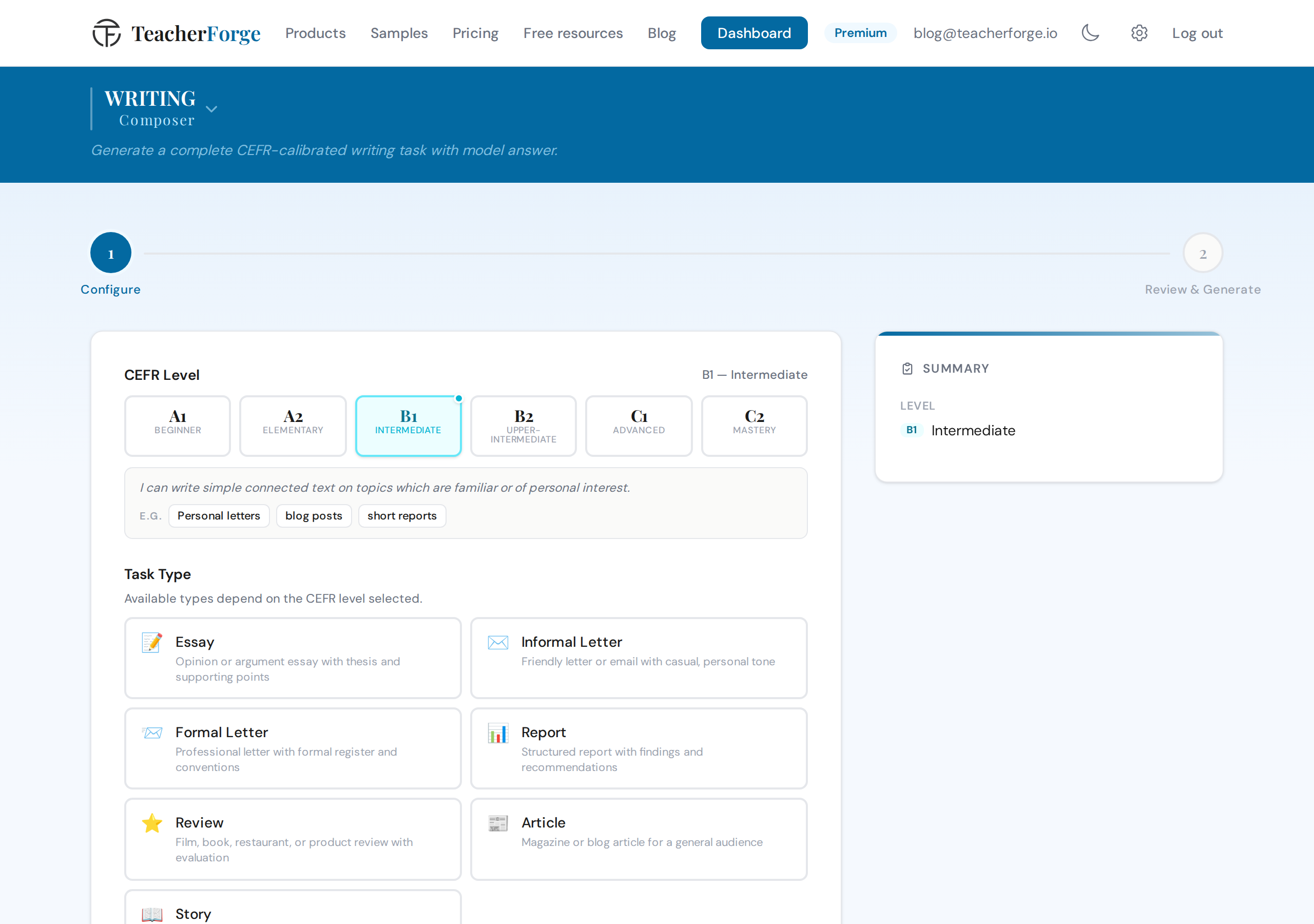
Cambridge Standard mode is available for essay, formal letter, report, review and article from B1. It enables all five output components and sets four task-specific criteria: Content, Organisation and Language, plus one named for the genre (Argument & Persuasion for an essay). For a B2 First class, the Exam Composer's B2 First preset sets the paper's own writing tasks, marked on Cambridge's four criteria: Content, Communicative Achievement, Organisation and Language.
Custom mode lets you toggle individual components on or off and choose between task-specific criteria and generic CEFR descriptors.
The useful language box, the component that takes longest to build manually, is generated with phrases grouped by communicative function and calibrated to the target CEFR level. A B1 essay box and a B2 essay box will contain different phrases, not just more of the same.
The student worksheet contains the prompt, the planning checklist, the useful language box, and a writing space. The teacher's answer key adds the assessment criteria and the model answer. Both download as PDF and DOCX, so you can print immediately or edit the model answer before sharing it with students.
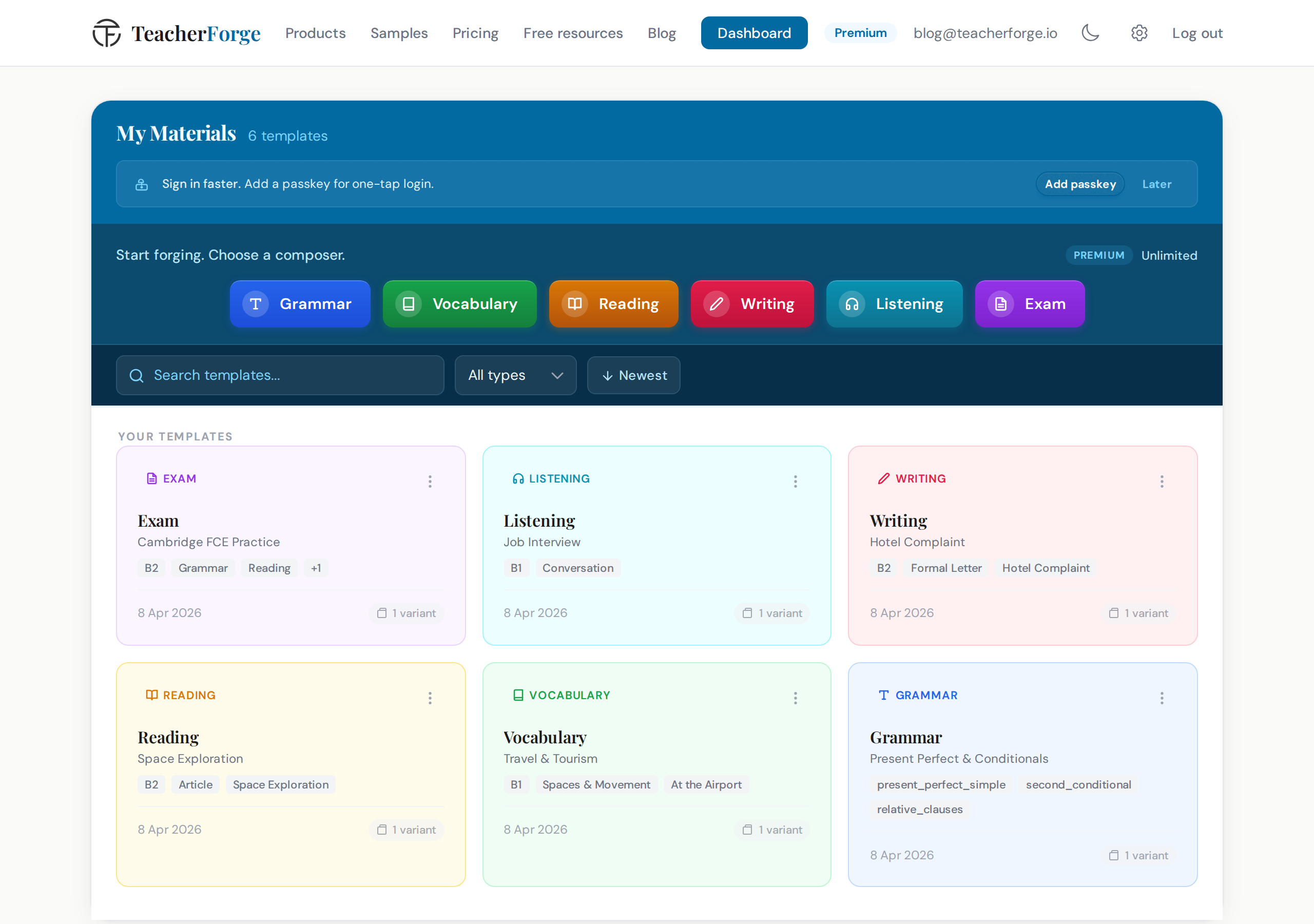
Templates are created automatically from every generation. From the dashboard, you can choose "Regenerate" from any writing task's card to get a fresh prompt, new language box phrases, and a new model answer with the same configuration. Useful for giving different groups the same task type without identical prompts.
For a closer look at what a complete writing task package contains and why each component matters, see How to Create a Complete ESL Writing Task (Not Just a Prompt).
If you are building a full B2 exam that includes a writing section alongside grammar, reading, and vocabulary, the Exam Composer handles multi-skill assessment in a single workflow, including Cambridge B2 First and C1 Advanced presets.
You can also read more about how much time material creation actually takes and where the biggest savings are in How Much Time Do ESL Teachers Spend Creating Materials.
Try It With Your Next B1–B2 Class
The next time you plan a writing lesson, try building the full five-component package rather than just a prompt. Even if you do it manually the first time, you will notice which component your students engage with most. For most classes at this level, it is the language box. For exam classes, it is the criteria.
Once you know what your students need, you can build it faster.