Sentence Transformation Exercises: How to Create Them and Why They Matter
Learn why sentence transformation exercises test grammar better than gap fill, how to write good stems, and how to create key word transformation exercises for FCE and CAE.
Sentence transformation exercises are deceptively simple on the surface: give students a sentence, a keyword, and ask them to rewrite the sentence using that word without changing the meaning. In practice, they are among the most demanding grammar tasks we can set, and among the hardest to write well.
If you prepare students for Cambridge exams, you will know this exercise type as key word transformation exercises: FCE Part 4 and CAE Part 4. But the exercise type is valuable far beyond exam preparation. Any teacher who wants to know whether students can use grammar, not just recognise it, should have these in their toolkit.
Why Sentence Transformation Tests What Other Exercise Types Don't
Consider the three most common grammar exercise types and what each actually measures.
A gap fill tests recognition and recall. The sentence structure is given; the student supplies a missing word or phrase. This is a useful first step, but a student can succeed by pattern-matching without truly understanding the grammar.
A multiple choice question tests discrimination. The student identifies the correct option from a set of plausible distractors. Again, this is valuable, but the student is choosing from a menu rather than producing language independently.
Sentence transformation tests production and flexible control. The student must hold two things in mind simultaneously: the meaning of the original sentence and the grammatical constraint imposed by the keyword. There is no menu to choose from. The student must construct the target form from scratch.
This is why sentence transformation sits at the top of the grammar exercise hierarchy. It requires active manipulation of structure, not passive recognition.
What Makes a Good Transformation Stem
A well-written transformation item has three qualities.
The keyword forces a specific structural change. The word "BEEN" forces the student to use a present perfect passive. The word "UNLESS" forces a conditional reformulation. The word "TOLD" forces reported speech. If the keyword could be slotted into the original sentence with minimal change, the item is too easy and tests nothing useful.
There is exactly one correct answer (or one narrow range of acceptable answers). This is the hardest constraint to satisfy when writing these manually. Ambiguous stems produce marking disputes and undermine student confidence. The target structure must be the only natural way to use the keyword while preserving the original meaning.
The difficulty is calibrated to the level. A B1 transformation might ask students to convert a simple active sentence to passive. A B2 item might require a hypothetical reformulation ("I didn't apply" → "I wish I had applied"). A C1 item might combine a structural shift with a register change or a complex nominal construction.
Common Transformation Patterns by Level
Here are the patterns that appear most frequently at each level, with brief examples.
B1 Patterns
- Active to passive: "Someone stole my bicycle last night." (STOLEN) → "My bicycle was stolen last night."
- Direct to reported speech: "'I am very busy today,' she said." (SAID) → "She said that she was very busy that day."
- Comparative structures: "No student in my class speaks English better than Maria." (AS) → "No student in my class speaks English as well as Maria."
- Modal deduction: "The office lights are still on at midnight, so someone is definitely inside." (MUST) → "The office lights are still on at midnight, so someone must be inside."
B2 Patterns
- Causative have/get: "Someone repaired my car last week." (HAD) → "I had my car repaired last week."
- Wish/regret structures: "I didn't apply for that interesting job last week." (WISH) → "I wish I had applied for that interesting job last week."
- Conditional reformulation: "If you do not hurry, you will miss the train." (UNLESS) → "Unless you hurry, you will miss the train."
- Inversion after a negative adverbial: "I have never encountered such a challenging problem at work." (NEVER) → "Never have I encountered such a challenging problem at work."
C1 Patterns
- Impersonal reporting: "Everyone says that the actor has retired from public life." (SAID) → "It is said that the actor has retired from public life."
- Nominalisation: "The policy failed. This resulted in public outrage." (FAILURE) → "The policy's failure resulted in public outrage."
- Inversion with so/such: "The task was so complex that only experts could complete it." (SO) → "So complex was the task that only experts could complete it."
- Not only...but also: "The museum displays rare artefacts and it also hosts international exhibitions." (ONLY) → "Not only does the museum display rare artefacts, but it also hosts international exhibitions."
For a sense of how this type sits among the other eight, the grammar worksheets generator page shows a sentence transformation example next to gap fill, multiple choice and error correction, each with its answer.
The Pitfalls of Writing These Manually
Any teacher who has tried to write a full set of transformation items from scratch will recognise these problems.
Ambiguous stems. You write an item, show it to a colleague, and they produce a perfectly valid answer you hadn't considered. Now you have a marking problem. Eliminating ambiguity requires testing each item against multiple possible responses, which is time-consuming.
Difficulty drift. It is easy to make all your items cluster at the same difficulty level, either all straightforward or all tricky. A well-calibrated set should have a spread, and achieving that spread intentionally takes planning.
Repetitive patterns. When writing quickly, most of us default to the same two or three transformation types. Students notice, and the exercise stops being a genuine test of flexible grammar control.
Inconsistent answer keys. If you accept a range of answers, you need to document all acceptable variants in the key. If you don't, different markers apply different standards.
For a single worksheet, writing four to six good transformation items might take 30 to 45 minutes. For a full Cambridge-style set of six items, you are looking at a significant block of preparation time, and that assumes you are confident in your own grammar knowledge at C1.
Practical Tips for Using Transformation Exercises in Class
Once you have a set of well-written items, here is how to get the most from them.
-
Use them as a diagnostic, not just a test. Ask students to write their answers, then compare with a partner before you reveal the key. The discussion that happens when two students have different answers is often more valuable than the exercise itself.
-
Work backwards from the keyword. For lower levels, teach students to look at the keyword first and ask: "What structure does this word belong to?" This metacognitive habit transfers to exam conditions.
-
Limit the word count constraint explicitly. In Cambridge exams, students must use between two and five words including the keyword at B2 First, and between three and six at C1 Advanced. Practise this constraint in class so it becomes automatic.
-
Group items by grammar point. A focused set of six passive transformations consolidates one structure thoroughly. A mixed set of eight items across different structures is better for revision and exam simulation.
-
Use the errors as teaching moments. Collect common wrong answers (anonymously) and display them on the board. Ask the class to identify what went wrong. This is more memorable than simply giving the correct answer.
-
Pair transformation practice with a grammar reference. Students who struggle with a particular item often have a gap in their understanding of the underlying rule, not just the exercise format. Having a clear grammar explanation to hand means you can address the root cause immediately.
How to Create Sentence Transformation Exercises with TeacherForge
Sentence transformation is one of 9 exercise types available in the Grammar Composer. When you build a grammar worksheet, you select up to 3 grammar tags from a 300-point CEFR curriculum (for example, "passive voice B2", "reported speech B1", or "third conditional B2"). The system uses a compatibility matrix to determine which exercise types are structurally valid for each tag. Sentence transformation only appears as an option when the selected grammar point genuinely supports it; you will not see it offered for a tag like "articles at A1" where the structural change would be trivial or impossible.
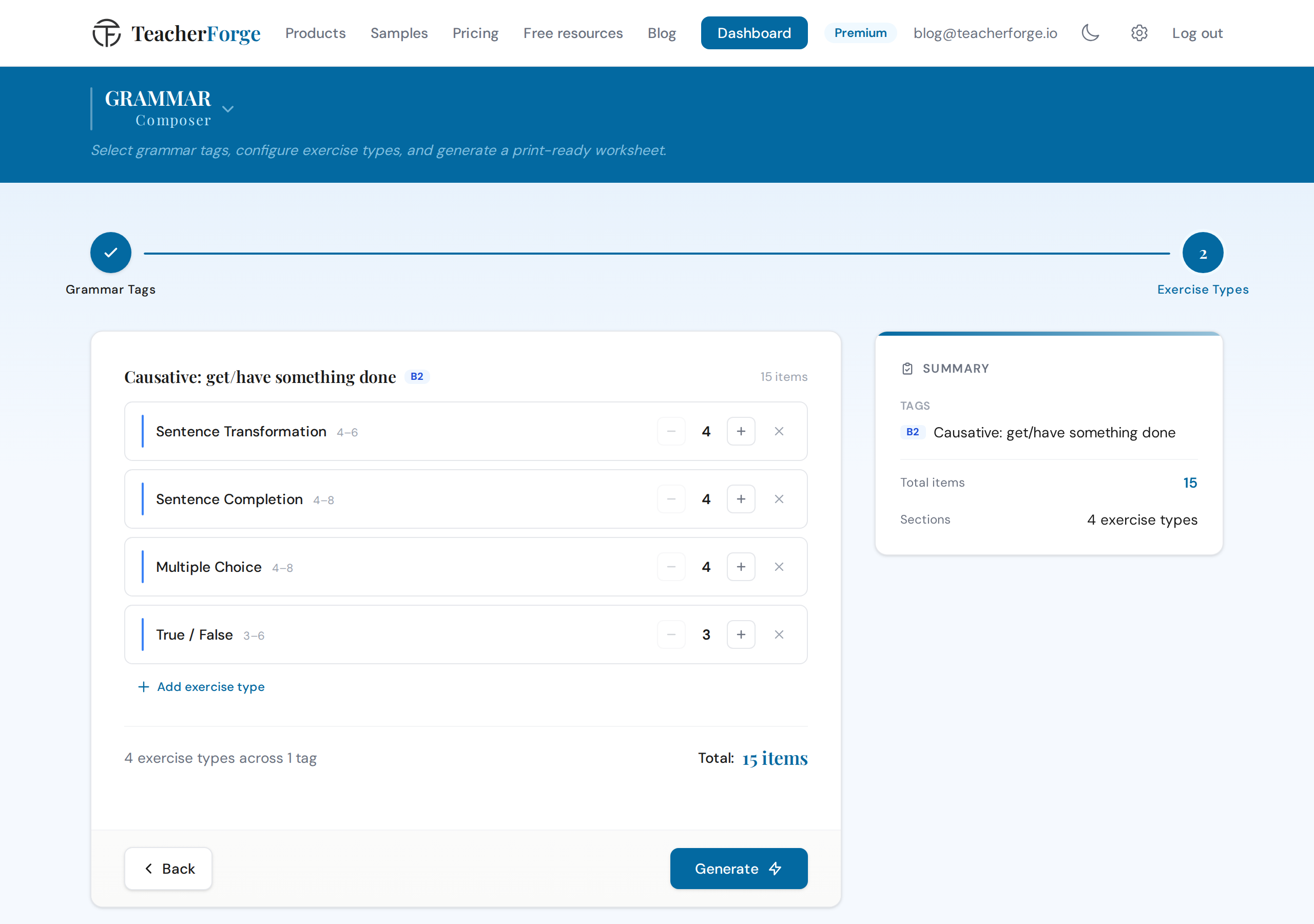
Once you select sentence transformation, you set the item count using a +/- stepper (the range for this type is 4 to 6 items). The AI generates each item around a key word, and the answer key, always included in the download, lists every acceptable variant.
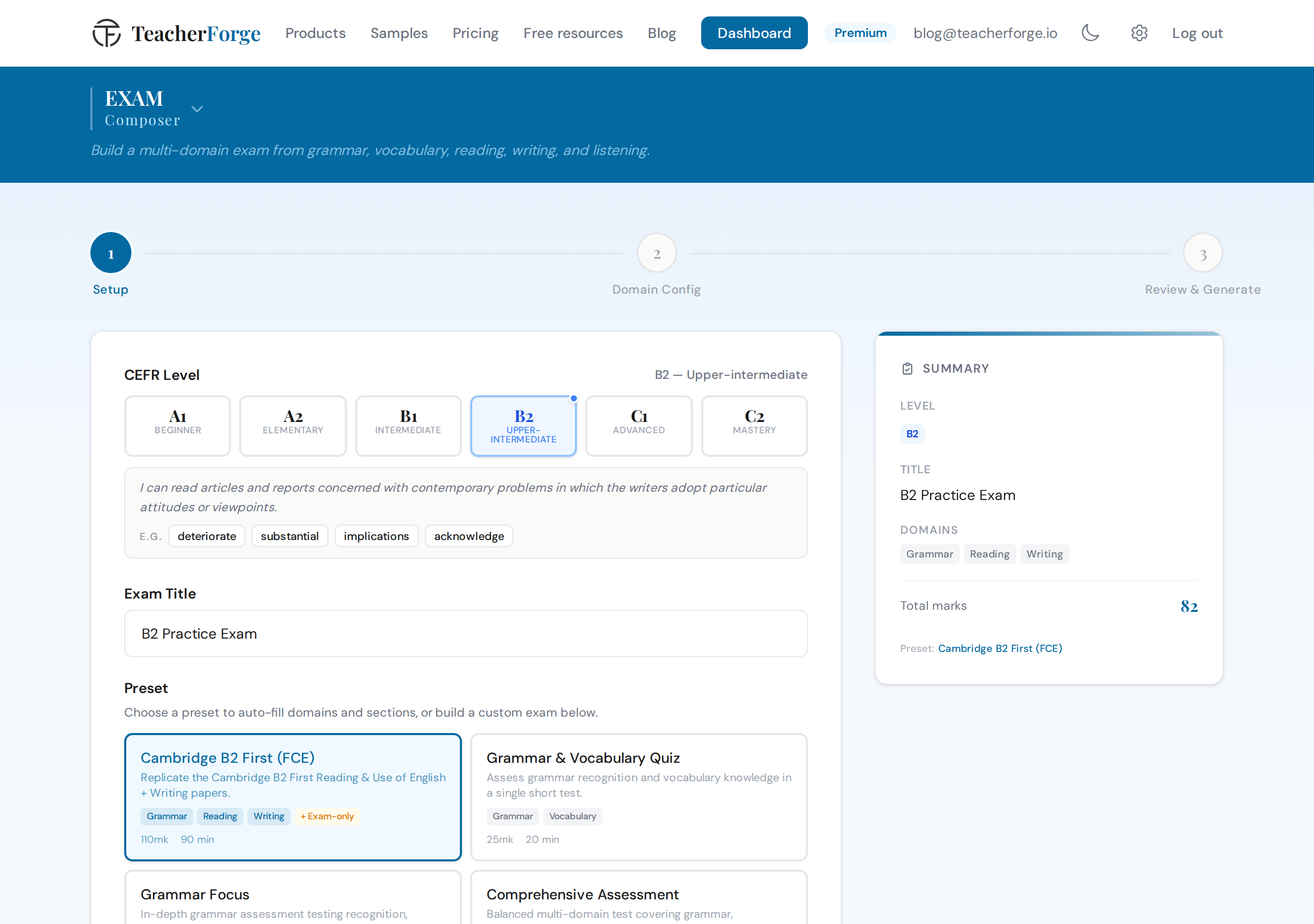
For Cambridge exam preparation specifically, the FCE and CAE presets inside the Exam Composer build Use of English Part 4 as its own key word transformation part: six items at 2 marks each, two to five words at B2 and three to six at C1, as in the real paper. Students practise under conditions that reflect the actual mark scheme.
Every ZIP download also includes textbook-quality grammar reference notes covering the grammar points on the worksheet. These span A1 to C2, are professionally designed, and can be printed as classroom handouts or shared digitally. There is no extra cost and no extra step; the notes are bundled automatically in a grammar-notes/ subfolder inside the ZIP. For students who struggle with a transformation item because they have not internalised the underlying rule, these notes address exactly that gap.
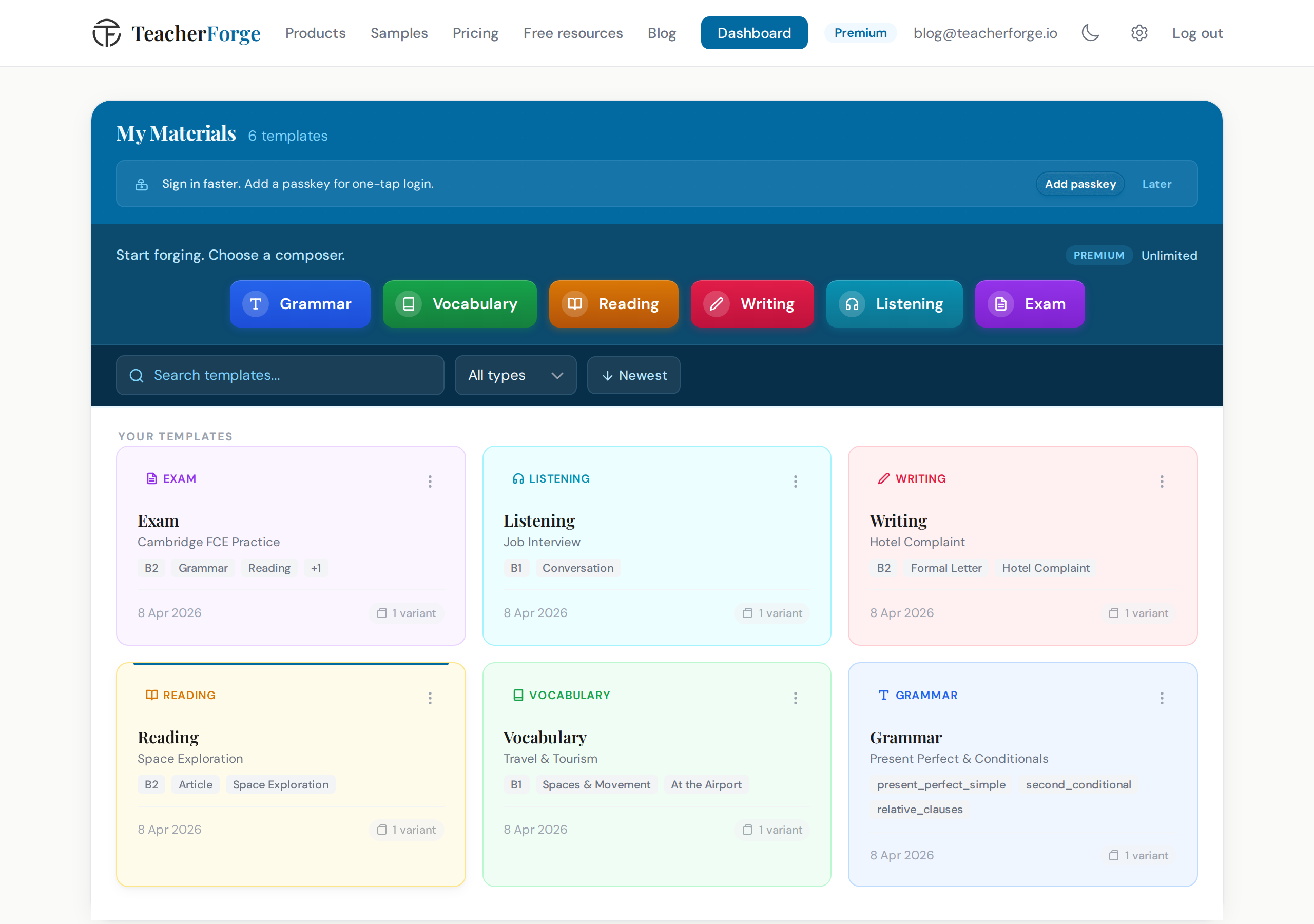
Because every generation automatically becomes a reusable template on your dashboard, you can regenerate fresh transformation sets with the same grammar tags whenever you need them. There is no re-setup required; choose "Regenerate" from the template card's menu and a new set of items is produced from the same configuration.
Related Reading
If you want to explore the full range of grammar exercise types available, the article Grammar Worksheets Beyond Gap Fill covers all 9 types and when to use each one. For a broader look at how CEFR level maps to specific grammar structures, The Complete CEFR Grammar Scope and Sequence for ESL Teachers is a useful reference. And if you are building a full Cambridge-style exam rather than a standalone worksheet, How to Build a Multi-Skill English Exam From Scratch walks through the complete process.
Start Building Your Transformation Exercises
Sentence transformation is worth the effort. It tests the kind of grammar knowledge that actually transfers to writing and speaking, and it is the one exercise type that cannot be gamed by pattern-matching alone. Whether you are preparing Cambridge candidates or simply want to know whether your B2 students have genuinely internalised the passive, a well-constructed transformation set will tell you what you need to know.
Try creating your own grammar worksheet with sentence transformation →