Most of us have written a test the night before it was due. We pick a few grammar points, add a reading text from the coursebook, and hope the marks add up to something sensible. The result is often a paper that measures nothing in particular.
Knowing how to create an ESL test starts with one question: what is this paper for? Checking progress, building confidence, finding gaps and closing a term are four different jobs. Each one changes which skills you include, how you split the marks and how long students get.
This guide walks through those decisions in order, then shows how to build the result quickly.
How to create an ESL test: start with the purpose
Before choosing a single question, decide which of these four jobs the exam does. The purpose sets the shape.
Mid-term progress check
The aim is to see whether the first half of the course has stuck. Keep it short and narrow. Test only what you have taught, in the formats students have practised, and aim for 30 to 40 minutes.
Grammar and vocabulary usually carry most of the marks here, because they are quick to mark and map directly onto your syllabus. A short reading text is a useful addition if reading has been a focus.
Students should get their papers back within a few days. The value of a progress check lies in the follow-up, so plan the feedback lesson before you set the paper.
Pre-exam confidence builder
A mock before an external exam has a different goal: familiarity. Students need to meet the format, the timing and the pressure before the real day, so it should resemble the target paper as closely as you can make it.
If your students are preparing for Cambridge B2 First or C1 Advanced, this means mirroring the papers part by part. A loose approximation can be worse than none, because students learn to expect the wrong task shapes.
Diagnostic assessment
A diagnostic is the opposite of a confidence builder. You want to find weak spots, so the paper should cover more ground, not more depth. Give each area a few items and look for patterns.
Good diagnostic design spreads the grammar points rather than testing one thing ten times. If students drop marks on three of the four points tested in the same way, you know where the next two weeks of lessons should go.
Tell students it does not count towards a grade. People show you what they actually know when the stakes are low.
End-of-term summative evaluation
This is the paper that goes in the gradebook, so it needs to be balanced and defensible. Cover every skill your course has taught, weight the marks to match the course, and allow enough time that speed does not decide the result.
For end of term English test ideas, a good rule is that the mark split should mirror your teaching time. If you spent half the term on grammar, about half the marks should be grammar.
Design decisions that apply to every mock exam
Once the purpose is clear, four decisions shape the paper.
Which domains to include
A grammar-only quiz is the right choice when you want a quick, precise signal about specific structures. It takes ten minutes to sit and very little time to mark.
A full multi-skill assessment tells you more about overall proficiency, but costs more in marking and in classroom logistics. Add a domain only if you will act on what it tells you. If you will not mark a writing task carefully, leave it out.
How to allocate marks
Let the course decide. On a grammar course, give grammar the biggest share, perhaps half the marks, with vocabulary and reading splitting the rest. On a general English course, balance the domains more evenly so no single skill can rescue or sink a student.
Whatever you choose, tell students the split in advance. People revise differently when they know where the marks are.
How many questions per section
There is a balance to strike. A section with two or three items is too thin to separate a student who knows a structure from one who guessed. A section with twenty items on one point tires students and tells you nothing new after the first ten.
A working range is 5 to 10 items per exercise, with around 10 items per grammar point. That is enough to see a pattern, and short enough that attention holds.
How long to allow
A short section of 10 items usually needs about 10 minutes. A full mock combining several domains needs 45 to 90 minutes, depending on level and how much extended reading and writing it includes.
If the paper is meant to test knowledge and not speed, allow a little more time than you think you need. Run through it yourself first, then add a margin.
Cambridge-aligned mocks versus classroom tests
These two kinds of paper follow different rules.
A Cambridge-aligned mock must mirror a specific paper. That means the same parts in the same order, the same exercise types, the same item counts and the same mark scheme. Students are practising a format as much as a language, so flexibility is a disadvantage. For FCE, the Reading and Use of English paper has seven parts and the Writing paper asks for two tasks. If you change those, you are no longer rehearsing the exam. Our guide to creating a Cambridge FCE practice exam goes through the paper in detail.
A general classroom test has far more freedom. You can choose any mix of exercise types, vary the difficulty within a section, and drop a domain entirely. The only fixed rule is that the paper should test what you taught.
The trade-off is effort. Building either kind by hand takes time, and a paper that combines several skills and needs a consistent layout, a cover page and a combined answer key is a long evening's work. A dedicated ESL exam maker with Cambridge FCE and CAE presets removes the formatting and answer-key work, so the effort goes into the decisions above.
Practical concerns: listening, writing and mixed ability
When to include listening
Listening needs audio, a room where everyone can hear and a way to play each recording. Include it when listening is a real course goal or when your target exam tests it. Skip it for a quick progress check.
If you do include it, test the speakers in the room beforehand and check the volume from the back row. Pick recordings at the paper's level, and give each exercise its own recording so that one task does not give away the answer to another.
Whether to include writing
Writing is the most informative part of an exam and the most expensive to mark. A single task from a class of 25 can take two or three hours to assess properly.
A sensible compromise is to include writing in the end-of-term paper and in pre-exam mocks, and leave it out of diagnostics and short progress checks. Mark against four criteria, such as content, communicative achievement, organisation and language, so your comments stay consistent across scripts.
Mixed-ability groups
There are two options. You can set one exam and use different expectations, for example grade boundaries that reflect where each student started. Or you can set separate papers at different levels.
If your students span more than one CEFR level, separate papers are usually fairer. A B1 student facing a B2 paper learns little and loses confidence. If the spread is narrow, one paper with tiered expectations is simpler. Our guide to differentiated worksheets for mixed-ability classes covers the same trade-offs for classroom material.
A build checklist for any mock exam
Use these steps each time you set a paper.
- Name the purpose. Progress check, confidence builder, diagnostic or summative. Write it at the top of your plan.
- Choose the level. Set the CEFR level for the paper, and build a second paper if the group is split across levels.
- Pick the domains. Include only the skills you will mark and act on.
- Set the mark split. Match it to your teaching time, and tell students.
- Choose item counts. Around 10 items per grammar point, and 5 to 10 per other exercise.
- Set the time. About 10 minutes per short section, 45 to 90 for a full mock, plus a margin.
- Take the paper yourself. Check that the timing works and the answer key is complete.
- Plan the feedback lesson. Decide in advance what you will do with the results.
Building these exams with TeacherForge
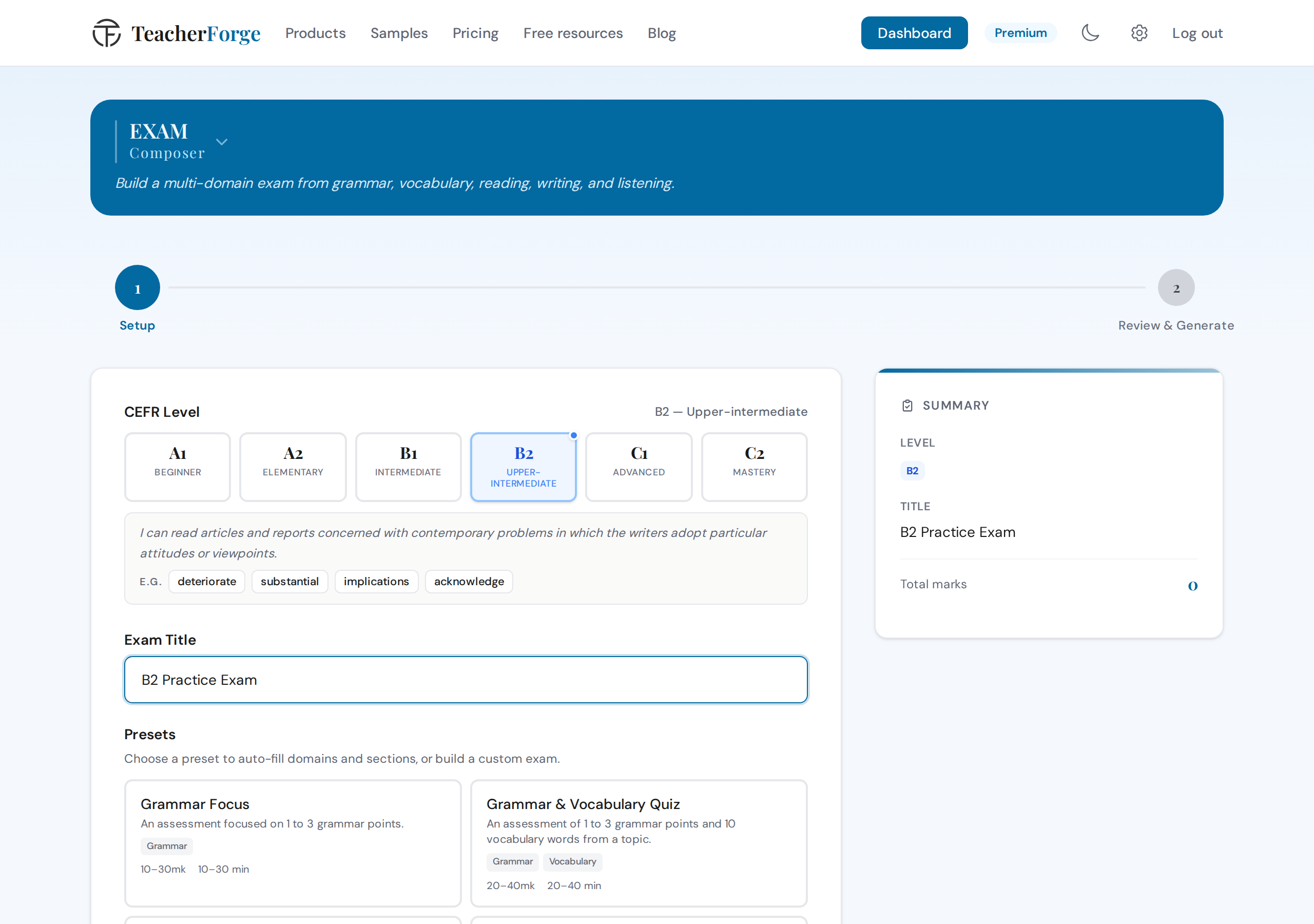
TeacherForge's Exam Composer is built around these decisions. You set the CEFR level, an exam title and the time, then choose a preset or build your own. Every generated paper comes as a print-ready PDF and an editable DOCX, with a cover page, an answer sheet and a single combined answer key.
There are five presets. Grammar Focus, Grammar & Vocabulary Quiz and Comprehensive Assessment are fixed papers built from the one to three grammar points you pick. Grammar Focus gives 10 marks and 10 minutes per grammar point, up to 30 marks. Grammar & Vocabulary Quiz adds a vocabulary part of 10 words from a topic, for 20, 30 or 40 marks. Comprehensive Assessment adds one reading text in the style and on the topic you choose, for 30, 40 or 50 marks and 40, 50 or 60 minutes.
The other two presets are for pre-exam practice. Cambridge B2 First (FCE) builds the Reading and Use of English paper and the Writing paper, for 110 marks and 155 minutes. Cambridge C1 Advanced (CAE) does the same for 118 marks and 180 minutes. These presets fix every part of the paper, and you choose only the topics, the title and the class and teacher printed on the answer sheet. They contain no listening or speaking.
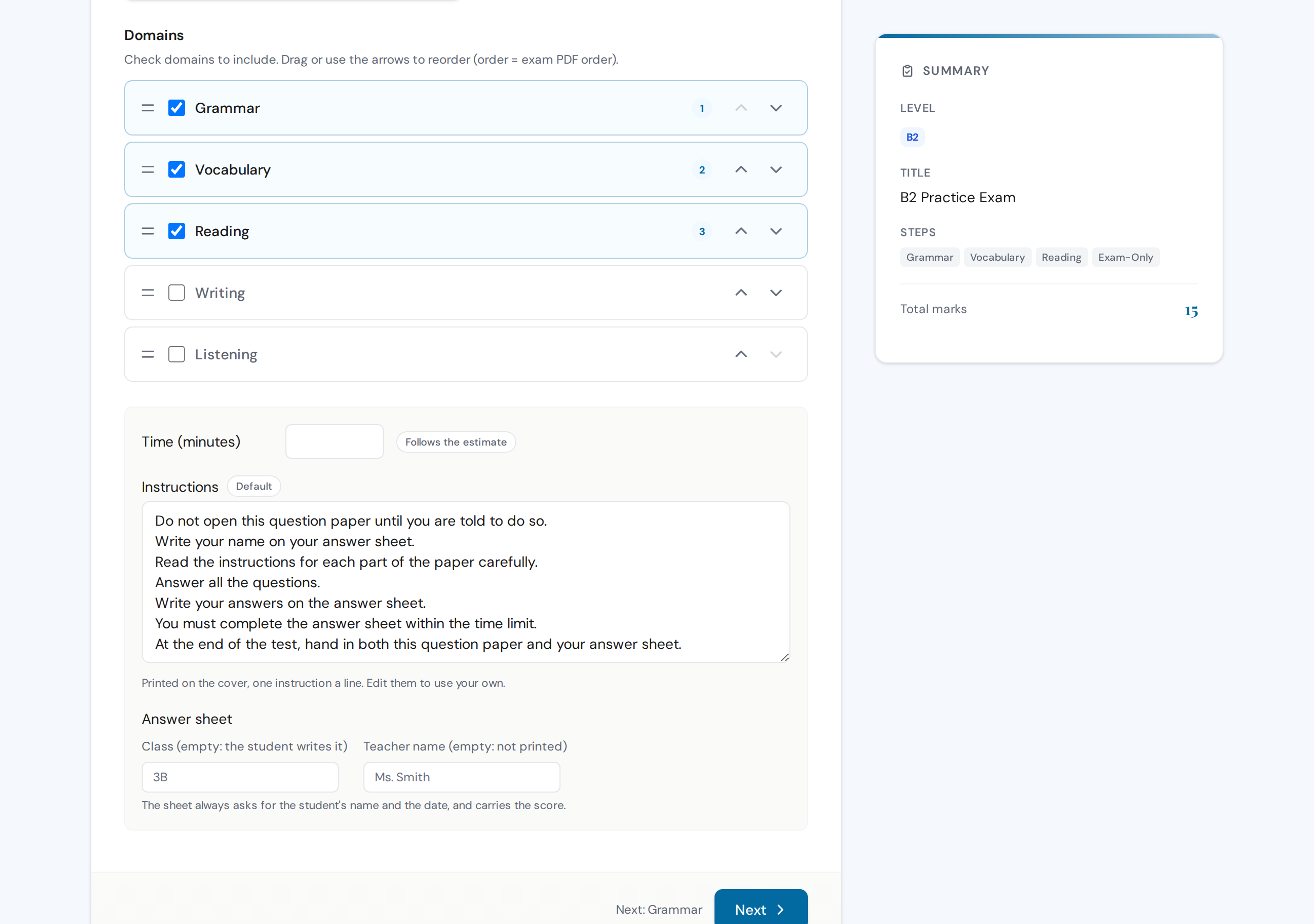
When you need full control, build a Custom Exam instead. You tick any combination of Grammar, Vocabulary, Reading, Writing and Listening, and each domain gets its own tab with the same options as the standalone composer. The marks per question are adjustable, so a grammar-heavy course can carry more marks in the grammar section.
You can drag the domains into any order, which sets the order they print in the paper. A live sidebar keeps a running total of marks as you configure each tab, so you can check the split against your plan as you go. The review step lists anything still missing, and all domains generate in parallel.
If you include listening in a custom exam, you pick each recording from the script library, and the MP3 for each recording is included in the download. Writing in a custom exam is one task, with the marks you set.
The last benefit is reuse. Every generation automatically becomes a template on your dashboard, with no save step. Choose Regenerate in a template card's menu and the composer reopens with the same configuration. You can tweak it before generating, and each regeneration costs the exam's 3 credits. A mid-term paper built once keeps its structure and mark allocation, and each new term gets fresh content.
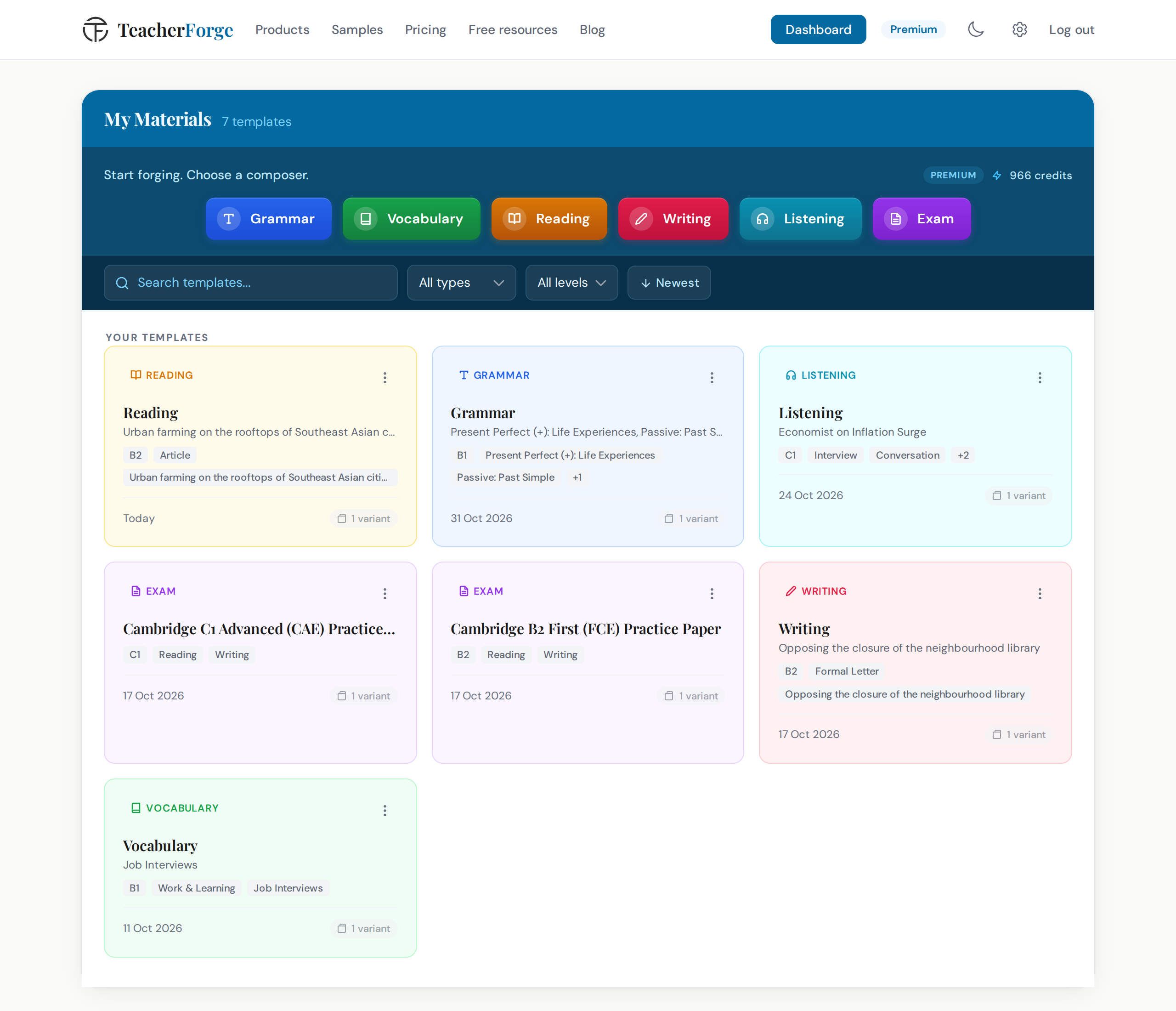
For mixed-ability groups, build one exam per level. Each is set at its own CEFR level, and both land on your dashboard as templates you can regenerate later.
Where to go next
If you want the full walkthrough of a custom paper, read our guide to building a multi-skill English exam from scratch. If you are preparing students for a Cambridge paper, start with how to create a Cambridge FCE practice exam. For an overview of the whole exam tool, see the Exam Composer page.