If you have ever tried to create an FCE practice test from scratch, you know the problem. A Cambridge B2 First mock is not a worksheet with a few extra questions. It is four papers and seventeen parts, a mark scheme that differs part by part, and a timing structure your students need to feel in their bones before exam day.
Below we walk through the real paper, part by part, so you know exactly what a faithful mock has to contain. Then we look at where teachers lose their weekends, and how to cut that down.
The B2 First exam at a glance
Cambridge B2 First (still widely called FCE) has four papers:
- Reading and Use of English: 7 parts, 1 hour 15 minutes
- Writing: 2 parts, 1 hour 20 minutes
- Listening: 4 parts, about 40 minutes
- Speaking: 4 parts, about 14 minutes, taken in pairs
The first two papers together run for 155 minutes, which is the figure to plan around if you want to sit a mock in one session. Check the current Cambridge handbook for the full specification before you finalise anything; the details below follow it, but exam boards do update.
Reading and Use of English: Parts 1 to 7
This is the paper students find most tiring, because the formats change every ten minutes. The handbook counts Parts 1, 5, 6 and 7 as the Reading section and Parts 2 to 4 as Use of English.
Part 1: Multiple-choice cloze
A short text with 8 gaps. For each gap, students choose from four options (A to D). It tests vocabulary in context: collocations, fixed phrases, phrasal verbs, linkers, and the one word among several close in meaning that fits. One mark per gap.
Part 2: Open cloze
A text with 8 gaps. Students write one word in each. The missing words are mostly grammar words: articles, prepositions, auxiliaries, pronouns, relatives. One mark per gap.
Part 3: Word formation
A text with 8 gaps. Each gap has a root word in capitals at the end of the line, and students must form the correct derived word: a prefix, a suffix, a change of part of speech, sometimes a negative. One mark per gap.
Part 4: Key word transformation
Six separate items. Students complete a second sentence so that it means the same as the first, using a key word in capitals and writing between two and five words. Each item is worth up to two marks, because the mark scheme splits each answer into two parts, one mark each. Every item should test a different point, and across the part you want a mix of grammar, vocabulary and collocation. (If you want to go deeper on this task type, we cover it in Sentence Transformation Exercises: How to Create Them and Why They Matter.)
Part 5: Multiple choice
A long text followed by six four-option questions, two marks each. These questions test detail, tone, attitude, purpose and inference, and the options are written to be plausible, so skimming rarely works.
Part 6: Gapped text
A text from which six sentences have been removed and placed in a jumbled list, with one extra sentence that fits nowhere. Students use cohesion clues (pronouns, linkers, reference, topic development) to restore the text. Two marks per gap.
Part 7: Multiple matching
Ten questions, one mark each. Students match statements to sections of a long text, or to several short texts, by scanning for specific information. It is a speed-and-precision task, and the part students most often run out of time on.
The marks across these seven parts add up to 70: 24 for Parts 1 to 3, 12 for Part 4, 12 for Part 5, 12 for Part 6 and 10 for Part 7.
Writing: two tasks, 80 minutes
Part 1 is a compulsory essay of 140 to 190 words. Students answer a question using both notes given and adding an idea of their own, and give reasons for their point of view.
Part 2 is a choice of one task from three, again 140 to 190 words. The text types are article, email or letter, report and review. Each task gives a specific situation, a reader, and a purpose.
Both parts are marked out of 20 on four criteria: Content, Communicative Achievement, Organisation and Language, 5 marks each. That gives 40 marks for the paper. Notice that the candidate's copy carries only the task. There is no planning checklist and no useful language box on the real paper, so a good mock should not provide one either. (Those scaffolds belong in regular classwork; see ESL Writing Tasks for B1-B2.)
Listening: four parts, 30 questions
- Part 1: eight short, unrelated extracts, each with one three-option multiple-choice question.
- Part 2: a monologue with ten sentences to complete, usually with a word or short phrase heard on the recording.
- Part 3: five short monologues on a shared theme, matched to eight options. Students choose five.
- Part 4: an interview or conversation with seven three-option multiple-choice questions, testing opinion, attitude and gist.
Every recording is played twice. The challenge for a teacher is sourcing audio at the right level, with the right speed and accents, and writing questions that test listening rather than reading.
Speaking: four parts
Speaking is a face-to-face test with two candidates and two examiners: a short interview, an individual long turn comparing photographs, a collaborative task, and a discussion. It does not produce a worksheet, so it sits outside what any material generator can build. The best preparation is regular pair practice with timed turns, and your own notes on the assessment scales.
Why a faithful mock takes so long
Teachers know what the paper looks like. The hours go on the details:
- Finding or writing six separate texts at B2 level, each with a different topic and genre.
- Writing Use of English items where every wrong option is plausible but only one fits, and where the answer key does not miss an alternative correct wording.
- Checking that Part 4 sentences each test a distinct point.
- Balancing marks so the paper totals correctly and each part carries the right weight.
- Formatting it so it looks like a paper and not a handout, then producing a separate answer key.
A single mock can easily eat a whole weekend, and students need several across a course. If you are already counting prep hours, How Much Time ESL Teachers Spend on Lesson Prep puts numbers on the problem.
How to create an FCE practice test that mirrors the real paper
Whether you build by hand or with software, these steps keep a mock faithful.
- Fix the structure first. Write out the parts, question counts and marks before you choose a single topic. The structure is not negotiable; only the content changes.
- Vary topics across parts. Do not let two reading texts, or a reading text and a writing task, cover the same theme. Real papers spread topics widely.
- Keep Use of English mixed. In Part 4, check that your six items cover grammar, vocabulary and collocation. In Part 1, rotate between collocation, phrasal verb, linker and meaning-in-context.
- Write Part 2 of Writing as a pool. Offer three options of different text types so students practise choosing, which is itself an exam skill.
- Remove the scaffolds on exam day. No checklists, no phrase banks, no model answers on the candidate's copy.
- Time it properly. Run Reading and Use of English in 75 minutes and Writing in 80, even if you split them across two lessons.
- Mark Writing with the four criteria. Give a score out of 5 for each, and give students the criteria so feedback is comparable between mocks.
- Write a second mock before you need it. Students will want to retake, so plan variants with different topics.
Doing this with TeacherForge
The exam maker in TeacherForge has a Cambridge B2 First (FCE) preset that builds the Reading and Use of English paper and the Writing paper part by part. In the Exam Composer you set the level to B2 and choose Cambridge B2 First (FCE). The Domains checklist is then replaced by a read-only outline of the paper's parts in print order, and a strip at the top of every step sums up the two papers: Reading and Use of English, 7 parts and 52 questions, and Writing, 2 tasks, all on the topics you choose.
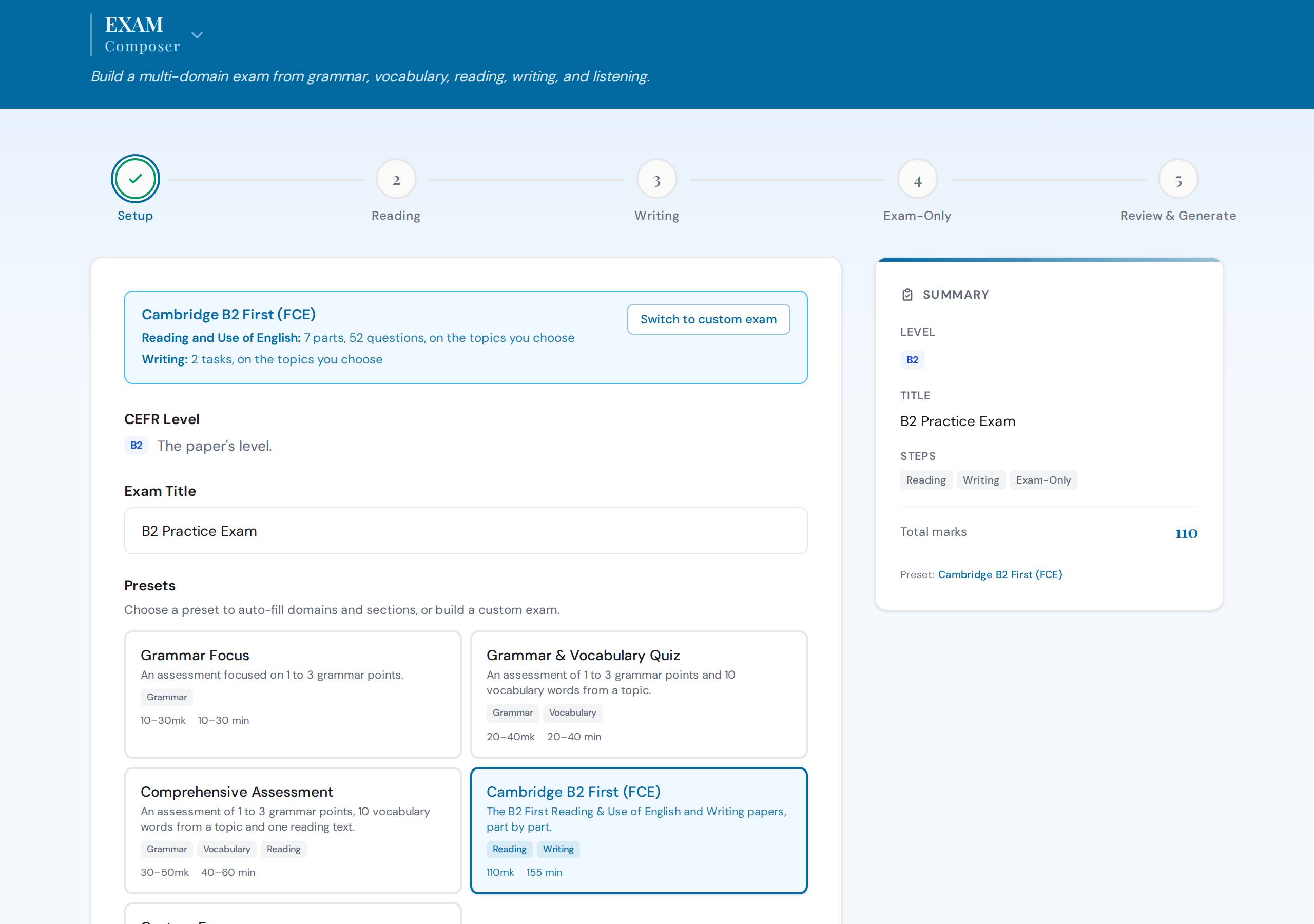
The preset gives you the seven parts of the Reading and Use of English paper in print order, with the question counts and marks set out above: multiple-choice cloze (8 gaps), open cloze (8), word formation (8), key word transformation (6 items, 2 marks each), multiple choice on a text of 620 to 700 words, gapped text, and multiple matching on an article in five lettered sections. The whole paper comes to 110 marks in 155 minutes once the Writing paper is added.
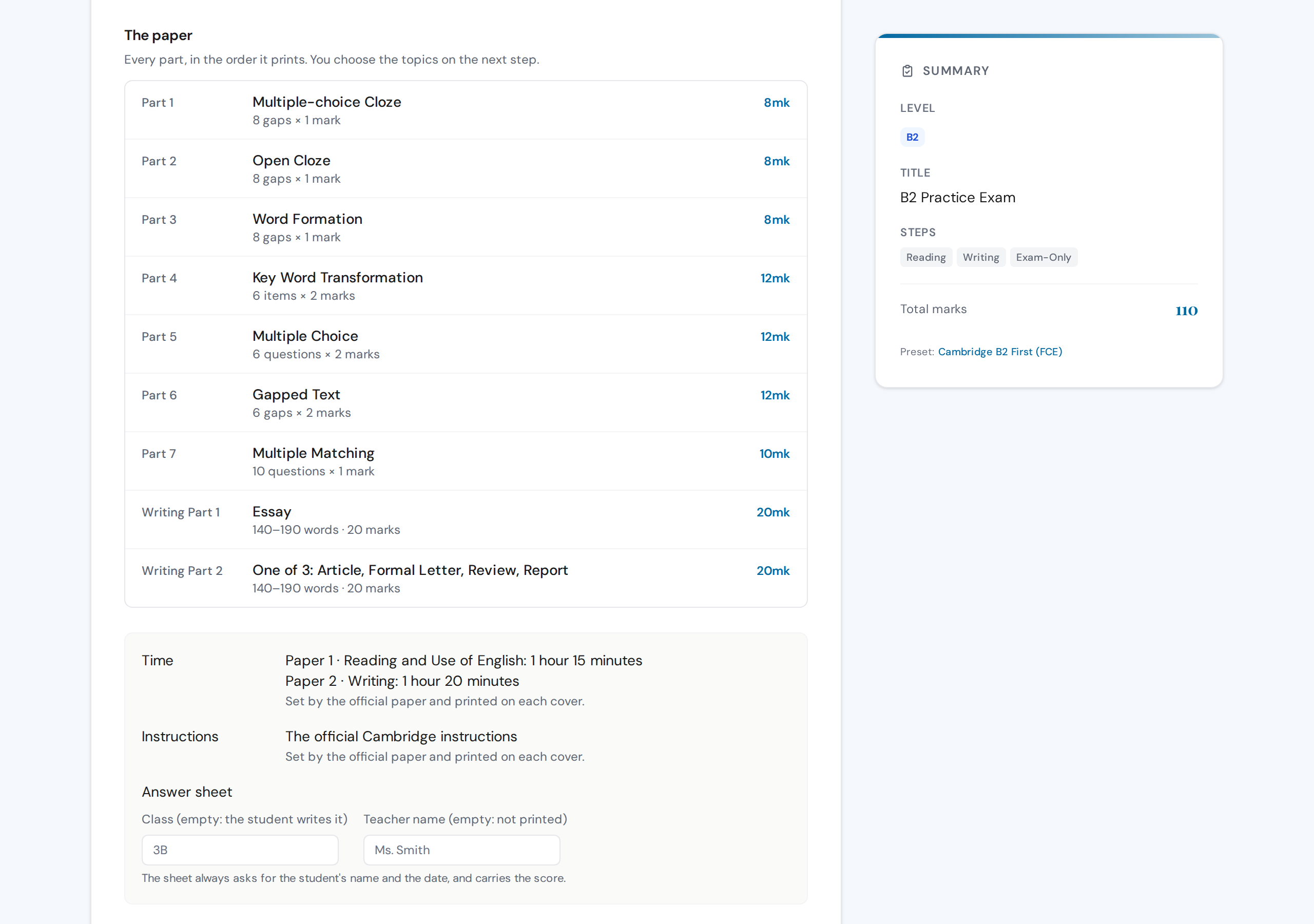
The Writing paper has the Part 1 essay, a question with two notes and a third idea left to the student, plus a choice of three Part 2 tasks, drawn per paper from article, formal letter, review and report and set on one topic you choose. Each is marked on Content, Communicative Achievement, Organisation and Language, with 20 marks per task. The candidate's copy carries each writing task alone, with no planning checklist and no useful language box, as in the real exam.
Five of the task types in this paper are available only in the Exam Composer, not in the standalone products. Multiple-choice cloze, open cloze, word formation and key word transformation make Parts 1 to 4, and gapped text makes Part 6. Multiple-choice cloze answers and their wrong options come from a curated, checked bank, and the text is written so that only the answer fits. The key word transformation answer key lists the wordings accepted for each gap, up to six.
There is no grammar point to pick. The structures tested come from the level, just as in the real paper. The parts, counts, marks, order, word limits, each paper's time and the official Cambridge instructions on its cover are fixed by the preset. What you choose is the topic of each text and each writing task, the exam title, and the class and teacher's name on the answer sheet. If you decide you need something different, one button, "Switch to custom exam", leaves the paper and keeps its parts as a starting point; a custom exam holds one reading text, one writing task and up to three exam-only sections, so you then choose which of them to keep.
You get a print-ready PDF and an editable DOCX, with a single combined answer key. On the preview page you can change the font (Arial, Times or Verdana) and the size (Small, Normal or Large) at no credit cost. A generation costs 3 credits, and the free plan starts you with 18.
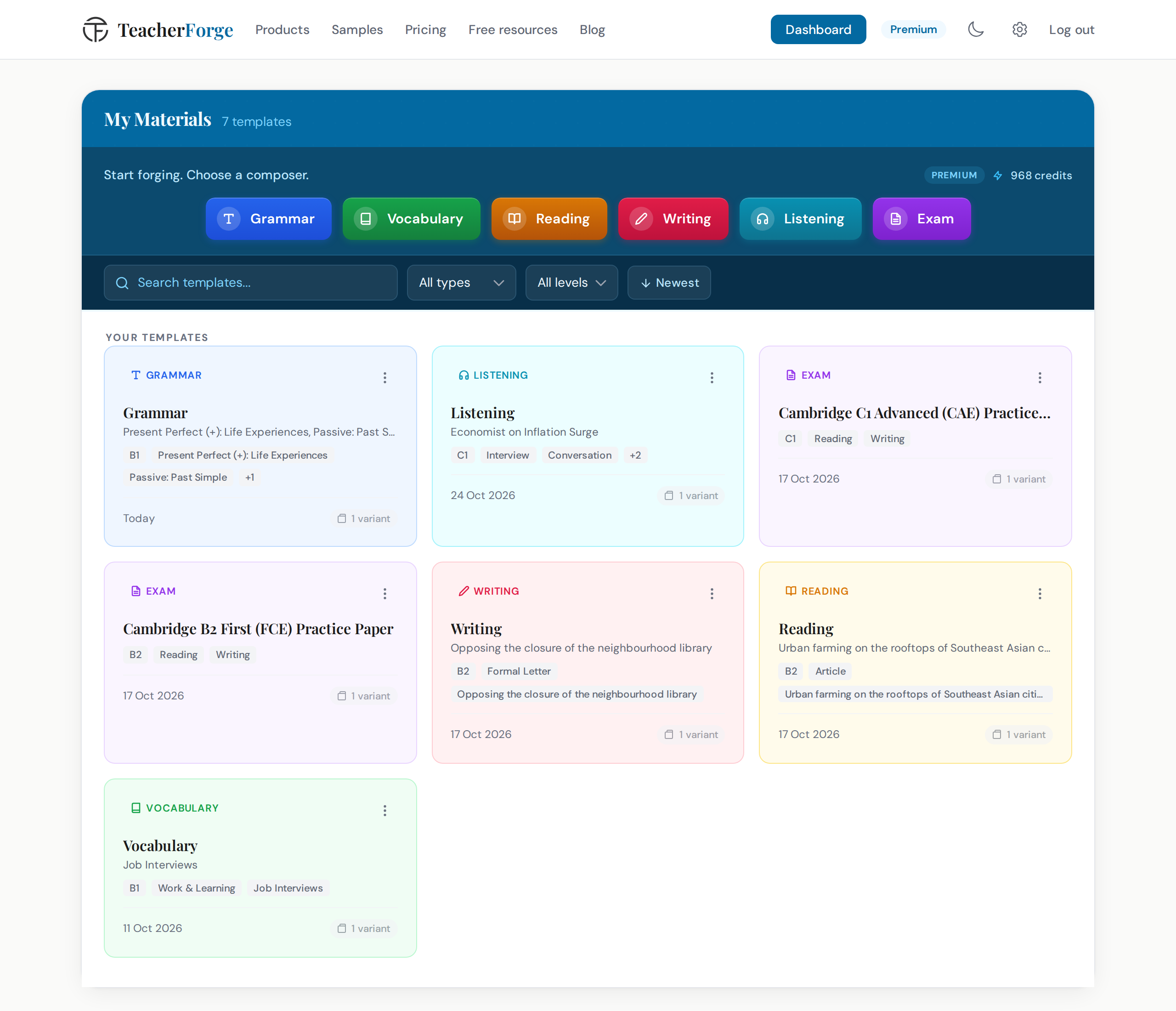
Every generation also becomes a template on your dashboard automatically. For your second and third mock, you open the template card's menu, choose "Regenerate", change the topics if you wish, and get a fresh paper with the same structure and marks.
What about Listening and Speaking?
The Cambridge B2 First (FCE) preset covers Reading and Use of English and Writing. For Listening, the Listening Composer has a library of scripts with audio across A1 to C2 and seven formats. At B2, under Custom, you set a Multiple Choice exercise and a Sentence Completion exercise, each on its own recording: multiple choice has three options at B2, as in the real paper, and sentence completion is the task of Part 2. Recordings are fixed library items, so you choose rather than edit them. That is a quicker route than recording your own; we cover the wider approach in How to Create Listening Exercises Without a Recording Studio.
It does not reproduce the five-speaker matching of Part 3, so treat it as practice for Parts 1, 2 and 4 rather than a full replica of the paper. Speaking you will need to run live with your own prompts and photographs.
If you would rather combine several skills in a non-Cambridge format, How to Build a Multi-Skill English Exam From Scratch covers that route.
Build your first mock
The FCE rewards students who have seen the format many times and practised under time pressure. The mock itself is the least interesting part of that; the feedback afterwards is where learning happens. Spend your hours there rather than on formatting.
Learn more about the Exam Composer, or try creating your own FCE practice exam →