The ESL Teacher's Guide to Differentiated Worksheets for Mixed-Ability Classes
Learn how to create differentiated ESL worksheets for mixed-ability classes using CEFR levels, tiered tasks, and scaffolded support across grammar, vocabulary, and reading.
Mixed-ability classes are the norm in ESL and EFL teaching. Whether you work in a private language school, a state secondary, or a university foundation programme, the chances of having a perfectly homogeneous group are slim. One student breezes through the gap fill while another is still decoding the instructions. The standard response from curriculum advisors is always the same: differentiate your materials. What they rarely explain is how to do that without tripling your preparation time.
This article walks through practical differentiation strategies grounded in CEFR levels, with concrete examples from grammar, vocabulary, and reading. The goal is a framework you can apply to your next lesson, regardless of what tools you use.
Why Vague Differentiation Doesn't Work
Most teachers have tried the classic approach: one worksheet with an "extension" task stapled to the bottom. In theory, stronger students do the extension while weaker students finish the core activity. In practice, stronger students rush the core activity to get to the extension, weaker students feel singled out, and the extension task is often just more of the same rather than genuinely different in demand.
The problem is that "easy, medium, hard" is not a principled framework. It is a feeling. Two teachers will disagree on which tasks belong in each category, and neither version is calibrated to what students at a specific proficiency level can actually do.
CEFR levels solve this. Instead of vague difficulty bands, each level comes with specific descriptors: vocabulary density, sentence complexity, text length, and the cognitive operations a student is expected to perform. An A2 student can identify explicitly stated information but cannot yet reliably infer meaning from context. A B2 student can follow complex argumentation and identify the writer's attitude. These are not arbitrary labels; they are the basis for designing tasks that genuinely match what a student is ready to do.
Tiered Tasks: Same Topic, Different Demand
The most effective differentiation strategy is the tiered task: all students work on the same topic, but the language and the exercise types shift by level. This keeps the class together thematically while giving each group work that is appropriately challenging.
Grammar: Same Theme, Each Level's Own Structure
Take talking about experiences as the theme. Each level works on the structure it is ready for.
At A2, the past simple: students say what they did and when. Multiple choice and sentence completion keep the production demand low while the form settles.
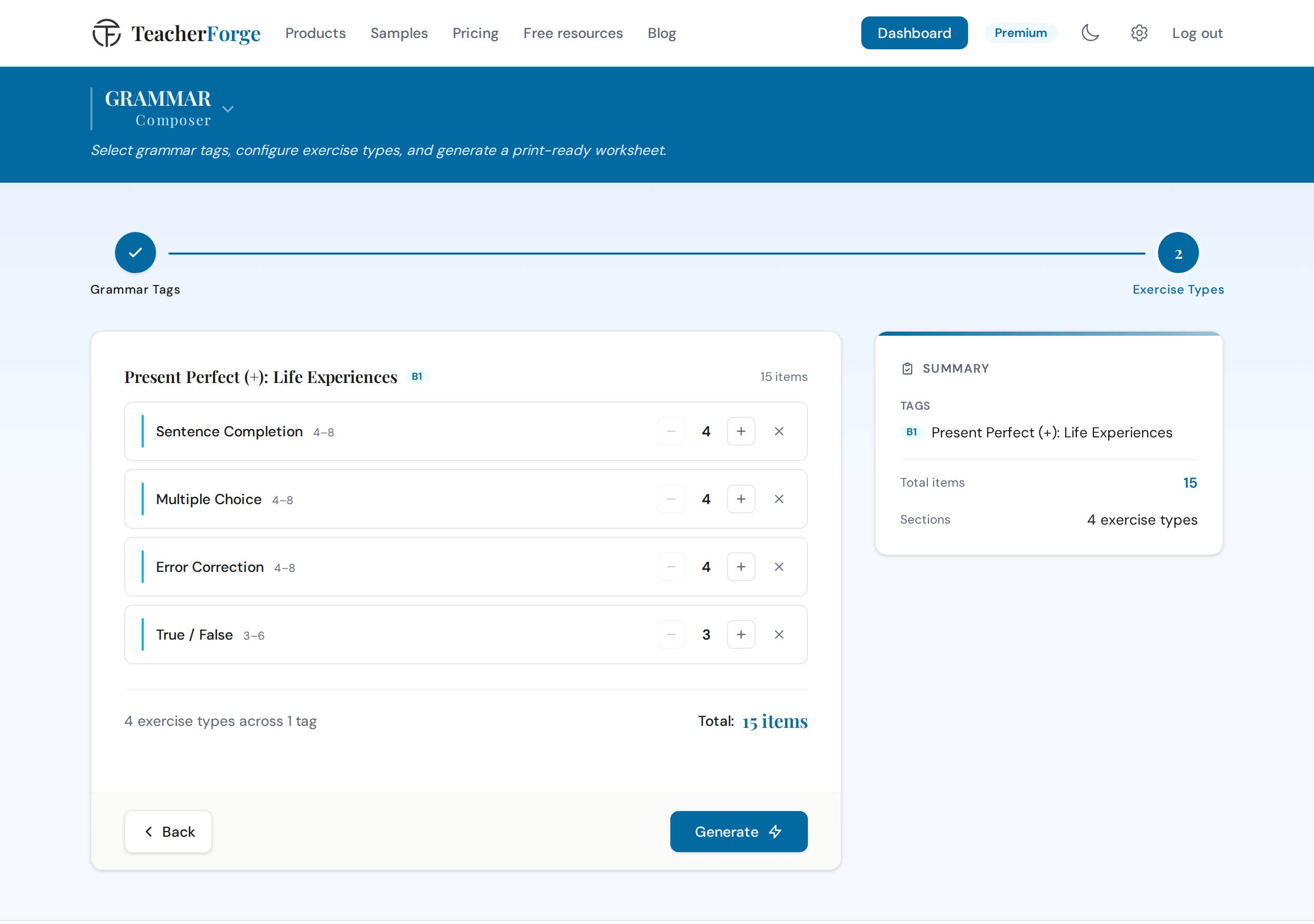
At B1, the present perfect for life experiences: students talk about experiences without a time. Sentence completion and error correction make them produce and check the form; with never, or with just and already, sentence transformation asks them to move between the two tenses.
At B2, the present perfect passive: open cloze and sentence transformation ask students to rebuild a sentence around has been done.
All three versions share one theme and the same kind of sentences (travel, experiences, recent news). What changes is the structure, and the type of processing it calls for.
For more on the range of exercise types available for grammar work, see our article on grammar worksheets beyond gap fill.
Vocabulary: Same Theme, Subjects That Grow With the Level
Differentiation in vocabulary is not just about choosing simpler words for lower levels. It is about the kind of subject a level can talk about, and the richness of the lexical network that comes with it.
Take technology as the theme. At A2, students talk about the technology they use every day: sending messages, taking photos, making video calls. Words like message, send, reply, password and login are high-frequency, with concrete referents and straightforward definitions.
At B1, the same theme moves on to how the tools work: storing files, streaming, paying online. Words like backup, sync, subscribe, transfer and refund have multiple uses across contexts.
At B2, the subjects turn abstract: how algorithms shape what we see, virtual worlds, connected devices. Words like algorithm, personalize, curate, immersive and automate require domain-specific meaning and often morphological awareness (personalization, automated, algorithmic).
The exercise types can change too. At A2, matching words to definitions tests recognition, and word ordering has students put a jumbled sentence in order around each word. At B2, matching alone is not enough: gap fill asks students to place each word in a sentence, choosing from a box that holds words from the same list, and true/false asks whether a definition really fits a word.
Our article on vocabulary worksheet exercise types covers the five exercise formats and how they test different aspects of word knowledge.
Reading: Same Theme, Different Text
Reading differentiation involves three variables: text length, text complexity, and question type.
Text length is the most visible variable. An A2 reading text on the theme of food might be 150 to 220 words. A B2 text on the same theme might be 300 to 450 words with multiple paragraphs, subarguments, and a more formal register.
Text complexity goes beyond length. Sentence structure, vocabulary density, and the proportion of implicit versus explicit information all increase with level. An A2 text states everything directly. A B2 text might require the reader to infer the writer's position from word choice rather than from explicit statements.
Question types are where CEFR-based differentiation becomes particularly powerful. At A1 and A2, multiple choice (where the answer is stated in the text), True/False/Not Given and short answer test whether students can locate and identify information, and sequencing on a story checks that they can follow events in order.
From B1, the tasks turn to how a text is built. Matching headings and multiple matching ask students to understand what each paragraph is about, cause and effect follows the logic of an argument or a story, and note completion pulls out the key details. At B2, the same tasks sit on a longer, less explicit text, so they demand more inference.
The key point is that a B2 student is not just doing "harder" true/false questions. They are doing fundamentally different cognitive work.
For a detailed breakdown of how reading tasks shift across the CEFR scale, see reading comprehension worksheets by CEFR level.
Scaffolded Support Within a Single Worksheet
Tiered tasks work well when you have time to prepare separate versions. But sometimes you need a single worksheet that works for a mixed group. Scaffolded support is the technique here.
The principle is simple: the support sits in the worksheet itself, so students who need it can lean on it and stronger students move past it.
Word boxes. A gap fill with a word box is easier than writing the word from memory. Adding a couple of extra words from the same list keeps students choosing, so those who need support can work by recognition without the task giving the answers away.
Useful language. For writing tasks, a box of phrases grouped by function ("Giving opinions", "Connecting ideas") and a planning checklist break the task into steps. They reduce the production burden while keeping the writing task intact.
Tiered question sets. Build a reading worksheet whose sections rise in demand: multiple choice and True/False/Not Given first, which test explicit information, then short answer or cause and effect, which ask for processing and inference. All students attempt all questions, but you grade with awareness of which sections suit which level.
Practical Steps for Building a Differentiated Set
Here is a process that works for creating a differentiated set of materials without burning an entire Sunday afternoon.
- Choose your anchor topic. Pick one topic that is relevant and appropriate for your class (e.g. social media, travel, the environment).
- Identify the grammar or vocabulary focus. What language point are you teaching this week? Keep it consistent across all versions.
- Write your A2 version first. Start with the most scaffolded version: a short text with multiple choice, True/False/Not Given and short answer, high-frequency vocabulary with matching and a gap fill word box, and the A2 grammar point.
- Adapt up to B1. Use a longer text and add a paragraph-level task such as matching headings or cause and effect; move the grammar to the B1 structure, with sentence completion and error correction.
- Adapt up to B2. Use a longer, less explicit text with multiple matching or note completion; move the grammar to the B2 structure, with sentence transformation or open cloze.
- Check your answer keys. Each version needs its own answer key. Do not try to use one key for all three.
- Label versions clearly. Use CEFR level labels (A2, B1, B2) rather than "easy, medium, hard". Students generally respond better to level labels, which feel descriptive rather than judgemental.
The repetition in steps 3 to 5 is what makes this expensive by hand. Because every composer on the ESL worksheet generator takes the CEFR level as a setting rather than something you write into the text, each version can be built at A2, B1 and B2 without redrafting from scratch each time.
How to Create Differentiated Materials with TeacherForge
Building a differentiated set manually takes time. TeacherForge is designed around CEFR levels from the ground up, which means creating three versions of a worksheet is a matter of generating three times, once per level.
Grammar: Three Versions, One Theme
In the Grammar Composer, you search a 300-tag curriculum and select up to three grammar tags per worksheet. Each tag is tied to one CEFR level, and the compatibility matrix offers only the exercise types that suit that tag. For a mixed class, build each version from tags at its own level around one theme, such as talking about experiences: the past simple at A2, the present perfect for life experiences at B1, and the present perfect passive at B2. Three generations, three calibrated worksheets, each with a complete answer key.
Vocabulary: Same Domain, Each Level's Subtopics
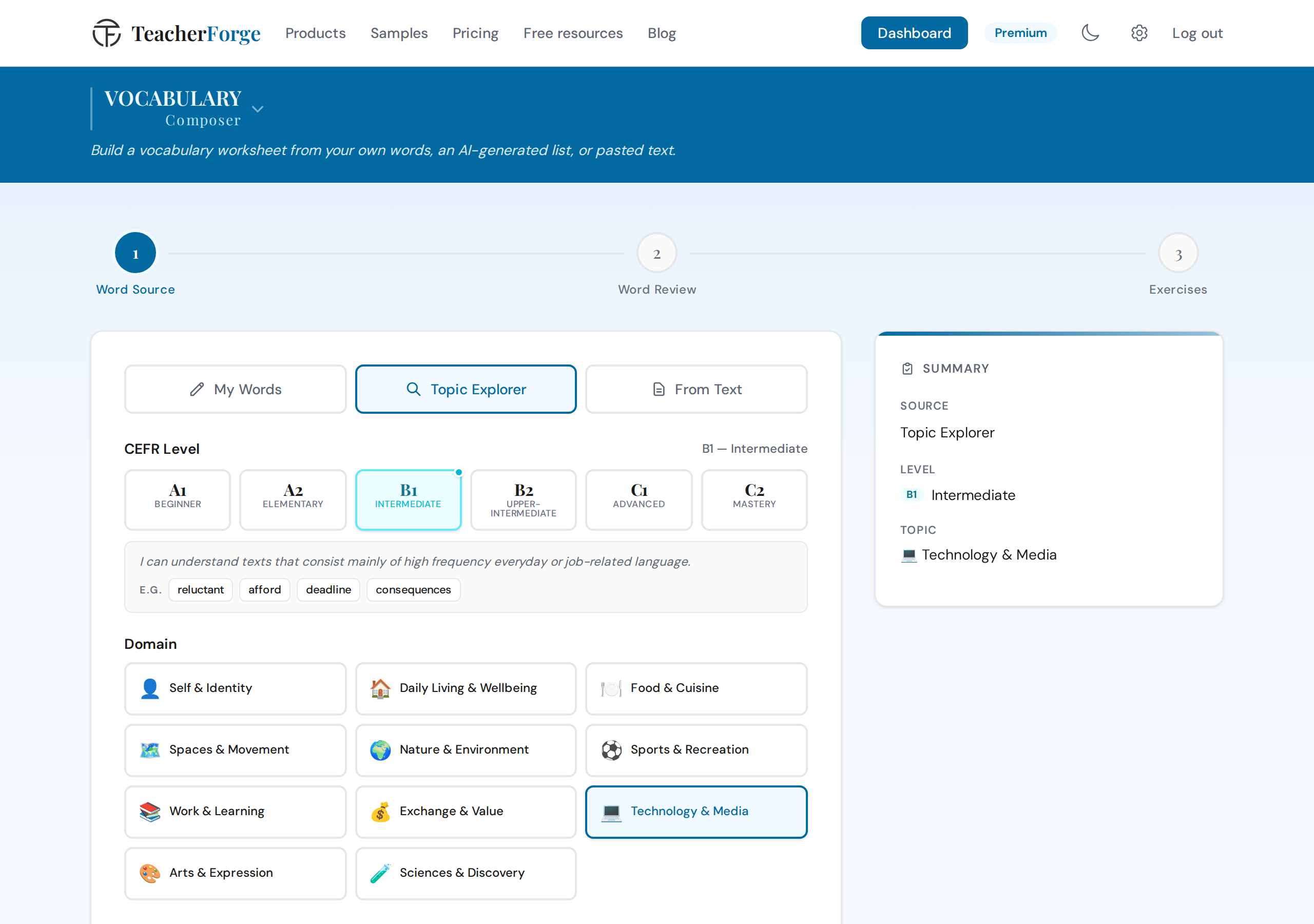
In the Vocabulary Composer, the Topic Explorer lets you select a CEFR level, a domain, and a subtopic. The domain stays the same at every level, and its subtopics follow the level: under Technology & Media, A2 offers Text Messaging or Video Calls, B1 Cloud Storage or Streaming Platforms, and B2 Social Media Algorithms or Virtual Reality. Pick one per level and generate three times. If you would rather keep one subject for all three groups, type your own subtopic and change only the level between generations. The word list and definitions are calibrated to the selected level, so the A2 version automatically uses higher-frequency vocabulary with simpler definitions. The exercise types you add (matching, gap fill, multiple choice) are the same across versions, but the words and contexts differ.
Reading: Level-Gated Exercise Types Do the Work
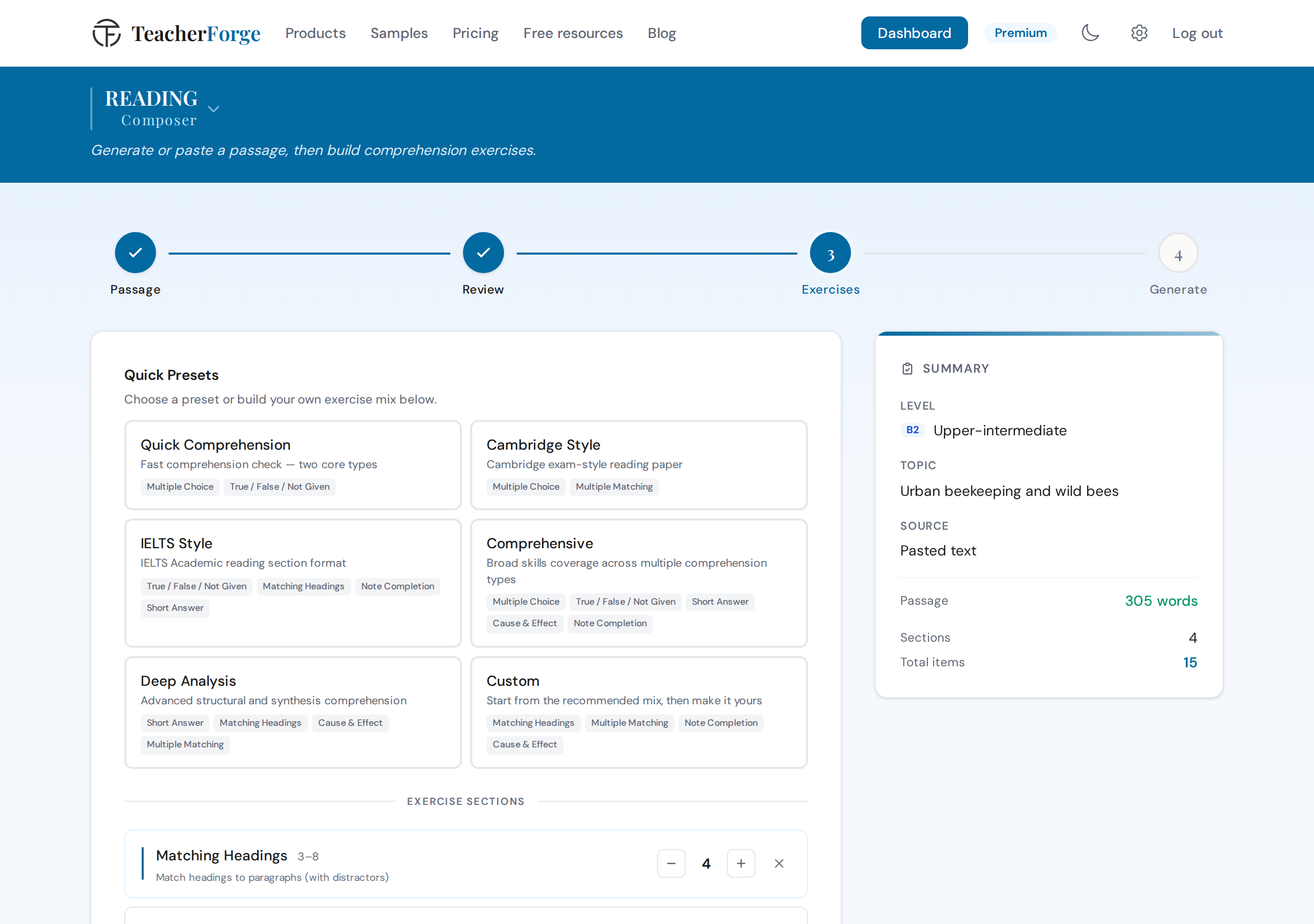
In the Reading Comprehension Composer, you set a CEFR level, topic, text style, and passage length. Multiple choice, True/False/Not Given and short answer are offered at every level, and sequencing from A1 to B1 on a story. From B1, matching headings, multiple matching, note completion and cause and effect are added, each on the text styles it suits. The passage length follows the level too: at the same length setting, an A2 passage runs 150 to 220 words and a B2 one 300 to 450. So your A2 group gets a shorter passage with the core question types, and your B1 and B2 groups a longer one where the paragraph-level tasks come in. The level-gating means you never have to manually downgrade an exercise type. The composer only offers what suits the level and text style you have selected.
Templates Make Next Term Effortless
Every generation in TeacherForge automatically becomes a reusable template on your dashboard. After you generate your A2, B1, and B2 versions this term, all three appear as template cards. Next term, you open each card's menu, choose "Regenerate", and get fresh exercises with the same configuration: same level, same topic, same exercise types, new content. No rebuilding from scratch. For teachers who run the same course across multiple terms, this is where the time saving compounds significantly.
If you want to understand how this configuration-first approach produces better output from the start, the article on config-first worksheet generation explains the underlying logic.
Wrapping Up
Differentiation is most effective when it is systematic rather than ad hoc. CEFR levels give you a principled framework: specific vocabulary density, sentence complexity, text length, and exercise types for each proficiency band. Tiered tasks and scaffolded support are the two practical techniques that translate that framework into classroom materials.
Building three versions of a worksheet used to mean three times the preparation. With a tool that generates at a specific CEFR level, it means three generations and a consistent set of materials that genuinely match what each group of students is ready to do.
Explore the Reading Comprehension Composer, Grammar Composer, and Vocabulary Composer to see how CEFR-based generation works in practice. Try creating your first differentiated set →