If you want to create a CAE practice test that feels like the real thing, the first temptation is to take your FCE mock and make everything harder. It rarely works. The Cambridge C1 Advanced paper is not a scaled-up B2 First paper. The texts are longer and more abstract, the distractors are subtler, and two parts of Reading and Use of English have no FCE equivalent in the same form.
This guide walks through the paper by paper, shows what changes from B2 First, and then explains how to build a full C1 Advanced practice exam without spending your weekend on it. If you have already read our guide to creating a Cambridge FCE practice exam, you will recognise the structure. The content is where the jump happens.
What changes from B2 First to C1 Advanced
The whole paper is bigger: 118 marks and 180 minutes. Reading and Use of English is 78 marks in 90 minutes, and Writing is 40 marks in 90 minutes. B2 First is 110 marks and 155 minutes.
The bigger shift is in what each part asks of the candidate. At C1, students are expected to handle abstract argument, infer attitude, follow cohesion across whole paragraphs and control register. Gap fill with a bit more vocabulary will not prepare them for that. Materials need to be written at C1 from the start.
That is also why ad hoc mock papers are so time-consuming. Eight Reading and Use of English parts and two writing tasks are a lot to assemble by hand. A purpose-built exam maker with Cambridge FCE and CAE presets removes the assembly work, so your time goes into marking and feedback instead.
Reading and Use of English, Parts 1–4
The first four parts are the same task types as at B2 First, pitched higher.
- Part 1, multiple-choice cloze (8 gaps, 1 mark each). One text, four options per gap. At C1 the options are close in meaning, so the answer depends on collocation, fixed phrases, idioms, phrasal verbs or the exact shade of meaning. A student who knows all four words can still get it wrong.
- Part 2, open cloze (8 gaps, 1 mark each). One word per gap, mostly grammar words: articles, prepositions, auxiliaries, pronouns, relatives. Some gaps sit inside fixed expressions or complex structures.
- Part 3, word formation (8 gaps, 1 mark each). This is where many strong B2 students stall. C1 needs awareness of complex derivational morphology: negative prefixes, suffixes that change part of speech, and noun, adjective and adverb forms of the same root. Teach word families as networks, not as single pairs. If you want to go further on that, see our piece on teaching vocabulary at B2 and above.
- Part 4, key word transformation (6 items, 2 marks each). The student completes a second sentence using a key word, keeping the meaning. At C1 the gap is three to six words, against two to five at B2. Each item tests a different point, and a good section mixes grammar, vocabulary and collocation. We cover the task type in more depth in our sentence transformation guide.
Reading and Use of English, Parts 5–8
Parts 5 to 8 are where the paper separates C1 from B2.
- Part 5, multiple choice (6 items, 2 marks each). One long text from a range of sources, fiction included. The questions often turn on attitude, implication and reference, not on spotting a detail.
- Part 6, cross-text multiple matching (4 items, 2 marks each). Four short texts by different writers on one theme, lettered A–D. The questions can only be answered by comparing the writers' views, for example which writer shares another's opinion on a point, or which one differs from the rest. This task has no counterpart in B2 First, so students need explicit practice in reading for stance across texts.
- Part 7, gapped text (6 items, 2 marks each). At B2 First the missing pieces are sentences. At C1 whole paragraphs are removed, and there is one extra paragraph that fits no gap. Students must follow the argument across paragraph boundaries, using reference words, linkers and the logic of the text. Sentence-level cohesion tricks are not enough.
- Part 8, multiple matching (10 items, 1 mark each). One text, either continuous, divided into sections or made of several short texts, with four to six options to match. The matches rely on paraphrase.
Writing
The Writing paper is two tasks, 20 marks each, at 220–260 words (140–190 at B2 First). Each task is marked on four criteria: Content, Communicative Achievement, Organisation and Language, 5 marks each.
- Part 1 is a compulsory essay for the student's tutor. After a class activity such as a panel discussion or a documentary, the notes list three points with an opinion on each. The candidate discusses two of the points and explains which is more important, with reasons. This differs from the B2 First essay, which gives two notes and asks for the candidate's own third idea.
- Part 2 is one task chosen from three. The options come from a letter or email, a proposal, a report and a review. The proposal replaces the article, which is an FCE option. Register and organisation are stricter here, since a proposal or report needs clear sections, a consistent tone and a recommendation that follows from the evidence.
At this level the Language criterion rewards range and accuracy together. Examiners give credit for an attempt at complex language when the errors do not impede communication, so accurate writing in a narrow range is not enough.
Listening and Speaking
Listening has four parts: multiple choice, sentence completion, multiple choice and multiple matching. Speaking is a live test, usually taken in pairs, with two examiners. Neither is covered by a printed Reading and Writing paper, so we treat them separately below.
Practical tips for running a CAE mock
A practice exam only helps if you use it diagnostically. Here is a routine that works with most C1 groups.
- Run the papers separately. Give Reading and Use of English its 90 minutes in one session and Writing its 90 minutes in another. Doing both in one go mainly measures stamina.
- Do not mark by total score alone. Record marks per part. A class that scores well on Parts 1 to 3 and badly on Part 7 needs cohesion work, not more vocabulary.
- Teach Part 6 as a separate skill. Ask students to write one line per text stating each writer's position on the point, then compare. Only then look at the questions.
- Practise Part 7 by prediction. Before looking at the removed paragraphs, students write what the gap must do in the argument: introduce, contrast, give an example or conclude.
- Mark writing with the four criteria. Give students a score out of 5 for each, and write one comment per criterion. That turns a mock into a revision plan.
- Give feedback on register. For Part 2, ask whether the tone suits the reader. A proposal for a committee should not read like an email to a friend.
- Repeat the same paper type with new content. A second mock a few weeks later, with the same structure but different topics, shows whether the weak parts have improved.
How to create a CAE practice test with TeacherForge
TeacherForge's Exam Composer has a Cambridge C1 Advanced (CAE) preset at C1 that builds the Reading and Use of English paper and the Writing paper part by part. The eight Reading and Use of English parts print in the official order, with every question count and mark as listed above, and the whole exam comes to 118 marks in 180 minutes. The Writing paper has the Part 1 essay plus three Part 2 tasks drawn from formal letter, proposal, report and review.
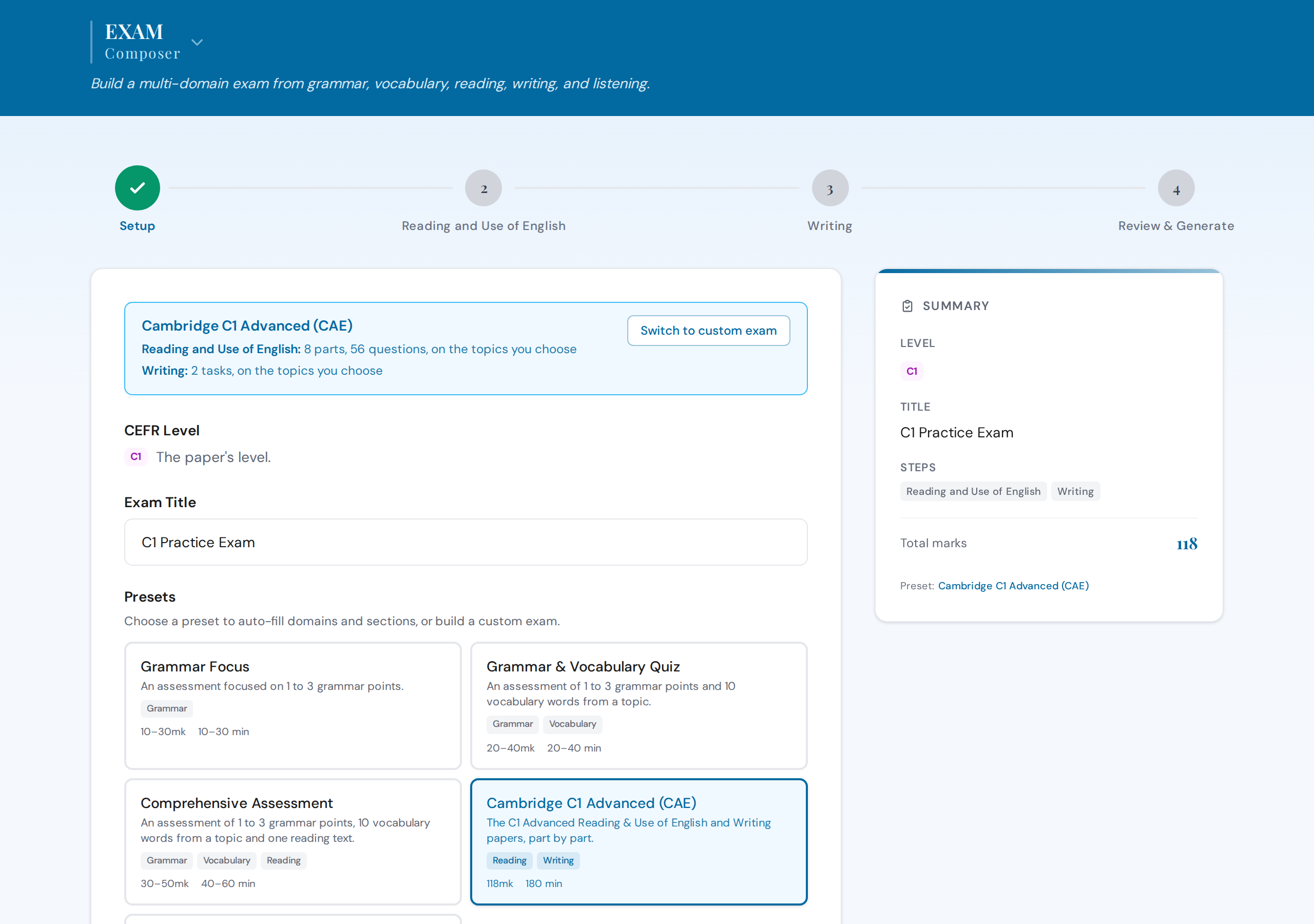
Six exercise types build this paper, and they exist only in the Exam Composer: multiple-choice cloze, open cloze, word formation and key word transformation for Parts 1 to 4, cross-text multiple matching for Part 6, and gapped text for Part 7, which removes whole paragraphs at C1. Cross-text multiple matching is a C1-only type.
Once you pick the preset, the composer locks to the paper and gives you one card per part. Most cards ask for a topic only. Reading topics and the Writing Part 1 topic are required. If you leave a Part 2 option blank, it takes one of the paper's suggested topics, and an exam-only part with no topic is generated for you. Part 4 takes no topic at all. You also set the exam title, and the class and teacher name that print on the answer sheet. Each paper's time and the official Cambridge instructions are set by the paper.
There is no grammar point to choose. The structures tested come from the level, as in the real paper. The candidate's copy carries each writing task alone, with no planning checklist and no useful language box. The answer key gives a model answer and the four criteria for every task printed, each Part 2 option included, with a note to mark only the option the candidate attempted.
The Cambridge C1 Advanced preset is usually ready in under 6 minutes and costs 3 credits. The preview lets you change font and size, and the PDF and editable DOCX both follow your choices. An exam has one look, modelled on the official papers, so there is no colour option.
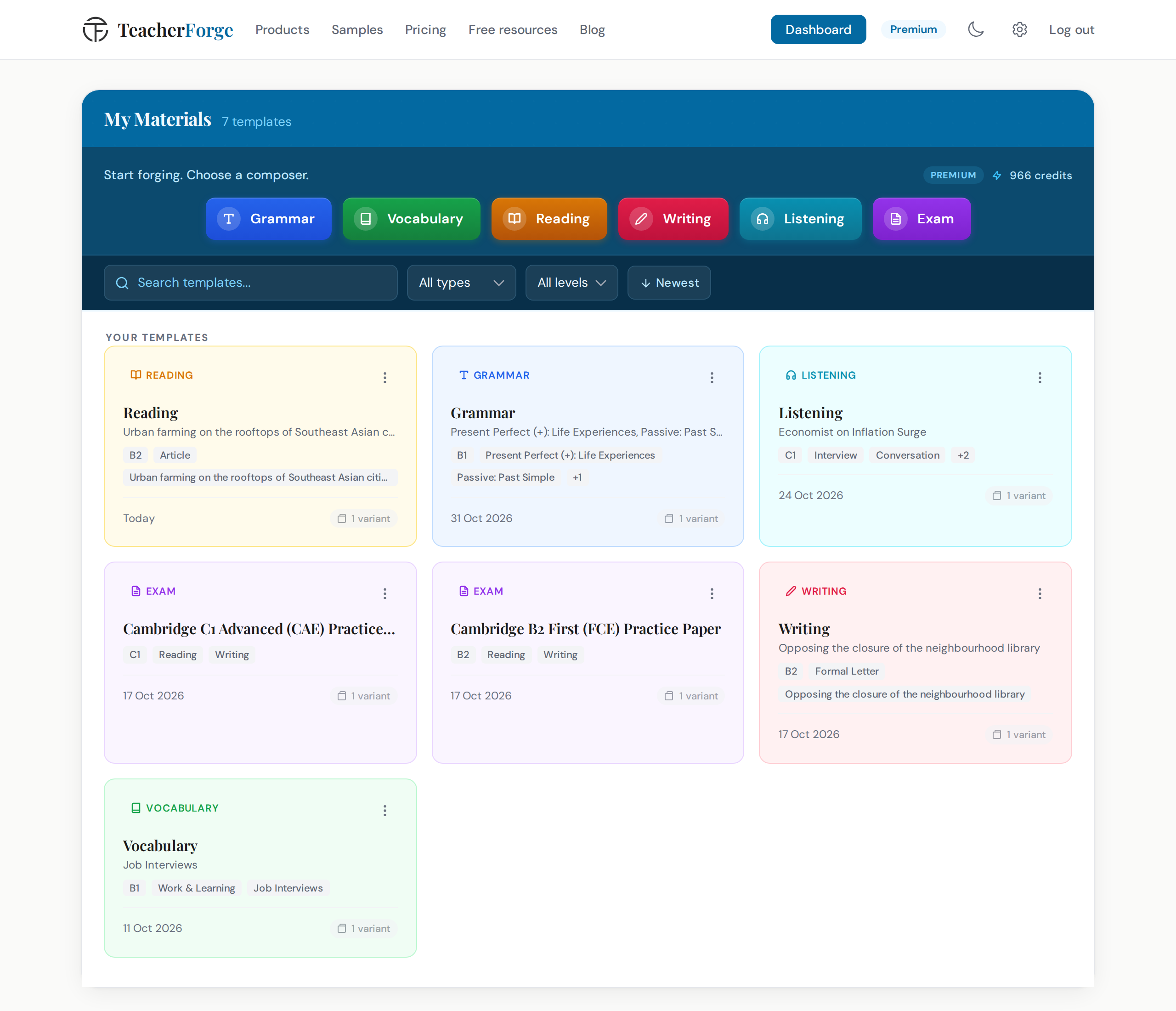
Every generation becomes a template on your dashboard automatically. When you want a second mock for the same class, choose Regenerate in the template card's menu. The composer reopens with the same configuration, and you can change topics before generating a fresh paper.
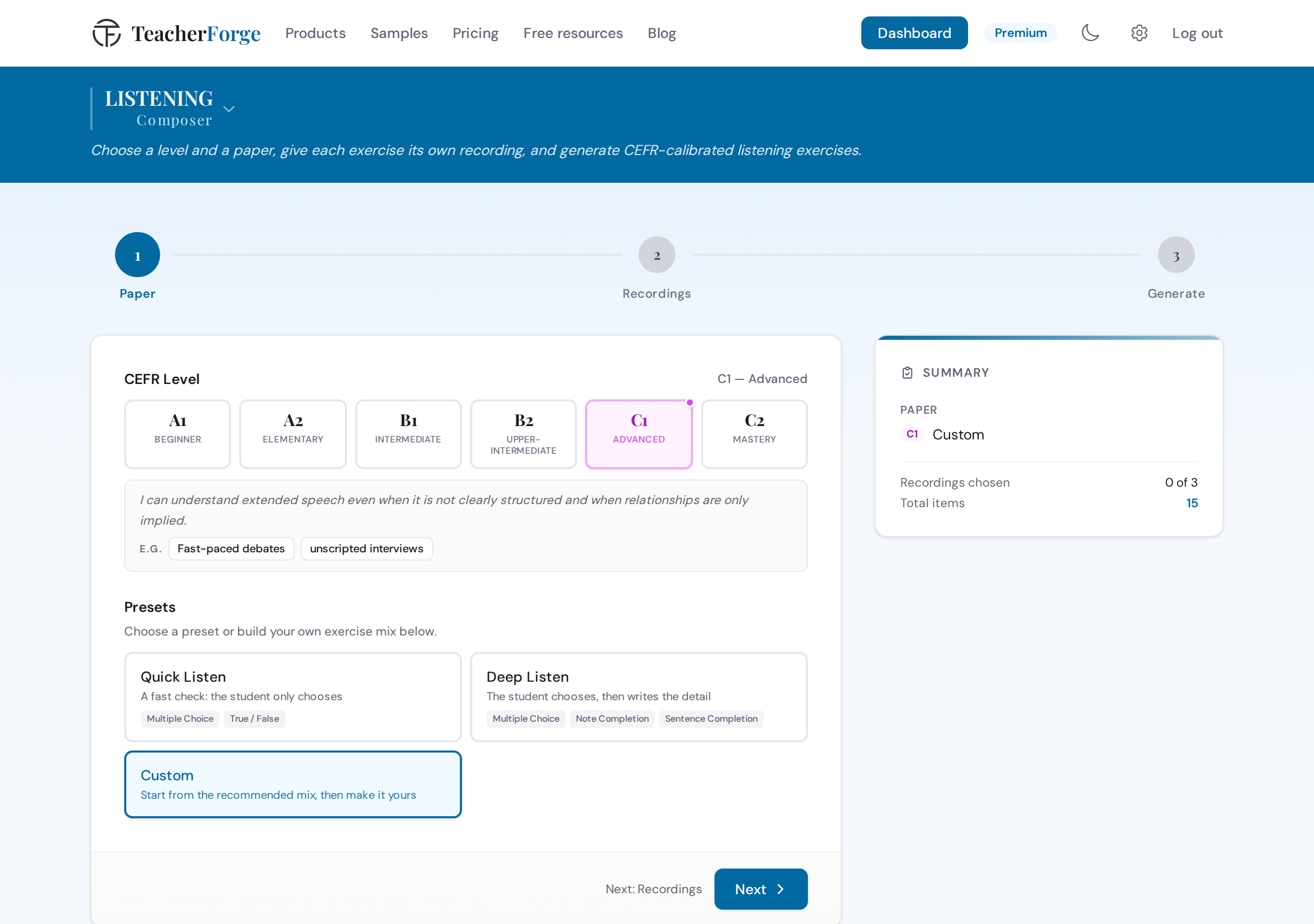
Listening and Speaking sit outside the preset. For listening practice, build a C1 worksheet in the Listening Composer under Custom, with a Multiple Choice exercise and a Sentence Completion exercise, each on its own recording from the library. At C1, Multiple Choice has four options, a to d. Speaking runs live, so plan it as a paired session in class.
If you need something the preset does not allow, such as a different mix of texts or a task with a checklist, the "Switch to custom exam" button keeps the paper's parts as a starting point with every control unlocked. A custom exam holds one text, one task and up to three exam-only sections, so the composer will ask you to remove the paper's other texts, tasks and exam-only sections. For more on mixing skills in one paper, see our guide to building a multi-skill English exam from scratch.
Explore the Exam Composer
You can read more about how the Cambridge presets and the custom exam builder work on the Exam Composer page. If you are also preparing FCE candidates, our FCE practice exam guide covers the B2 version of the same workflow.